
Marketing
Ecommerce SEO: Benefits, Agency Support, Audit, Strategy, Technical, On-Page and Off-Page SEO, Platforms and Measurement
On this page
- What is ecommerce SEO?
- What does an ecommerce SEO agency do?
- What does an ecommerce SEO audit check?
- What does an ecommerce SEO strategy include?
- What does technical SEO for ecommerce cover?
- What does on-page SEO for ecommerce cover?
- What does off-page SEO for ecommerce involve?
- Which ecommerce platform is best for SEO?
- How do you measure ecommerce SEO performance?
- How does ecommerce SEO diagnose and improve ecommerce growth?
Ecommerce search engine optimisation (SEO) earns organic visits for category and product pages at no cost per click. An ecommerce SEO agency diagnoses underperforming pages and prioritises their fixes. An audit ranks crawling, indexing, content and link issues by commercial impact.
A strategy orders keyword, site structure and AI search work by revenue. Technical and on-page fixes depend on each platform's controls, while off-page SEO earns links. Google Search Console and Google Analytics 4 (GA4) measure visibility and organic revenue.
What is ecommerce SEO?
Ecommerce SEO is the practice of making an online store's category pages, product pages, and supporting content easy for Google to crawl, understand, and rank, so shoppers find its products in unpaid search results. Ecommerce SEO is the organic search channel within ecommerce marketing. That channel feeds Traffic, the first section of the Ecommerce Engine.
That commercial role separates ecommerce SEO from content-site SEO in four ways. A store's catalogue can hold hundreds or thousands of product pages. Prices and stock levels change with each sale, promotion and delivery. Product searches carry buying intent, so their rankings link directly to revenue. Filters and size or colour options multiply the URLs Google must crawl.
Why is SEO important for ecommerce?
SEO matters for ecommerce because unpaid search results send shoppers to category and product pages at no cost per click, reducing a store's dependence on paid advertising for every visit. Paid campaigns stop sending Traffic when their budget runs out, while organic rankings keep earning visits between and after campaigns. Google Ads spend doesn't lift a store's organic rankings, so visibility must be earned through the quality of the store's pages.
Organic visibility for an online store extends beyond standard results into Google Images, Google Lens and the Shopping tab. Across those surfaces, an optimised category page keeps earning clicks while it ranks.
What does an ecommerce SEO agency do?
An ecommerce SEO agency diagnoses why an online store's category and product pages underperform in Search, then plans, prioritises, and reports the technical, on-page, content, and link work designed to grow organic Traffic and revenue. An ecommerce SEO agency sets each task based on the store's own search data. That work starts with a review of the store's content and site structure. It then extends to technical advice on hosting, redirects, error pages and JavaScript rendering. Content development, keyword research and optimisation for AI-powered Search complete the core scope. Together, these tasks form the e-commerce SEO services an agency delivers.
Agency pricing for those services scales with catalogue size, page templates and content volume. Within that price, the agency specifies each change, and the store's developers build it. The store owner still approves every change because they remain accountable for what happens on the site. The same working arrangement applies when a store hires an independent ecommerce SEO consultant instead of an agency.
When does an ecommerce business need an ecommerce SEO agency?
An ecommerce business needs an ecommerce SEO agency when organic revenue stalls or falls without a clear cause, when the catalogue outgrows the in-house team's SEO capacity, or before a redesign, replatform or new store launch.
A redesign or launch is the best time to bring in an agency, because the URL and template decisions made at that stage shape rankings for years. Smaller stores with a limited product range can often handle the SEO basics themselves.
A catalogue one marketer can optimise can therefore stay in-house. Larger catalogues, by contrast, need an agency under three conditions:
- Stalled or falling revenue: an agency traces causes to pages, queries or technical changes.
- Catalogue growth: new categories and products add pages faster than one marketer can optimise.
- Redesign, replatform or launch: an agency protects existing rankings while URLs and templates change.
What does an ecommerce SEO audit check?
An ecommerce SEO audit checks whether Google can crawl and index a store's revenue-earning pages, whether those pages match what shoppers search for, and which technical, content or link issues hold back their organic visibility, then ranks each fix by commercial impact. Google Search Console shows indexed pages and the searches they appear for. A crawl of the site shows the URLs, links and errors Google encounters. Google Analytics 4 (GA4) then shows organic revenue by landing page. The audit groups that evidence by page type: category, product and guide.
For example, a category page with 8,000 monthly impressions but 40 clicks comes first. Its proven demand outranks a filter page with no impressions. Each ranked fix should carry a realistic estimate of improvement and work. An ecommerce SEO checklist then rechecks those fixes after each template or URL change.
What does an ecommerce SEO strategy include?
An ecommerce SEO strategy includes keyword research mapped to search intent, a site structure that links categories to products, and a plan for AI-powered Search, ordered by the revenue each affected page can earn. The strategy sets the order and timing of the fixes the audit finds. Ecommerce SEO tips and best practices, such as unique product titles, follow that order.
How do ecommerce SEO keywords match search intent?
Ecommerce SEO keywords match search intent by type: broad product terms such as "running shoes" belong to category pages, terms naming a brand, model, or size belong to product pages, and questions such as "how to choose running shoes" belong to buying guides.
| Intent | Example keyword | Page type | Why it fits |
|---|---|---|---|
| Browsing a range | running shoes | Category page | Compares options across a range |
| Buying a specific item | [brand] [model] running shoes size 6 | Product page | Has already chosen the exact item |
| Researching before buying | How to choose running shoes | Buying guide | Needs advice before choosing |
That mapping assigns each page one primary keyword, so no two pages compete. Site owners should choose that keyword by considering the words users might search. Search Console queries show which of those words already drive impressions for the store. A keyword research tool then adds volume data for words still without impressions.
How should an ecommerce site be structured for SEO?
An ecommerce site should use a shallow hierarchy: menus link to categories, categories link to subcategories, and subcategories link to every product page through standard HTML links. Google reads an ecommerce site's structure from the links between its pages. Those links, not URL paths, show Google each page's relative importance. Linking best-selling products from the homepage therefore signals to Google that those products matter most.
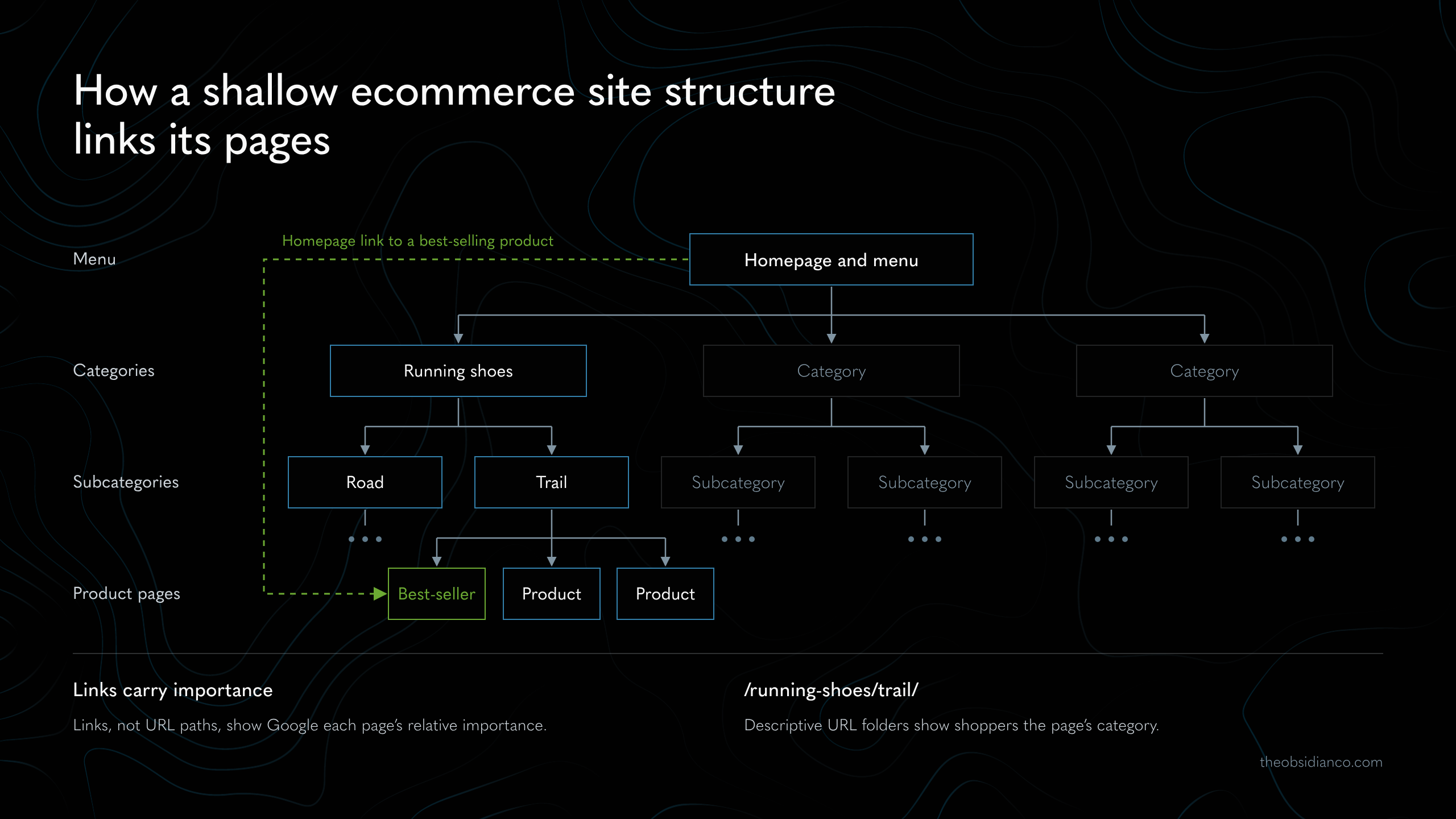
URL paths instead inform shoppers, because Google often displays a page's URL folders as a breadcrumb trail above its search result. Descriptive folders such as /running-shoes/trail/show shoppers the page's category before they click.
How does ecommerce SEO apply to AI search?
Ecommerce SEO applies to AI search in the same way, because Google sets no additional requirements for AI Overviews or AI Mode beyond having an indexed page eligible to appear in Search with a snippet. Pages need AI-specific optimisation to appear in AI Overviews or AI Mode. Advice sold as answer engine optimisation (AEO) should therefore match Google's guidance on AI features (Google Search Central, Do you need an SEO?, 2026). The same rule covers generative engine optimisation (GEO) services sold to stores. Crawlable product text, internal links and accurate product data therefore serve AI and standard results. Google confirms that Search Console counts AI feature clicks as part of overall search traffic.
What is the #1 thing holding back your ecommerce revenue?
Get an instant PDF audit powered by The Ecommerce Engine™ methodology, refined through five years of research and development.
What does technical SEO for ecommerce cover?
Technical SEO for ecommerce covers crawling and indexing the catalogue, controlling filter and variant URLs, product structured data, and page speed, so Google can reach, understand, and present every page that sells. One template fault repeats across every page built from that template. A single product-page error can therefore affect thousands of URLs at once.
Crawling and indexing decide whether those pages can appear in results at all. Search Console's Page indexing report shows which URLs Google has indexed. The same report explains why Google excluded each remaining URL. An XML sitemap lists the category and product URLs the store wants Google to crawl.
How do faceted navigation and product variants affect ecommerce SEO?
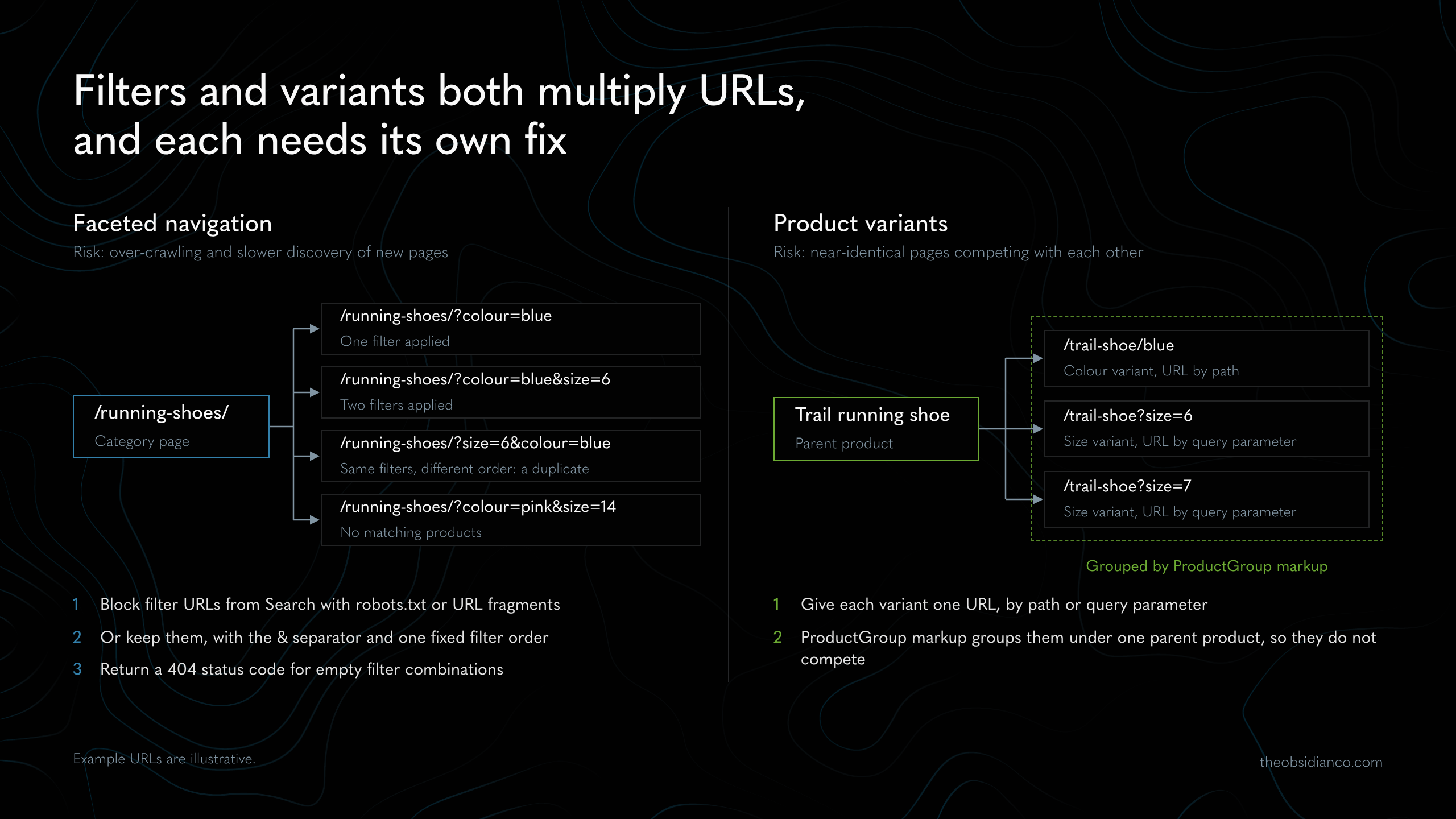
Faceted navigation and product variants affect ecommerce SEO by multiplying URLs, because every filter combination and every size or colour option can create an address that Google must crawl before it can judge its value.
| Factor | Faceted navigation URLs | Product variant URLs |
|---|---|---|
| Source | Size, colour, price and brand filters | Size and colour options |
| Main risk | Over-crawling and slower discovery | Near-identical pages competing |
| Google's guidance | Block or standardise filter URLs | One URL per variant, grouped by ProductGroup markup |
Filter URLs cause over-crawling and slow the discovery of new pages. Stores can block filter pages from Search via robots.txt or URL fragments. Keep filter pages for Search with the & separator and a fixed filter order. Empty filter combinations should return a 404 status code. Product variants, by contrast, can each take their own URL through a path or query parameter, with ProductGroup markup grouping them under one parent product so they don't compete with each other.
What does product structured data do for ecommerce SEO?
Product structured data gives Google a page's product name, price, availability, and reviews in a machine-readable format, making the page eligible for product rich results and merchant listings in Google Search. Valid markup makes a page eligible for these results, but Google still decides whether to show them. Merchant listings also need an Offer that includes a price above zero and a currency.
| Factor | Product structured data | Google Merchant Centre feed |
|---|---|---|
| Data location | Product page code | Feed sent to Google |
| Powers | Rich results and merchant listings | Shopping tab listings |
| Requirement | Correct markup on each product page | An approved Merchant Centre account |
How fast should an ecommerce site load for SEO?
An ecommerce page should show its main content within 2.5 seconds, respond to taps and clicks within 200 milliseconds and keep its layout shift below 0.1, the good Core Web Vitals thresholds Google sets. Core Web Vitals are three metrics that measure how quickly a page loads its main content, how fast it responds to shoppers and how stable its layout stays.
| Metric | What it measures | Good threshold |
|---|---|---|
| Largest Contentful Paint (LCP) | Main content loading time | Within 2.5 seconds |
| Interaction to Next Paint (INP) | Response delay after a tap or click | Less than 200 milliseconds |
| Cumulative Layout Shift (CLS) | Unexpected layout movement | Less than 0.1 |
Good scores align with what Google's core ranking systems reward. Large product images delay LCP when they load at full size. Third-party apps add scripts that slow response times and increase INP. Pop-ups that push content down raise CLS on mobile screens.
What does on-page SEO for ecommerce cover?
On-page SEO for ecommerce covers title tags, headings, copy, images, and internal links on category and product pages, plus buying guides that answer the questions those pages leave open. Google prioritises helpful, reliable, people-first content over ranking-driven content. Page copy should answer shopper questions first, then include the page's primary keyword. Buying guides and blog posts answer questions shoppers ask before choosing a product. Internal links in those guides then pass shoppers to the matching category pages.
How do you optimise ecommerce product pages for SEO?
Optimise an ecommerce product page for SEO by giving it a unique title and description based on the product's specifications, descriptive image alt text, accurate price and stock information, and genuine customer reviews. According to Google Search Central, share your product data with Google (Google, 2025); product data covers attributes such as title, description, colour, price and availability. Each of those attributes maps to one element on the product page:
- Title and heading: names the brand, product and key attribute shoppers search for.
- Original description: replaces copied manufacturer text that already appears on other retailers' pages.
- Image alt text: describes each photo so Google understands what the image shows.
- Price and availability: match the structured data and Merchant Centre feed exactly.
- Customer reviews: add product details and shopper wording the store's own copy lacks.
How do you optimise ecommerce category pages for SEO?
Optimise an ecommerce category page for SEO by targeting the broad product term shoppers search for, adding a short introduction that helps them choose within the range, linking to every subcategory and product, and giving each paginated page its own URL.
Category pages carry broad terms that name an entire product range. For example, a running shoe category targets "running shoes" rather than one model. The introduction sits with the product grid and helps shoppers compare options.
What does off-page SEO for ecommerce involve?
Off-page SEO for ecommerce involves earning links and mentions from relevant outside sites, such as press coverage, supplier and manufacturer pages, and independent product reviews, which point shoppers and Google towards the store. Each relevant link sends referral visitors and signals the store's credibility to Google.
According to Google Search Central, Google's spam policies for web search (Google, 2026) count buying or selling links for ranking purposes as link spam. When Google detects link spam, it can lower the store's rankings or remove its pages from search results altogether, cutting off the organic Traffic those pages earn. The policy also covers trading goods, including gifted products, for a linked review. The same page accepts paid links with rel="sponsored" or rel="nofollow". Gifted-product reviews therefore need one of those attributes on each link.
Which ecommerce platform is best for SEO?
No single ecommerce platform is best for SEO; the best choice lets a store edit titles, headings, and URLs, set canonical tags and redirects, output product structured data, control filter URLs, and serve fast, crawlable HTML. Established ecommerce platforms already handle sound URL design as standard. Shopify, Adobe Commerce (formerly Magento), WooCommerce and BigCommerce all fit that description. Their SEO controls vary by theme, apps, extensions, and configuration. Five capabilities therefore decide how far each platform supports SEO:
- Editable titles, headings and URLs: let each page target its own primary keyword.
- Canonical tags and redirects: consolidate duplicates and protect rankings when URLs change.
- Product structured data output: makes product pages eligible for rich results and listings.
- Filter URL control: stops faceted navigation from multiplying crawlable catalogue URLs.
- Fast, crawlable HTML: lets Google read product content and meet Core Web Vitals.
How does a platform migration affect ecommerce SEO?
A platform migration affects ecommerce SEO through URL changes, because every category and product URL that moves needs a permanent redirect to its closest new equivalent to preserve rankings and earned links. Start every migration with a map that pairs each old URL with its new one. Move the platform first, then redesign the layout so that you can trace any ranking change to one cause. During that move, 301 and other permanent redirects pass on PageRank, Google's link-based importance signal, in full. Keep those redirects in place for at least 1 year.
Mass redirects to the home page, by contrast, can count as soft 404 errors. A soft 404 marks a page that loads but offers no relevant content.
How do you measure ecommerce SEO performance?
Measure ecommerce SEO performance by tracking clicks, impressions, click-through rate (CTR) and average position in Google Search Console, then tracking organic revenue and purchases by landing page in Google Analytics 4 (GA4). Search Console measures visibility before the click, while GA4 measures what follows it.
| Factor | Google Search Console | GA4 |
|---|---|---|
| Measures | Visibility before the click | Behaviour and revenue after the click |
| Key metrics | Clicks, impressions, CTR, position | Sessions, purchases, revenue |
| Ecommerce use | Queries and pages earning visibility | Landing pages earning revenue |
CTR equals clicks divided by impressions for a page or query. For example, 40 clicks from 2,000 impressions gives a CTR of 2%.
GA4 sorts those visits into two separate channels, Organic Search and Organic Shopping. Ecommerce SEO reporting therefore combines both organic channels. Page-type reporting (category, product, guide) shows which pages limit organic revenue.
How does ecommerce SEO diagnose and improve ecommerce growth?
Ecommerce SEO diagnoses what limits ecommerce growth by showing which category and product pages fail to earn organic visibility. It improves growth by fixing those pages in the order of the revenue they can carry. Growth therefore comes from a repeatable cycle of audit, strategy and measurement rather than one-off changes.
Audit evidence identifies the pages and issues that limit organic visibility. The strategy then ranks those fixes by the organic revenue each page can earn. Measurement closes the loop by tracking whether organic visibility turns into organic revenue.
Each completed cycle strengthens the Traffic section of the Ecommerce Engine. An ecommerce SEO agency runs that cycle when in-house SEO capacity runs short.
Try Us Free for 4 Weeks. Up to $5,000 in Agency Fees, On Us.
Four weeks of agency work on us, with no commitment and no obligation to carry on. For ecommerce brands at $50K+ a month and $10K+ in ad spend.
Next month’s intake closes in00days00hours00minutes00seconds

Works on the content half of search: keyword research, page copy, blog articles and the words that turn a store’s visitors into buyers.
Writes about Technical SEO, Structured data, Site architecture
More articles
 MarketingGoogle Ads for Ecommerce: Agency Support, Shopping Ads, Performance Max and Growth StrategyAlexander W. · 23 November 2026
 MarketingEcommerce Meta Ads: Agency, Facebook, Instagram and Ad CreativeAlexander W. · 23 November 2026
 MarketingEcommerce CRO: Conversion Metrics, Audits, Agency Support, UX, Landing Pages, Product Pages, Checkout, Site Search and MerchandisingAlexander W. · 23 November 2026