
Marketing
Ecommerce Meta Ads: Agency, Facebook, Instagram and Ad Creative
On this page
- What Are Ecommerce Meta Ads?
- What Does a Meta Ads Agency for Ecommerce Do?
- How Do Facebook Ads for Ecommerce Support Sales?
- How Do Instagram Ads for Ecommerce Support Sales?
- What Is Ecommerce Ad Creative in Meta Advertising?
- How Does an Ecommerce Meta Ads Strategy Connect Creative, Delivery and Measurement?
Ecommerce Meta Ads are paid campaigns that put online products in front of shoppers across Meta's apps and measure the purchases that follow. These ads create demand before shoppers search, which supports ecommerce growth. The Sales objective and Advantage+ sales campaigns direct delivery across 6 platforms.
The Meta Pixel and Conversions API then record each resulting purchase. Return on ad spend (ROAS) reads those purchases under standard or incremental attribution. Agency management, Facebook ads, Instagram ads, and ad creative decide overall performance.
What Are Ecommerce Meta Ads?
Ecommerce Meta Ads are paid campaigns that create product demand across Meta's apps through sales objectives, connected placements, purchase tracking and performance measurement. Meta advertising serves as the paid social channel of ecommerce marketing. An online retailer buys ad delivery through Meta Ads Manager, Meta's campaign tool. Meta's delivery system then decides which shoppers see each ad.
The retailer sets the offer, budget and creative, while Meta chooses each viewer. That division of control makes creative and measurement the retailer's main levers. Meta Ads sit in Traffic, the first section of The Ecommerce Engine. Traffic sends shoppers to the store, where Website & Branding Performance, the framework's second section, converts them.
How Do Ecommerce Meta Ads Create Demand for Online Stores?
Ecommerce Meta Ads create demand for online stores by showing products to shoppers before they search for them and directing interested shoppers to the store to buy. Discovery happens while shoppers browse Meta's apps, before they type any product query. Meta's retrieval stage narrows tens of millions of ads to a few thousand. That shortlist differs for each person, based on predicted relevance.
Meta's system therefore matches each product to a shopper, rather than a typed keyword. Meta ads for ecommerce stores suit new products shoppers haven't discovered yet. For example, a homeware store shows a new lamp to shoppers who follow interior content. Interested shoppers then tap through to the product page and buy.
Which Meta Ads Objectives Support Ecommerce Sales?
The Sales objective supports ecommerce sales by optimising delivery toward purchases, and Advantage+ Sales campaigns automate the audience, budget, and placement settings for that objective. Meta Ads Manager offers 6 campaign objectives, each tied to one outcome. The six are Awareness, Traffic, Engagement, Leads, App Promotion, and Sales. An online store needs completed purchases, so Sales matches its commercial goal.
Advantage+ sales campaigns replaced Advantage+ shopping campaigns under a 2025 rename. A sales campaign reaches its Advantage+ state when three settings work together. Those settings are Advantage+ audience, Advantage+ campaign budget and Advantage+ placements. Automation then shifts budget toward the audiences and placements producing purchases.
Where Can Ecommerce Meta Ads Appear?
Ecommerce Meta Ads can appear across 6 platforms: Facebook, Instagram, Messenger, WhatsApp, Threads and Meta Audience Network. One campaign in Meta Ads Manager reaches all 6 platforms. Advantage+ placements spread delivery across every eligible placement by default. Meta Audience Network extends that delivery to partner apps outside Meta's own platforms.
Threads opened ads to users in all markets from the week of 26 January 2026. WhatsApp Status ads followed globally in February 2026 through existing Ads Manager campaigns. Value rules let advertisers adjust bids for individual placements. Each rule can decrease bids by 90% or increase them by 1,000%. Retailers therefore steer spend between platforms inside a single campaign.
How Do the Meta Pixel and Conversions API Track Ecommerce Purchases?
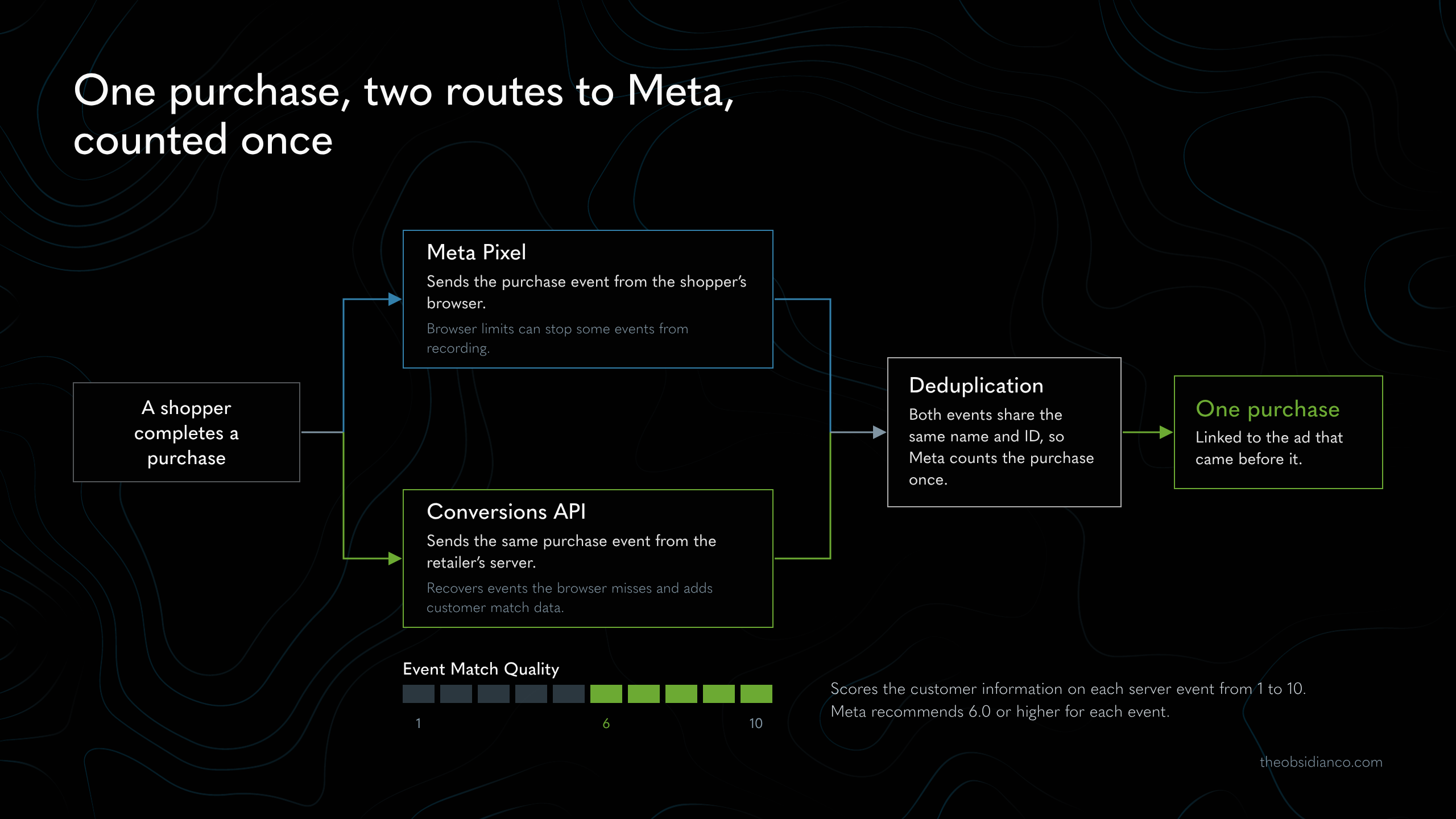
The Meta Pixel tracks ecommerce purchases from the shopper's browser, and the Conversions API sends the same purchase events from the retailer's server. API stands for application programming interface, a direct link from the retailer's server to Meta. Meta recommends sending the same events through that server link and the Pixel. The server copy recovers purchases that browser limits stop the Pixel from recording. Deduplication counts a purchase once when both events share the same name and ID.
Each server event also carries customer information, which Event Match Quality scores from 1 to 10. Meta recommends a score of 6.0 or higher for each event. Higher match quality links more purchases to the preceding ads.
How Do Ecommerce Brands Measure Meta Ads Performance?
Ecommerce brands measure Meta Ads performance through return on ad spend (ROAS), cost per purchase, cost per thousand impressions (CPM), and cost per click (CPC), using Meta's standard or incremental attribution model. Each metric compares ad spend or revenue with a different result:
- ROAS divides attributed purchase value by the ad spend that produced it.
- Cost per purchase divides ad spend by the number of attributed purchases.
- CPM shows the ad spend needed to deliver 1,000 ad impressions.
- CPC divides ad spend by the number of link clicks the ads earned.
For example, £1,000 of spend returning £4,000 in purchases gives a ROAS of 4. Meta offers 2 attribution models for crediting those purchases. Standard attribution credits purchases within set click, view and engagement windows. Incremental attribution uses machine learning to predict whether an ad caused each purchase.
Click-through attribution for website conversions now counts only link clicks. Shares, saves, and likes now fall under a separate engage-through attribution category. Meta names Conversion Lift experiments as its gold standard for incrementality
What Does a Meta Ads Agency for Ecommerce Do?
A Meta Ads agency for ecommerce plans, buys, briefs and measures Meta advertising for online retailers. Its value depends on when a retailer hires it and which capabilities it brings. A Meta Ads agency for ecommerce works inside the retailer's own ad account. Meta supplies the delivery technology, while the agency decides how to use it. The ads themselves carry the product message that the agency briefs and approves. Agency management therefore sits between Meta's technology and the shopper-facing ads. That position lets one agency connect budget, creative and measurement decisions.
When Should an Ecommerce Brand Hire a Meta Ads Agency?
An ecommerce brand should hire a Meta Ads agency when its team lacks the media-buying, creative strategy, or measurement capacity its Meta advertising requires. Each capability gap shows up as a specific commercial symptom:
- Media buying: budgets drift toward ad sets that spend without producing purchases.
- Creative strategy: cost per purchase rises while the same ads keep running.
- Measurement: the team cannot separate attributed purchases from incremental ones.
Each symptom raises acquisition cost, which shrinks the margin on every new customer. The hiring decision therefore depends on the team's capability and capacity. A brand with strong creative but weak buying needs media-buying support first. An agency brings all three capabilities when the team has none.
Which Capabilities Define an Ecommerce Meta Ads Agency?
Media planning, media buying, creative strategy and measurement are the 4 capabilities that define an ecommerce Meta Ads agency. Each capability owns one commercial decision in the retailer's Meta advertising:
- Media planning sets the objective, budget and audience strategy for each campaign.
- Media buying runs campaigns in Meta Ads Manager and moves spend toward purchases.
- Creative strategy briefs distinct ads that match products to different shopper needs.
- Measurement reads attributed and incremental results to decide where to allocate budget next.
Of those 4 capabilities, Meta offers credentials in media buying and creative strategy. Meta calls them the Meta Certified Media Buying Professional and the Meta Certified Creative Strategy Professional. Credential holders must recertify every year to keep the credential active. The credentials stay with individual holders, while the retailer owns the business portfolio and ad account.
What is the #1 thing holding back your ecommerce revenue?
Get an instant PDF audit powered by The Ecommerce Engine™ methodology, refined through five years of research and development.
How Do Facebook Ads for Ecommerce Support Sales?
Facebook Ads for ecommerce support sales by reaching shoppers in Facebook's Feed, Marketplace, Reels, and Stories; finding new and returning customers; and presenting catalogue products for browsing. Facebook is therefore one platform inside Meta's shared advertising system. One campaign shares budget, audiences and purchase data across Facebook and Instagram. Facebook's distinct role lies in the shopping contexts its surfaces create. Those contexts decide which product message each Facebook ad needs.
Where Do Facebook Ads Reach Ecommerce Shoppers?
Facebook Ads reach ecommerce shoppers in 4 main surfaces: Feed, Marketplace, Reels and Stories. Each surface creates a different shopping context for the product ad:
- Feed places ads between friends' posts, so a product needs instant recognition.
- Marketplace reaches shoppers already comparing items, so price and product detail matter.
- Reels shows short vertical video, so the product needs movement and sound.
- Stories fills the full screen briefly, so the ad carries one clear offer.
Advantage+ placements spread one ad across all 4 surfaces by default. One ad therefore needs versions that suit both Feed and vertical formats. A static image suits Feed, while vertical video suits Reels and Stories.
How Do Facebook Ads Reach New and Returning Ecommerce Customers?
Facebook Ads reach new ecommerce customers through broad automated audiences and returning customers through audiences built from past store visits and purchases. Advantage+ audience is Meta's automated audience setting, which finds likely buyers on its own. The retailer can add audience suggestions, which Meta treats as starting signals. Returning customers come from custom audiences built on Pixel and Conversions API events. Those events identify past visitors, cart abandoners and previous buyers.
A new customer needs the product introduced, priced and justified from scratch. A returning shopper already knows the product, so one reminder can close the sale. Returning shoppers, however, include buyers who would purchase without any ad. Their reported returns therefore overstate what the ads actually caused. New customers, by contrast, add revenue the store would otherwise lose.
How Do Facebook Catalogue Ads Support Ecommerce Product Browsing?
Facebook catalogue ads support ecommerce product browsing by pulling products from the retailer's catalogue and showing each shopper the items most relevant to their interests and actions. Meta now calls the format Advantage+ catalogue ads, previously dynamic product ads. A catalogue in Meta Commerce Manager holds each product's image, title, price and link. The format personalises which products each person sees.
For example, a shopper who viewed trainers sees those trainers and similar pairs. The shopper then swipes through a carousel or collection ad of matched products. Each tap opens the product page, where they decide to purchase. One catalogue therefore advertises the whole range without a separate ad for each product.
How Do Instagram Ads for Ecommerce Support Sales?
Instagram Ads for ecommerce support sales by reaching shoppers in Instagram's Feed, Stories, and Reels; presenting products through vertical Reels video; and running creator content as partnership ads. Instagram Ads for ecommerce run inside the same Meta Ads Manager campaigns. Instagram is an image-led and video-led platform within Meta's shared advertising system. Products therefore compete with photos and videos from accounts that shoppers chose to follow. Visual quality and product clarity decide whether a shopper stops scrolling.
Where Do Instagram Ads Reach Ecommerce Shoppers?
Instagram Ads reach ecommerce shoppers in Feed, Stories and Reels, the 3 main surfaces of Instagram's ad inventory. Each surface changes what a shopper notices first about the product:
- Feed shows image-led posts, so the product's appearance carries the first impression.
- Stories appear full screen between friends' updates, so one message fits each frame.
- Reels play short vertical videos, so product use and movement lead the ad.
Feed suits products that sell on appearance, such as clothing or homeware. Stories and Reels suit products that need a demonstration to explain their value. One product can therefore need different creative for each Instagram surface.
How Do Instagram Reels Ads Present Ecommerce Products?
Instagram Reels ads present ecommerce products through full-screen 9:16 vertical video with sound, so the product and its use need to appear in the opening seconds. 46% of Reels online purchase conversions happen within 2 seconds of attention. The first frame therefore decides whether a Reels ad can sell.
Reels creative should use sound and keep key information inside safe zones. Safe zones are areas of the frame that Instagram's buttons and captions leave uncovered. Feed ads, by contrast, show captions below the media within a scrolling mix of posts.
| Dimension | Reels ads | Feed ads |
|---|---|---|
| Screen format | Full-screen vertical video | Image or video inside the feed |
| Sound | Sound forms part of the message | The message works without sound |
| Viewing context | One video at a time, full attention | A scrolling mix of posts |
| What the product needs to show | The product in use within seconds | Clear appearance and offer at a glance |
When Do Instagram Partnership Ads Support Ecommerce?
Instagram partnership ads support ecommerce when a creator gives a brand permission to run paid ads from the creator's handle, putting the product in front of that creator's audience. Each partnership ad, formerly a branded content ad, links the advertiser, creator, and approved content. Meta launched Creator Marketing Hub in September 2026 by merging Creator Marketplace and Partnership Ads Hub so that advertisers can find and approve creators in one workspace. Brands request and manage creator approval through permissions inside that workspace. Approved content then runs as paid media, which separates it from organic creator mentions. The brand therefore sets the budget, audience, and duration, while the creator's followers provide credibility. Meta's own data shows partnership ads averaging 19% lower cost per acquisition and 13% higher click-through rates than standard ads.
What Is Ecommerce Ad Creative in Meta Advertising?
Ecommerce ad creative is the image, video or catalogue content a shopper sees in a Meta ad, and its performance depends on persuasive attributes, product-fitting formats and creative diversification. Ecommerce ad creative carries the product message to whichever shopper Meta's system selects. Campaign settings and placements decide where an ad appears and who sees it. Creative then decides whether that shopper understands the product and acts. Automated delivery leaves creative as the input retailers shape most directly. Weak creative therefore raises cost per purchase even when targeting and budget hold steady.
Which Attributes Make Ecommerce Ad Creative Convert?
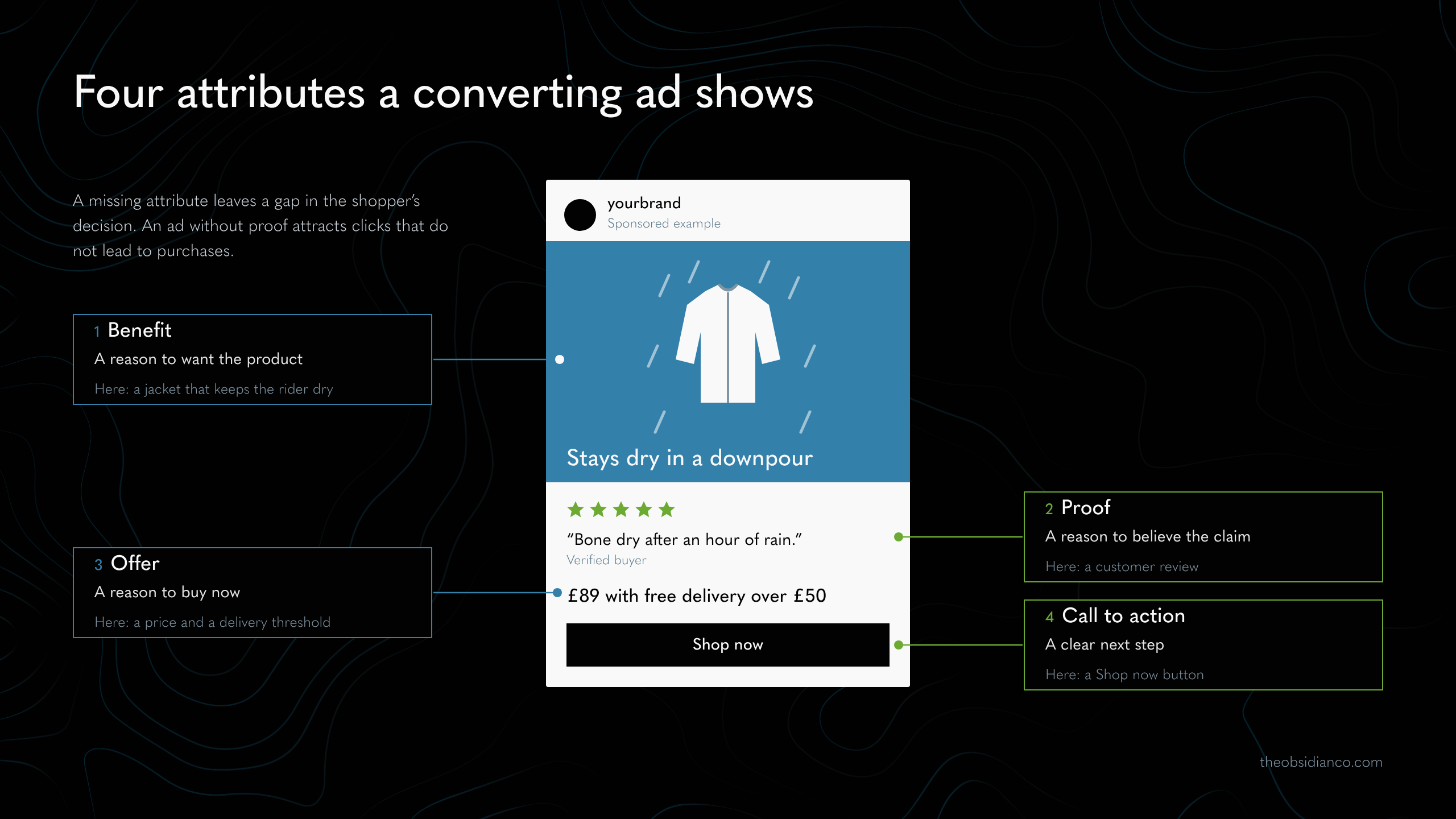
Ecommerce ad creative converts when it shows a clear product benefit, credible proof, a specific offer and a direct call to action. The four attributes work as a diagnostic checklist for any ecommerce ad.
| Attribute | What it gives the shopper | Example element |
|---|---|---|
| Benefit | A reason to want the product | A jacket shown keeping a cyclist dry in rain |
| Proof | A reason to believe the claim | A customer review or a live demonstration |
| Offer | A reason to buy now | A price, delivery threshold or bundle |
| Call to action | A clear next step | A "Shop now" button |
A missing attribute creates a clear gap in the shopper's decision. For example, an ad without proof attracts clicks that don't lead to purchases. A polished image still fails when shoppers can't see the benefit. Each attribute therefore earns its place by moving the shopper toward purchase.
Which Ecommerce Ad Creative Formats Present Products on Meta?
Ecommerce ad creative presents products on Meta through 5 formats: single image, video, carousel, collection and catalogue product video. Each format suits a different job in presenting the product:
| Format | What it shows best |
|---|---|
| Single image | Product appearance at a glance |
| Video | Product use, movement and results |
| Carousel | Several products or angles in one ad |
| Collection | A hero visual that opens into product browsing |
| Catalogue product video | Product-level video inside Advantage+ catalogue ads |
Format choice therefore follows what shoppers need to see. A sofa sells on appearance, while a blender sells on demonstration. Catalogue product video carries that demonstration into catalogue ads through motion creative added in Commerce Manager. Meta then pairs each personalised product with its own personalised video. Mixing catalogue product video with other formats widens Meta's creative options for each shopper.
How Does Creative Diversification Differ From Duplication in Ecommerce Ads?
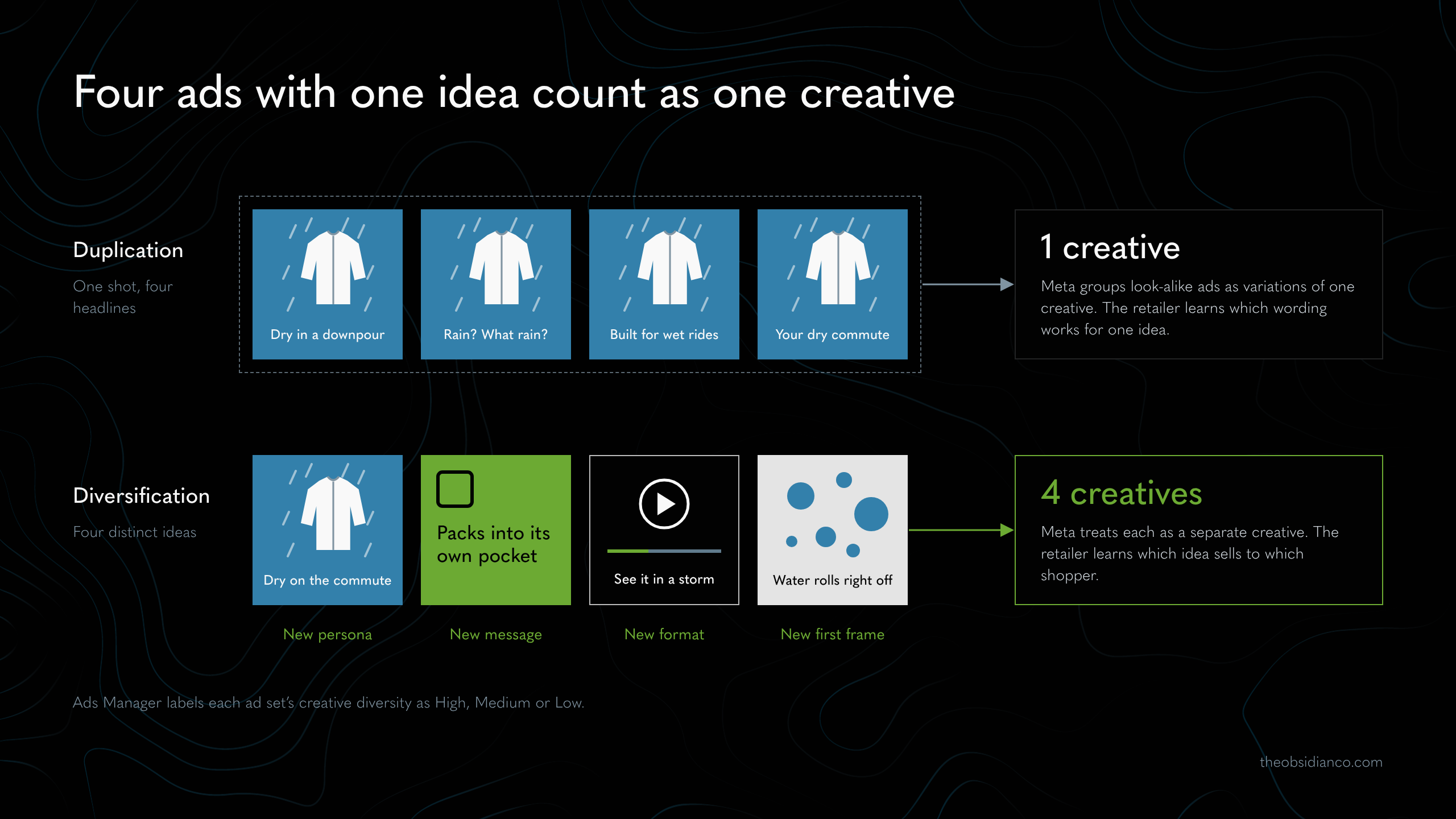
Creative diversification gives Meta's ads system distinct images, messages, and formats for different shoppers, while duplication repeats one idea with small edits the system treats as the same creative. Meta groups ads that share the same imagery, setting and message. Look-alike ads then count as variations of one creative. Twenty new hooks over the same shot therefore test only one idea.
| Dimension | Diversification | Duplication |
|---|---|---|
| What changes | Persona, message, format or first frame | Headline, hook or call to action only |
| How Meta groups the ads | As separate creatives | As variations of one creative |
| What the retailer learns | Which idea sells to which shopper | Which wording works for one idea |
Ads Manager labels each ad set's creative similarity. The Creative diversity label reads High, Medium or Low for each ad set.
How Does an Ecommerce Meta Ads Strategy Connect Creative, Delivery and Measurement?
An ecommerce Meta Ads strategy connects distinct creative, automated delivery across Meta's platforms and incremental measurement, so each budget decision rests on the sales the ads caused. Ecommerce Meta Ads reach shoppers before they search, so creative carries the first impression. Automated delivery then decides which shoppers across Meta's apps see each ad. Measurement then separates purchases the ads caused from purchases they merely followed.
Each element answers a different growth question for online products. Agency capability decides whether the team can run all three elements together. Facebook and Instagram surfaces decide where online products meet shoppers in Meta's apps. Ad creative decides whether those shoppers understand the product and complete purchases. A gap in any element raises acquisition cost across the Traffic section. Meta Ads therefore grow sales profitably when all three elements work together.
Try Us Free for 4 Weeks. Up to $5,000 in Agency Fees, On Us.
Four weeks of agency work on us, with no commitment and no obligation to carry on. For ecommerce brands at $50K+ a month and $10K+ in ad spend.
Next month’s intake closes in00days00hours00minutes00seconds

Works on the content half of search: keyword research, page copy, blog articles and the words that turn a store’s visitors into buyers.
Writes about Technical SEO, Structured data, Site architecture
More articles
 MarketingEcommerce SEO: Benefits, Agency Support, Audit, Strategy, Technical, On-Page and Off-Page SEO, Platforms and MeasurementAlexander W. · 23 November 2026
 MarketingGoogle Ads for Ecommerce: Agency Support, Shopping Ads, Performance Max and Growth StrategyAlexander W. · 23 November 2026
 MarketingEcommerce CRO: Conversion Metrics, Audits, Agency Support, UX, Landing Pages, Product Pages, Checkout, Site Search and MerchandisingAlexander W. · 23 November 2026