
Ecommerce Marketing: Strategy, SEO, Google Ads, Meta Ads, CRO, Email, Retention, Content, Social Media, Branding and Agencies
On this page
- What is ecommerce marketing?
- What does an ecommerce marketing strategy include?
- How does ecommerce SEO grow organic sales?
- How do Google Ads drive ecommerce sales?
- How do Meta Ads drive ecommerce sales?
- How does ecommerce CRO turn more visitors into buyers?
- How does ecommerce email marketing drive repeat sales?
- How does ecommerce customer retention grow revenue?
- What does ecommerce content marketing do?
- How does social media marketing work for ecommerce?
- Why does branding matter in ecommerce marketing?
- What does an ecommerce marketing agency do?
- How do the parts of ecommerce marketing work together?
Ecommerce marketing is the set of channels that fill the three sections of the Ecommerce Growth Engine: Traffic, Website & Branding Performance, and Customer Retention. A strategy drives traffic through search engine optimisation (SEO), Google Ads, and Meta Ads.
Conversion rate optimisation (CRO) then turns that traffic into buyers. Email and retention programmes bring customers back for repeat orders. Content, social media and branding build demand and trust, and agencies run the mix.
What is ecommerce marketing?
Ecommerce marketing uses search, advertising, email, content, social media, and branding to attract shoppers to an online store, convert them into customers, and bring them back to buy again. Within ecommerce, marketing succeeds only when shoppers complete an order. The Ecommerce Growth Engine sorts these channels into three commercial jobs. Traffic brings qualified visitors to the store through search, ads and social media. Website & Branding Performance turns those visitors into buyers and earns their trust. Customer Retention earns repeat purchases from people who have already bought once.
The three jobs depend on each other because sales need all three to work. A store with strong Traffic still loses money when its checkout fails. The weakest link limits returns from every other channel. Clicks and followers count only when they lead to completed orders. Ecommerce marketing therefore runs as one system against one revenue target.
How does ecommerce marketing differ from general digital marketing?
Ecommerce marketing differs from general digital marketing because it judges every channel on product sales, order value, and repeat purchases, not on leads, visits, or awareness alone.
| Dimension | Ecommerce marketing | General digital marketing |
|---|---|---|
| Main goal | Completed orders and repeat purchases | Leads, sign-ups or awareness |
| Conversion point | Online checkout | Lead form, call or sign-up |
| Data used | Product catalogue, order and customer data | Contact and engagement data |
| Budget metric | Revenue and margin per channel | Cost per lead or reach |
Product feeds and checkout data link ecommerce digital marketing spend directly to revenue. A lead-based business, by contrast, waits for a sales team to close each deal.
Which channels does ecommerce digital marketing use?
Ecommerce digital marketing uses nine channels: SEO, Google Ads, Meta Ads, content marketing, social media, CRO, branding, email marketing and retention programmes. Those nine channels fall into three Ecommerce Growth Engine sections, each doing one commercial job:
- Traffic: SEO, Google Ads, Meta Ads, content marketing and social media bring qualified visitors. Search channels catch existing demand, while social channels create new demand.
- Website & Branding Performance: CRO and branding turn those visitors into buyers and build trust. A higher conversion rate raises the return on every paid visit.
- Customer Retention: Email marketing and retention programmes turn first orders into repeat revenue. Each repeat order arrives without paying to acquire the customer again.
What does an ecommerce marketing strategy include?
An ecommerce marketing strategy includes revenue and customer objectives, a full-funnel channel mix, a budget split, a written marketing plan, and the tools that run and measure it. A clear ecommerce marketing strategy gives every channel one commercial job and one target. Objectives decide whether each channel drives revenue, new customers, or repeat orders.
The channel mix covers every funnel stage, from first visit to repeat order. A budget split then shows how much each Engine section receives each month. The marketing plan turns the strategy into dated campaigns, owners and budgets. Marketing tools run and measure that plan across analytics, email, advertising and SEO.
The strategy funds the weakest Engine section first because it caps the rest. For example, doubling ad spend doubles costs, but a weak checkout keeps sales flat. In that case, budget moves to CRO before it moves to more Traffic.
How does an ecommerce marketing strategy cover the full funnel?
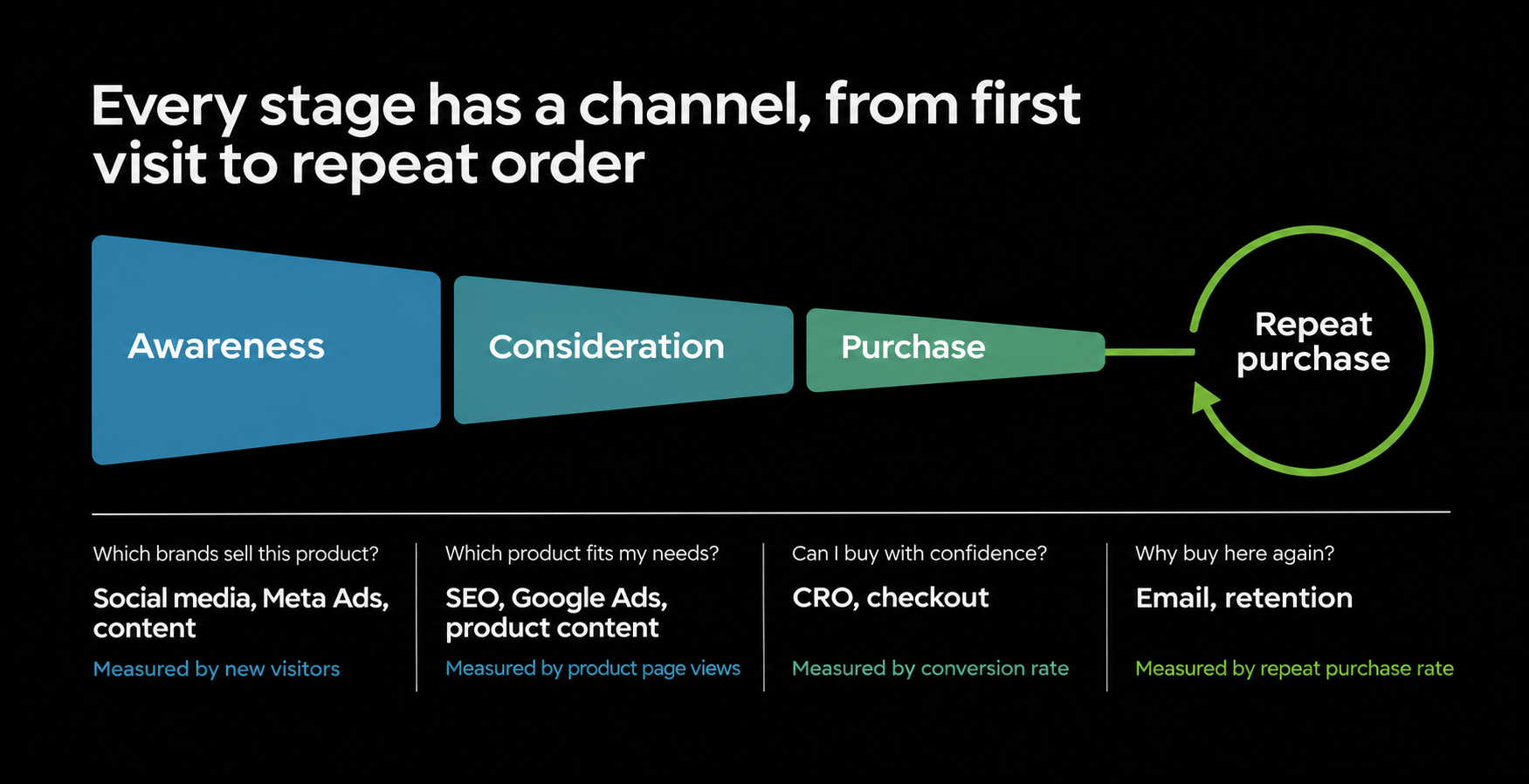
An ecommerce marketing strategy covers the full funnel by assigning channels to awareness, consideration, purchase and repeat purchase, so no stage is left without a channel.
| Funnel stage | Shopper's question | Main channels | Progress metric |
|---|---|---|---|
| Awareness | Which brands sell this product? | Social media, Meta Ads, content | New visitors |
| Consideration | Which product fits my needs? | SEO, Google Ads, product content | Product page views |
| Purchase | Can I buy with confidence? | CRO, checkout | Conversion rate |
| Repeat purchase | Why buy here again? | Email, retention | Repeat purchase rate |
A gap at any stage shows up as a fall in that stage's metric. The ecommerce marketing funnel therefore shows a store which stage to fix first.
How does ecommerce SEO grow organic sales?
Ecommerce SEO grows organic sales by ranking product, category and blog pages for the searches shoppers make before they buy, without paying for each click. Strong ecommerce SEO turns search demand into a steady, unpaid source of orders.
The work starts with an SEO strategy that maps searches to pages. On-page SEO then improves product, category and homepage titles, copy and links. An e-commerce blog captures the research searches that come before a purchase. SEO tools track rankings, while the store's platform shapes how well pages rank.
SEO feeds the Engine's Traffic section with qualified organic visitors. Rankings keep sending visits after the work is done, so returns compound over time. Each new ranking page therefore lowers the average cost of a visitor.
How do organic and paid search work together in ecommerce marketing?
Organic and paid search work together in ecommerce marketing by running from one shared keyword plan, in which Google Ads buys immediate visibility for priority products, and SEO builds lasting visibility at no cost per click.
| Dimension | SEO | Paid search (Google Ads) |
|---|---|---|
| Cost model | No cost per click | A cost for every click |
| Speed of results | Builds gradually as pages rank | Starts the day a campaign launches |
| Durability | Rankings keep sending visits | Visits stop when spend stops |
| Main use | Lasting visibility for core categories | Launches, offers and priority products |
Converting search terms in Google Ads show which pages SEO should target next. Ad spend then moves from terms where SEO pages rank to unranked terms.
How do Google Ads drive ecommerce sales?
Google Ads drive ecommerce sales by showing products and text ads to shoppers already searching, through Search, Shopping, and Performance Max campaigns. Search campaigns show text ads against the keywords shoppers type. Shopping campaigns, by contrast, show product images and prices drawn from a product feed.
A Google Ads strategy assigns budgets and priority products across these three campaign types. Google Ads for ecommerce spends those budgets one click at a time. Each click buys a visit from a shopper who already knows what they want. Ecommerce PPC (pay-per-click) marketing stops sending those shoppers when the budget runs out.
How do Meta Ads drive ecommerce sales?
Meta Ads drive ecommerce sales by placing product ads in front of shoppers on Facebook and Instagram before they search, then retargeting the products they viewed. Meta Ads reach shoppers through interests and behaviour rather than search terms.
That targeting runs across Facebook and Instagram from one Meta ad account and catalogue. The Meta pixel records each shopper’s actions on the online store, including product views, add-to-carts, and purchases. Those pixel signals let catalogue ads retarget each shopper with the exact products viewed.
How do Google Ads and Meta Ads divide ecommerce performance marketing?
Google Ads and Meta Ads divide ecommerce performance marketing by demand: Google Ads captures shoppers who already search for a product, while Meta Ads creates demand among shoppers who haven't searched yet.
| Dimension | Google Ads | Meta Ads |
|---|---|---|
| Shopper intent | Searching for a product now | Browsing before any search |
| Ad format | Text ads and product listings | Image, video and catalogue ads |
| Targeting signal | Search terms | Interests, behaviour and site activity |
| Funnel role | Consideration and purchase | Awareness and retargeting |
| Main cost | Each click | Every thousand impressions, for most objectives |
Meta Ads therefore create the searches that Google Ads later capture. That hand-off means ecommerce performance marketing measures both channels by revenue against combined spend.
What is the #1 thing holding back your ecommerce revenue?
Get an instant PDF audit powered by The Ecommerce Engine™ methodology, refined through five years of research and development.
How does ecommerce CRO turn more visitors into buyers?
Ecommerce CRO turns more visitors into buyers by removing the friction on product pages, landing pages, site search and checkout that stops shoppers from completing an order. Ecommerce CRO measures success by the share of visits that end in an order. Cart abandonment is the clearest sign of that friction, as shoppers add products to the cart and leave before paying. Unexpected shipping costs, taxes and fees at checkout are among the most common reasons those shoppers leave.
CRO serves the Website & Branding Performance section of the Engine. A higher conversion rate raises the return on every visitor Traffic delivers. Each removed point of friction lifts orders without adding any ad spend. The work covers user experience (UX), merchandising and personalisation across the store. CRO works on an existing store, so website builds sit outside its scope.
How does ecommerce email marketing drive repeat sales?
Ecommerce email marketing drives repeat sales by bringing past customers back to buy again through automated post-purchase, replenishment and win-back emails. Email serves the Engine’s Customer Retention section, where repeat orders build lifetime value. The store sends those emails to its own list of customers and subscribers who opted in to hear from it. Owning that list removes media costs, so each send reaches past buyers more cheaply than paid ads.
A store needs each person’s specific prior consent before sending them marketing emails. The soft opt-in is the exception, allowing emails to existing customers about similar products, as long as they can opt out. Both consent and the soft opt-in require a simple unsubscribe option in every marketing email.
What does ecommerce marketing automation do?
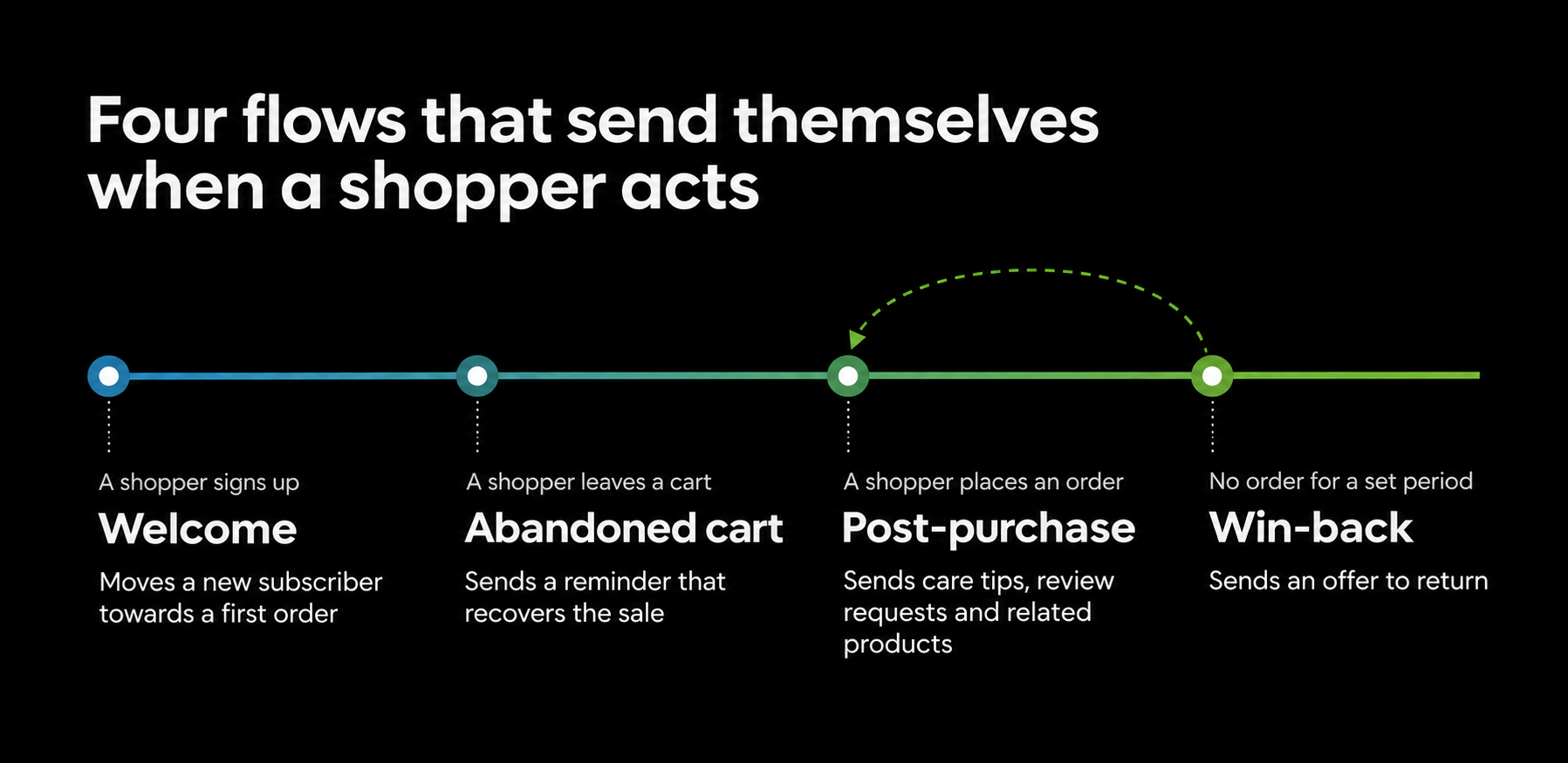
Ecommerce marketing automation automatically sends emails and texts when a shopper takes an action, such as signing up, leaving a cart, or placing an order. The automation runs these messages without anyone pressing send.
Those triggers power four core flows, each tied to one commercial goal:
- Welcome: A sign-up triggers messages that move a new subscriber towards a first order.
- Abandoned cart: A left cart triggers a reminder that recovers the sale.
- Post-purchase: An order triggers care tips, review requests and related products.
- Win-back: A set period without an order triggers an offer to return.
Each flow runs continuously once set up, so the flow earns revenue every day.
How does ecommerce customer retention grow revenue?
Ecommerce customer retention grows revenue by turning first-time buyers into repeat customers through loyalty programmes, lifecycle marketing, customer relationship management (CRM) data and customer service. Strong ecommerce customer retention means each acquired customer pays back more than once.
| Dimension | Customer acquisition | Customer retention |
|---|---|---|
| Who it targets | People who have never bought | People who have bought before |
| Main channels | SEO, Google Ads, Meta Ads, social media | Email, loyalty programmes, customer service |
| Cost per order | Includes the cost to acquire the customer | Carries no new acquisition cost |
| What it measures | New customers and acquisition cost | Repeat purchase rate, purchase frequency and churn |
Repeat purchase rate shows the share of customers who order again. Purchase frequency shows how many orders each customer places in a set period. Churn shows the share of customers who stop buying altogether. Higher retention increases lifetime value so that a store can spend more on each new customer.
What does ecommerce content marketing do?
Ecommerce content marketing creates copy, video, guides and visual content that helps shoppers choose a product and trust the store enough to buy. Ecommerce content marketing uses video and imagery to show shoppers what a product looks like, how it works, and how it fits into their lives. Video content shows products in use and answers questions that still photos cannot.
Image content covers product photography, lifestyle imagery and infographics for product and category pages. Content supports the Traffic section by driving visits from Google Images, video results, and YouTube. Clear visuals also raise trust, which lifts conversion on product pages.
What should an ecommerce content marketing strategy include?
An ecommerce content marketing strategy should include buyer questions to answer, the formats that answer them, the channels that distribute them and the sales each piece supports.
Those four parts link every video, image and graphic to a commercial result:
- Buyer questions: Search data, product reviews and customer service logs show what shoppers need to see before they buy.
- Formats: Product photography, lifestyle imagery, product videos and infographics each answer a different question.
- Distribution: Product pages, YouTube, social media and email put visual content in front of buyers.
- Commercial link: Each video or image supports one product or category with a clear sales goal.
How does social media marketing work for ecommerce?
Social media marketing for ecommerce builds an audience through organic posts and creator content, then sends that audience to product pages. Organic ecommerce social media builds the audience that later buys through the store. Social media serves the Traffic section, mainly at the awareness stage of the funnel. Organic posts reach existing followers without paying for each view.
Creator content extends that reach to audiences the brand has never met. Short-form video lets creators demonstrate products in use within seconds. Each video links to a product page, so attention turns into store visits. Those store visits carry no ad spend, unlike paid Meta advertising.
How does influencer marketing work for ecommerce brands?
Influencer marketing works for ecommerce brands by paying or gifting creators to show products to their followers in their own words. Ecommerce influencer marketing borrows the trust each creator has built with followers. That trust gives the creator's recommendation a weight that brand ads lack. Brands keep that weight by leaving presentation to creators after a product brief. That creator content also works as user-generated content (UGC) on product pages and ads.
According to the Committee of Advertising Practice (CAP) Code, Section 2 (Advertising Standards Authority, 2026), every marketing communication, including paid creator content, must be obviously identifiable as advertising. Each paid creator post therefore needs a clear label showing it is an ad.
Why does branding matter in ecommerce marketing?
Branding matters in ecommerce marketing because a clear identity, positioning, and value proposition earn trust, turn visitors into buyers, and let a store compete on more than price. Clear ecommerce branding tells shoppers what the store sells and why it matters. Branding serves the Website & Branding Performance section of the Engine. Recognised brands earn more clicks on ads because shoppers trust names they know. That trust also lifts conversion on product pages and at checkout.
A brand strategy sets the positioning, value proposition, and tone of voice. Building an ecommerce brand then applies that strategy to every customer touchpoint. A trusted brand needs fewer discounts to win a sale, protecting margins.
What does an ecommerce marketing agency do?
An ecommerce marketing agency plans, runs and reports on the marketing channels that grow an online store, from SEO and paid advertising to CRO, email and branding. An ecommerce marketing agency runs every channel against one shared revenue target. A shared target stops channels from competing for credit and budget. The agency reports each channel's results against revenue, acquisition cost and retention. Those three measures show which Engine section currently limits growth.
By contrast, an ecommerce ad agency runs paid media only on Google and Meta. A full ecommerce digital marketing agency also covers SEO, CRO, email and branding. That breadth suits stores whose growth depends on several channels at once. The agency focuses on marketing, so website design and development sit elsewhere.
What services does an ecommerce marketing agency provide?
An ecommerce marketing agency provides ten services: SEO, Google Ads, Meta Ads, content marketing, social media, CRO, branding, email marketing, marketing automation and retention strategy. These e-commerce digital marketing services span the three Ecommerce Growth Engine sections, so no section runs unmanaged. Each service belongs to the Engine section it improves:
- Traffic: The agency runs SEO, Google Ads, Meta Ads, content marketing and social media.
- Website & Branding Performance: CRO audits and testing, plus branding work, raise conversion and trust.
- Customer Retention: Email marketing, marketing automation and retention strategy increase repeat orders.
Ecommerce marketing packages combine these services around one revenue target. For a store with weak retention, for example, a package should weight email and automation more heavily.
How should an ecommerce business choose an ecommerce marketing agency?
An ecommerce business should choose an ecommerce marketing agency based on ecommerce experience, channel coverage, revenue-tied reporting, and evidence behind every performance claim.
Each of those four criteria comes with one question to ask the agency:
- Ecommerce experience: Ask which online stores the agency has grown, and over what period.
- Channel coverage: Ask which Engine sections the agency manages and which it hands off elsewhere.
- Revenue reporting: Ask whether reports show revenue, acquisition cost and retention, beyond clicks.
- Evidence behind claims: Ask for the data behind every performance figure the agency quotes. According to the Committee of Advertising Practice (CAP) Code, rule 3.7 (Advertising Standards Authority, 2026), marketers must hold documentary evidence for objective claims.
How do the parts of ecommerce marketing work together?
The parts of ecommerce marketing work together as one Ecommerce Growth Engine: traffic channels bring shoppers, website and branding performance converts them, and Customer Retention brings them back.
Each section depends on the others, so the weakest one caps total returns. Extra Traffic spend returns less when conversion or customer retention lags. An ecommerce marketing strategy therefore fixes the weakest section before adding spend. Customer retention then multiplies the value of every customer that Traffic and conversion win.
The Ecommerce Growth Engine turns separate channels into one commercial system. An ecommerce marketing agency runs that system against one revenue target. Every channel then answers to the same result: profitable and repeatable sales.
Ecommerce marketing uses search, advertising, email, content, social media, and branding to attract shoppers to an online store, convert them into customers, and bring them back to buy again. Within ecommerce, marketing succeeds only when shoppers complete an order. The Ecommerce Growth Engine sorts these channels into three commercial jobs. Traffic brings qualified visitors to the store through search, ads and social media. Website & Branding Performance turns those visitors into buyers and earns their trust. Customer Retention earns repeat purchases from people who have already bought once.
The three jobs depend on each other because sales need all three to work. A store with strong Traffic still loses money when its checkout fails. The weakest link limits returns from every other channel. Clicks and followers count only when they lead to completed orders. Ecommerce marketing therefore runs as one system against one revenue target.
Try Us Free for 4 Weeks. Up to $5,000 in Agency Fees, On Us.
Four weeks of agency work on us, with no commitment and no obligation to carry on. For ecommerce brands at $50K+ a month and $10K+ in ad spend.
Next month’s intake closes in00days00hours00minutes00seconds

Works on the content half of search: keyword research, page copy, blog articles and the words that turn a store’s visitors into buyers.
Writes about Technical SEO, Structured data, Site architecture
More articles
 GrowthEcommerce Growth: Strategy, Framework, Metrics, Profitability, Experimentation, Consulting and AgenciesAlexander W. · 20 November 2026
 EcommerceEcommerce: Meaning, Market Trends, Growth Drivers, Marketing, Metrics, Business Models and TechnologyAlexander W. · 19 November 2026
 EcommerceEcommerce Analytics and Measurement: Tracking, KPIs, Funnels, Cohorts, Attribution, Incrementality, Segmentation and ForecastingAlexander W. · 23 November 2026