
Marketing
Ecommerce CRO: Conversion Metrics, Audits, Agency Support, UX, Landing Pages, Product Pages, Checkout, Site Search and Merchandising
On this page
- What Is Ecommerce CRO?
- What Does an Ecommerce CRO Agency Contribute to Growth?
- How Does Ecommerce UX Affect Conversion Performance?
- How Do Ecommerce Landing Pages Influence Conversion Rates?
- How Do Ecommerce Product Pages Affect Purchase Decisions?
- How Do Ecommerce Checkout and Cart Affect Completed Purchases?
- How Does Ecommerce Site Search Influence Conversions?
- How Does Ecommerce Merchandising Influence Conversion Performance?
- How Should Ecommerce CRO Priorities Support Sustainable Ecommerce Growth?
Ecommerce conversion rate optimisation (CRO) removes barriers that stop online store visitors from buying, so existing Traffic generates more revenue. The conversion rate measures completed orders against total visits. Revenue per visit adds the value of each order.
Randomised experiments confirm which changes caused each improvement. An ecommerce CRO audit locates the barriers before testing begins. Seven disciplines own the fixes: agency support, UX, landing pages and product pages. Checkout and cart, site search and merchandising complete the seven.
What Is Ecommerce CRO?
Ecommerce conversion rate optimisation (CRO) is the marketing discipline that improves online purchasing performance by calculating conversion rate, tracking revenue metrics, testing changes, auditing purchase barriers and assigning each barrier to one of seven specialist disciplines. Within ecommerce marketing, CRO converts Traffic the store already pays for into completed orders. CRO serves the Website & Branding Performance section of the Ecommerce Engine.
Every CRO measure serves one outcome: the completed purchase. A completed purchase turns a visit into measurable revenue. That outcome links each discipline's work to revenue and margin. Activity that leaves completed purchases unchanged adds cost without adding growth.
How Is the Ecommerce Conversion Rate Calculated?
The ecommerce conversion rate equals completed orders divided by visits, multiplied by 100.
Conversion rate (%) = completed orders ÷ visits × 100
The numerator counts completed orders within the reporting period. The denominator counts every visit (session) in the same period. Multiplying by 100 expresses the result as a percentage. For example, 300 orders from 12,000 visits yield a 2.5% conversion rate.
Product views, basket additions and email sign-ups count as supporting signals of buying intent. Those signals show progress towards a purchase, while revenue arrives only with the order. User-based reporting divides the same orders by users instead of visits. One user who visits three times counts once, so the user-based rate runs higher. Valid comparisons therefore use the same denominator, definitions and reporting period. A store compares its rate against its own segmented history. Device, traffic source and product category each form a separate segment.
Which Ecommerce CRO Metrics Explain Revenue Growth?
Conversion rate, average order value and revenue per visit together explain the revenue growth that ecommerce CRO produces. Each metric draws on orders, visits or purchase revenue from the same reporting period: Revenue per visit equals conversion rate multiplied by average order value. For example, a 2.5% conversion rate and an £80 AOV produce £2 per visit. RPV therefore reveals trade-offs that conversion rate alone hides. A shift in traffic mix moves all three metrics without changing the store.
Changing how you define purchase revenue also moves AOV and RPV without changing the store. To keep figures comparable, report online, in-store, and total sales separately, and state how you classify each sale. Revenue figures should also declare components such as refunds, tax, and shipping.
How Does Ecommerce CRO Establish Evidence of Improvement?
Ecommerce CRO establishes evidence of improvement through randomised controlled experiments that compare a changed experience against an unchanged control group. These experiments are A/B tests, in which random assignment gives both groups the same mix of shoppers. Any difference in results then traces back to the change itself. We judge each experiment against one overall evaluation criterion, defined before the test starts. Trustworthiness checks then confirm the data before we act on results. Causal claims in our CRO reporting therefore rest on A/B tests.
Incrementality is the causal impact a change produces beyond what would have happened without it. Before-and-after analysis offers only directional insight into incrementality. Such a comparison mixes the change with seasonality, promotions and traffic shifts.
What Does an Ecommerce CRO Audit Examine?
An ecommerce CRO audit examines measurement accuracy, segment-level commercial performance, and observed shopper behaviour to identify barriers that reduce completed purchases. Measurement comes first because everything else depends on it. Reliable measurement data meets standards for accuracy, consistency, and completeness. Data quality audits should therefore run at least once a year. Segment analysis then compares performance by device, traffic source and product category. Each comparison shows where performance falls below the store's own baseline. Behaviour analysis then shows the step where shoppers stop progressing. Funnel reports and usability tests supply that behavioural evidence.
The audit also separates visible symptoms from their underlying causes. A falling conversion rate signals a problem without naming its cause. The audit output is a prioritised list of purchase barriers. The audit assigns each barrier to the discipline responsible for fixing it. Priority follows the revenue each barrier costs the store. The audit therefore locates the bottleneck inside Website & Branding Performance.
Where Do Ecommerce CRO Disciplines Act in the Shopper Journey?
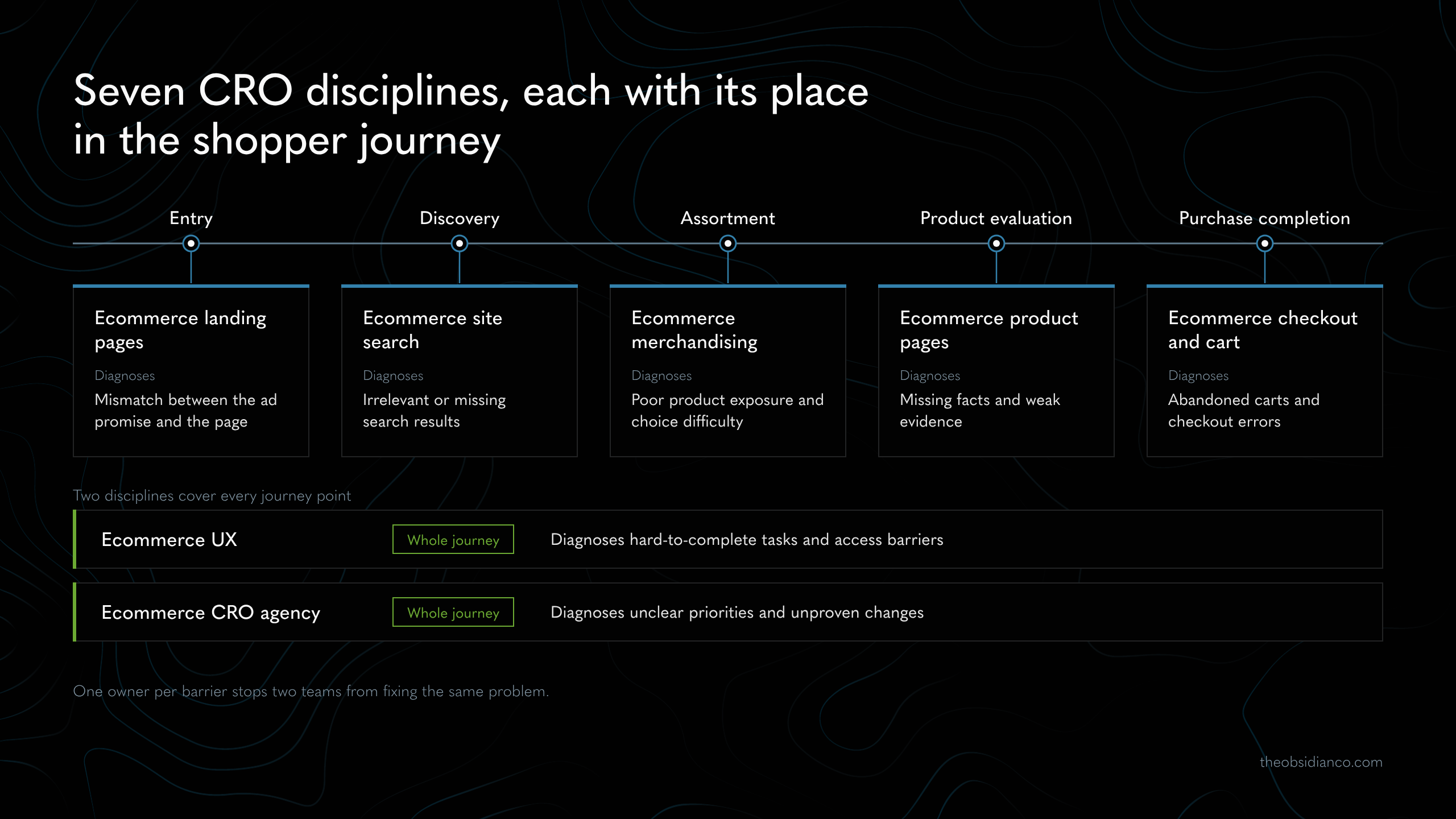
The seven ecommerce CRO disciplines act at five points in the shopper journey: entry, product evaluation, discovery, assortment and purchase completion, with agency support and UX covering the whole journey. The two whole-journey disciplines diagnose problems across every page, while the other five diagnose problems at a single journey point:
| Discipline | Journey point | Problem it diagnoses |
|---|---|---|
| Ecommerce CRO agency | Whole journey | Unclear priorities and unproven changes |
| Ecommerce UX | Whole journey | Hard-to-complete tasks and access barriers |
| Ecommerce landing pages | Entry | Mismatch between the ad promise and the page |
| Ecommerce product pages | Product evaluation | Missing facts and weak evidence |
| Ecommerce checkout and cart | Purchase completion | Abandoned carts and checkout errors |
| Ecommerce site search | Discovery | Irrelevant or missing search results |
| Ecommerce merchandising | Assortment | Poor product exposure and choice difficulty |
Losses concentrated at one journey point name its discipline, while losses across every page point to UX. For example, shoppers who search but never reach a product page point to ecommerce site search.
What Does an Ecommerce CRO Agency Contribute to Growth?
An ecommerce CRO agency drives growth by turning more visits into completed orders through diagnosed, prioritised, and measured purchase improvements, while a website development agency builds those changes. An ecommerce CRO agency works on existing stores that already attract paying visitors. The agency acts as a performance partner accountable to commercial results. Completed orders and revenue per visit measure that accountability.
Each recommendation carries an expected revenue effect and a test plan. Within the Engine, the agency strengthens website and branding performance. Stronger conversion then raises the return on every visitor that Traffic delivers.
How Does an Ecommerce CRO Agency Differ From a Website Development Agency?
An ecommerce CRO agency diagnoses and prioritises conversion improvements, whereas a website development agency builds and changes website functionality. The CRO agency is judged on sales outcomes, while the development agency is judged on delivery:
| Dimension | Ecommerce CRO agency | Website development agency |
|---|---|---|
| Objective | Raise completed orders from existing traffic | Deliver working site features |
| Main deliverable | Diagnosis, prioritised tests and measured results | Built templates, features and integrations |
| Accountability measure | Conversion rate and revenue per visit | Delivery on time, in scope and on budget |
The CRO agency's scope covers diagnosis, testing and performance measurement. Website builds and platform migrations sit with the development agency. Separate scopes mean the two agencies work in sequence on the same store. CRO diagnosis defines the change, and development implements it. Test results then confirm whether the built change raised sales.
What is the #1 thing holding back your ecommerce revenue?
Get an instant PDF audit powered by The Ecommerce Engine™ methodology, refined through five years of research and development.
How Does Ecommerce UX Affect Conversion Performance?
Ecommerce user experience (UX) affects conversion performance through usability, measured by effectiveness, efficiency, and satisfaction, and through accessibility standards that set minimum text contrast and pointer-target sizes. Strong ecommerce UX lets shoppers find, compare and buy products without errors. Usability is how well shoppers achieve their intended goals on the site. Effectiveness, efficiency and satisfaction measure that achievement within a given shopping context. UX evaluates the quality of each shopping task, while CRO evaluates the commercial outcome of those same tasks.
Which Accessibility Standards Matter to Ecommerce UX?
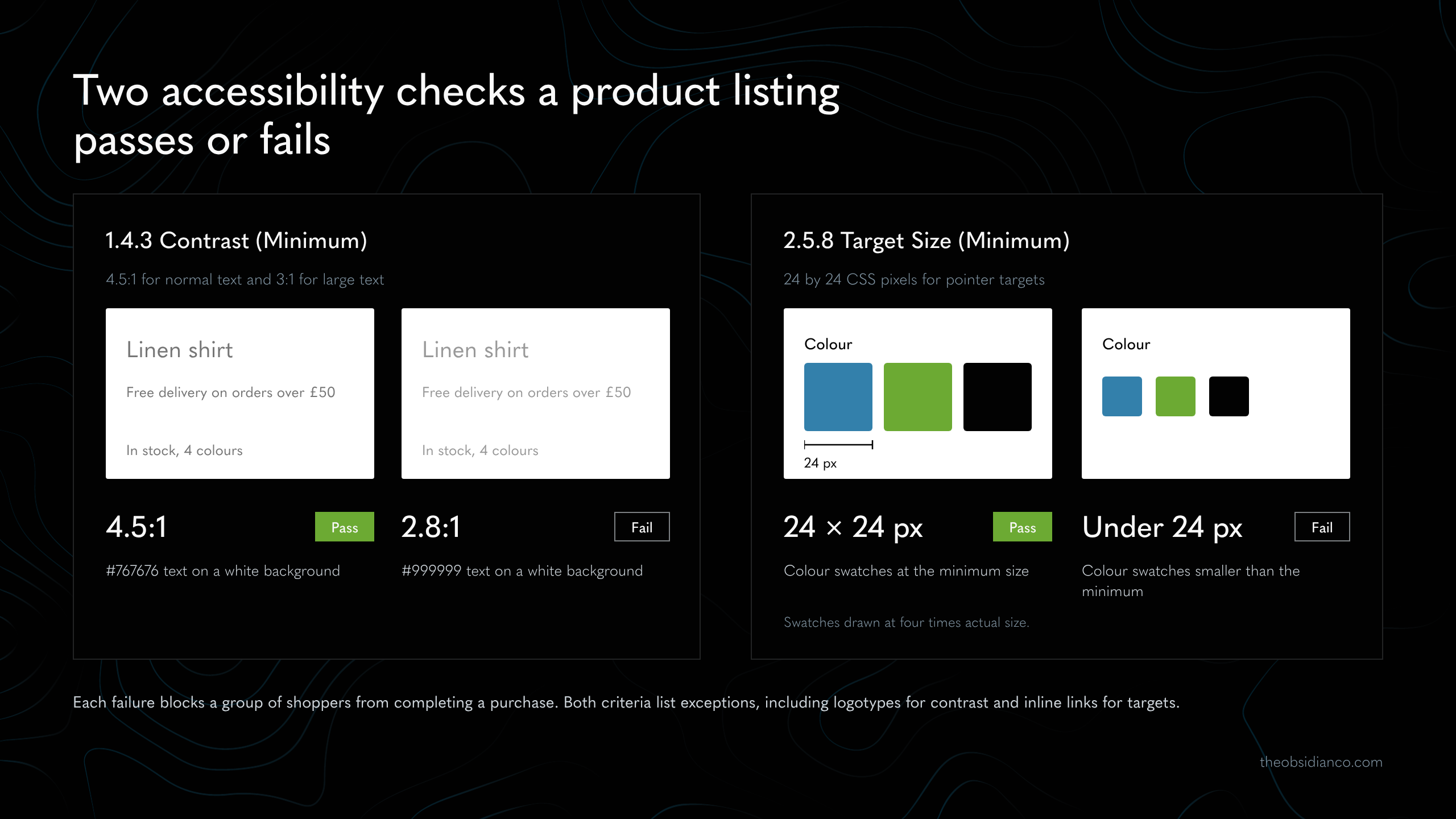
The two Web Content Accessibility Guidelines (WCAG) 2.2 standards that matter most to ecommerce UX are a minimum text contrast of 4.5:1 for normal text and a minimum pointer target size of 24 by 24 CSS pixels. According to the World Wide Web Consortium (W3C), both standards fall under conformance Level AA in the Web Content Accessibility Guidelines (WCAG) 2.2 (W3C, 2023). Each success criterion sets a specific threshold for existing store pages:
| Criterion | Level | Requirement |
|---|---|---|
| 1.4.3 Contrast (Minimum) | AA | 4.5:1 for normal text; 3:1 for large text |
| 2.5.8 Target Size (Minimum) | AA | 24 by 24 CSS pixels for pointer targets |
Both criteria list exceptions, including logotypes for contrast and inline links for targets. The thresholds provide a pass/fail check for product listings. Grey #999999 text on a white background measures 2.8:1 and fails the contrast criterion. A colour swatch smaller than 24 by 24 pixels fails the target criterion. Each failure blocks a group of shoppers from completing a purchase. Conversion rate then loses those buyers before the store can count them.
How Do Ecommerce Landing Pages Influence Conversion Rates?
Ecommerce landing pages influence conversion rates by matching the visitor's arrival intent, repeating the promised message and presenting one relevant next action. Ecommerce landing pages receive visitors from ads, emails and search with defined intent. A general storefront entry page, by contrast, supports broad category browsing. Paid Traffic sent to a general page loses the promise that drew the click.
The landing-page action, such as an add-to-basket click, and the completed purchase form two separate outcomes. Measuring each outcome separately shows where visitors drop between them. For example, a high add-to-basket rate with few completed purchases places the barrier beyond the landing page, elsewhere in Website & Branding Performance.
Which Attributes Make Ecommerce Landing Pages Relevant to Incoming Traffic?
Message continuity, proposition clarity and a single expected next action make ecommerce landing pages relevant to incoming Traffic. Message continuity repeats the promise that drew the visitor's click. For example, a visitor who clicked a 20% discount ad sees that discount first. Proposition clarity states the offer and its value in plain terms. A clear proposition names the product, price, and main benefit. The expected next action matches the visitor's stage in the journey. Ready buyers receive an add-to-basket button, while researchers receive product details.
How Do Ecommerce Product Pages Affect Purchase Decisions?
Ecommerce product pages affect purchase decisions by providing complete product facts, clear buying conditions, and credible customer evidence. Ecommerce product pages give shoppers the final information they need before buying. Product facts include specifications, dimensions, materials and variant details. Buying conditions cover price, delivery time, and the returns policy. Missing facts or conditions therefore leave the purchase decision unfinished.
How Do Ecommerce Product Pages Establish Credible Purchase Evidence?
Ecommerce product pages establish credible purchase evidence through genuine customer reviews, accurate product claims and clear disclosure of any incentivised feedback. Customer reviews come from buyers, while product claims come from the merchant. Shoppers therefore read reviews as independent evidence of quality.
How Do Ecommerce Checkout and Cart Affect Completed Purchases?
Ecommerce checkout and cart affect completed purchases through cart composition, abandonment causes and checkout accessibility. Ecommerce checkout and cart are the last two steps before revenue. The cart holds the shopper's selected purchase set. Checkout is the attempt to complete payment and place the order. An accessible checkout meets three specific requirements:
- Error identification: Detected input errors are described in text.
- Redundant entry: Checkout never asks for the same details twice.
- Accessible authentication: Shoppers can sign in without memorising a password or solving a puzzle, for example by pasting or using a password manager.
Which Causes of Ecommerce Cart Abandonment Are Distinguishable?
Ecommerce cart abandonment has three distinguishable causes: purchase hesitation, cart composition and checkout barriers. Each cause leaves different evidence in store data, so each needs its own fix:
- Purchase hesitation: Shoppers save items in the cart to compare or decide later.
- Cart composition: The mix of indulgent and practical products affects purchase likelihood.
- Checkout barriers: Input errors, repeated entry or sign-in problems stop the order.
Within cart composition, a higher indulgent-to-practical ratio predicts more cart abandonment. This pattern holds regardless of total cart price, item count, browsing duration, or user traits. Practical items in the cart help shoppers justify indulgent purchases. Abandonment therefore traces back to cart contents and checkout design.
How Does Ecommerce Site Search Influence Conversions?
Ecommerce site search influences conversions by interpreting shopper queries, retrieving suitable products, and ranking the most useful ones first. Ecommerce site search serves shoppers who already know what they want. Shoppers type three types of queries: exact item names, attributes, and broad requests. For example, a shopper might type a model number, "blue linen shirt", or "summer outfit".
Category browsing, by contrast, supports exploration through predefined product groups. Search answers an expressed need, so poor results lose high-intent buyers. Each failed search therefore costs a sale the shopper intended to make.
Which Measures Describe Ecommerce Site Search Relevance?
Recall and normalised discounted cumulative gain (nDCG) describe ecommerce site search relevance. Recall measures the share of relevant products that a search retrieves. For example, a search returning 8 of 10 suitable products scores 80% recall. nDCG scores how well a search ranks the most relevant products first. The score rises when highly relevant products appear higher in the results. A perfect ranking scores 1, and weaker orderings score closer to 0.
Relevance measures describe retrieval quality before any sale. The search-to-purchase rate provides the commercial counterpart to those relevance measures. The rate divides searching sessions that end in an order by all searching sessions. Low recall alongside a falling search-to-purchase rate points to a retrieval problem.
How Does Ecommerce Merchandising Influence Conversion Performance?
Ecommerce merchandising influences conversion performance through assortment attributes, product exposure and the choice outcomes that shoppers experience. Ecommerce merchandising decides which products a store offers and where shoppers encounter them. Product exposure describes which eligible products appear in category pages and search results. Position within those pages sets the order in which shoppers see products.
Together, range and exposure decisions shape three choice outcomes: purchase incidence, choice satisfaction, and choice difficulty. Purchase incidence measures the share of shoppers who buy from the range. Choice difficulty rises when the range offers more options than shoppers can compare.
Which Assortment Attributes Define Ecommerce Merchandising?
Assortment breadth, product mix and product availability define e-commerce merchandising. Assortment breadth counts the number of alternatives within each category. Product mix describes the spread across categories, brands and price points. Product availability shows whether shoppers can buy each listed product today.
Greater assortment breadth more often increases sales than reduces them. The sales effect is nonlinear, so each additional product adds less sales benefit than the previous one. Larger ranges also carry costs in the form of choice stress and choice difficulty. Unavailable products raise those costs without adding any sales benefit. Each unavailable listing adds a product to compare that shoppers can't purchase.
How Should Ecommerce CRO Priorities Support Sustainable Ecommerce Growth?
Ecommerce CRO priorities support sustainable ecommerce growth when a business links each diagnosed purchase barrier to the discipline that owns it and measures results by completed orders and revenue per visit. An ecommerce CRO audit supplies that diagnosis before any budget moves. Ownership then directs each fix to one discipline, from landing pages to merchandising. Randomised experiments confirm which fixes raised the conversion rate. Revenue per visit then shows whether each fix raised revenue overall.
Purchase barriers move as traffic sources, product ranges and devices change. Ecommerce CRO therefore runs as a repeating cycle of audit, test and measurement. Each cycle repairs the current bottleneck in website and branding performance. The same Traffic then produces more orders without extra advertising spend. Every fix links one purchase barrier to one measured commercial result. That return lets e-commerce growth continue without paying more for each sale.
Try Us Free for 4 Weeks. Up to $5,000 in Agency Fees, On Us.
Four weeks of agency work on us, with no commitment and no obligation to carry on. For ecommerce brands at $50K+ a month and $10K+ in ad spend.
Next month’s intake closes in00days00hours00minutes00seconds

Works on the content half of search: keyword research, page copy, blog articles and the words that turn a store’s visitors into buyers.
Writes about Technical SEO, Structured data, Site architecture
More articles
 MarketingEcommerce SEO: Benefits, Agency Support, Audit, Strategy, Technical, On-Page and Off-Page SEO, Platforms and MeasurementAlexander W. · 23 November 2026
 MarketingGoogle Ads for Ecommerce: Agency Support, Shopping Ads, Performance Max and Growth StrategyAlexander W. · 23 November 2026
 MarketingEcommerce Meta Ads: Agency, Facebook, Instagram and Ad CreativeAlexander W. · 23 November 2026