
Ecommerce Technology: Stack, Platforms, Software, Payments and AI
On this page
- What is ecommerce technology?
- How does an ecommerce platform affect ecommerce growth?
- How does ecommerce software affect ecommerce growth?
- How do ecommerce payment systems affect ecommerce growth?
- How does AI in ecommerce affect ecommerce growth?
- How should an ecommerce business prioritise ecommerce technology?
Ecommerce technology falls into four groups: ecommerce platforms, ecommerce software, payment systems, and artificial intelligence (AI). Businesses assemble these systems as one all-in-one stack or as composable services. Each technology group supports sections of the Ecommerce Engine and can limit its growth.
Platform reliability, software data exchange and payment completion decide how much demand becomes revenue. Digital wallets took 56% of global ecommerce spend in 2025. AI needs suitable data and oversight, and 20.2% of firms used AI in 2025.
What is ecommerce technology?
Ecommerce technology is the set of platforms, software, payment systems, and AI a business uses to sell online and run the work behind each order. Every digital order in ecommerce passes through these systems, from product page to payment.
Customer-facing systems include the online store, product pages and checkout. Back-office systems hold order, stock, and customer records for each sale. Together, these systems decide how many orders a store can take. These same systems also determine each order record's accuracy and processing cost.
What technologies are used in ecommerce?
Ecommerce uses four groups of technology: ecommerce platforms, ecommerce software, payment systems and AI. Platforms and payment systems handle every order directly, while software and AI extend what the store and its team can do:
- Ecommerce platforms: Shopify and Adobe Commerce form the online store's core.
- Ecommerce software: enterprise resource planning (ERP) manages stock, while email tools send marketing emails.
- Payment systems: providers such as Adyen and wallets such as Apple Pay collect payments.
- AI: automated analysis and content production run inside platforms, software and advertising tools.
What is an ecommerce technology stack?
An ecommerce technology stack is the full set of connected systems a business runs to sell online, built either around one all-in-one platform or from separate composable services. An all-in-one stack relies on one platform provider for the core store. The provider hosts and maintains that store, while the business adds extra applications. A composable stack connects separate specialist services through application programming interfaces (APIs).
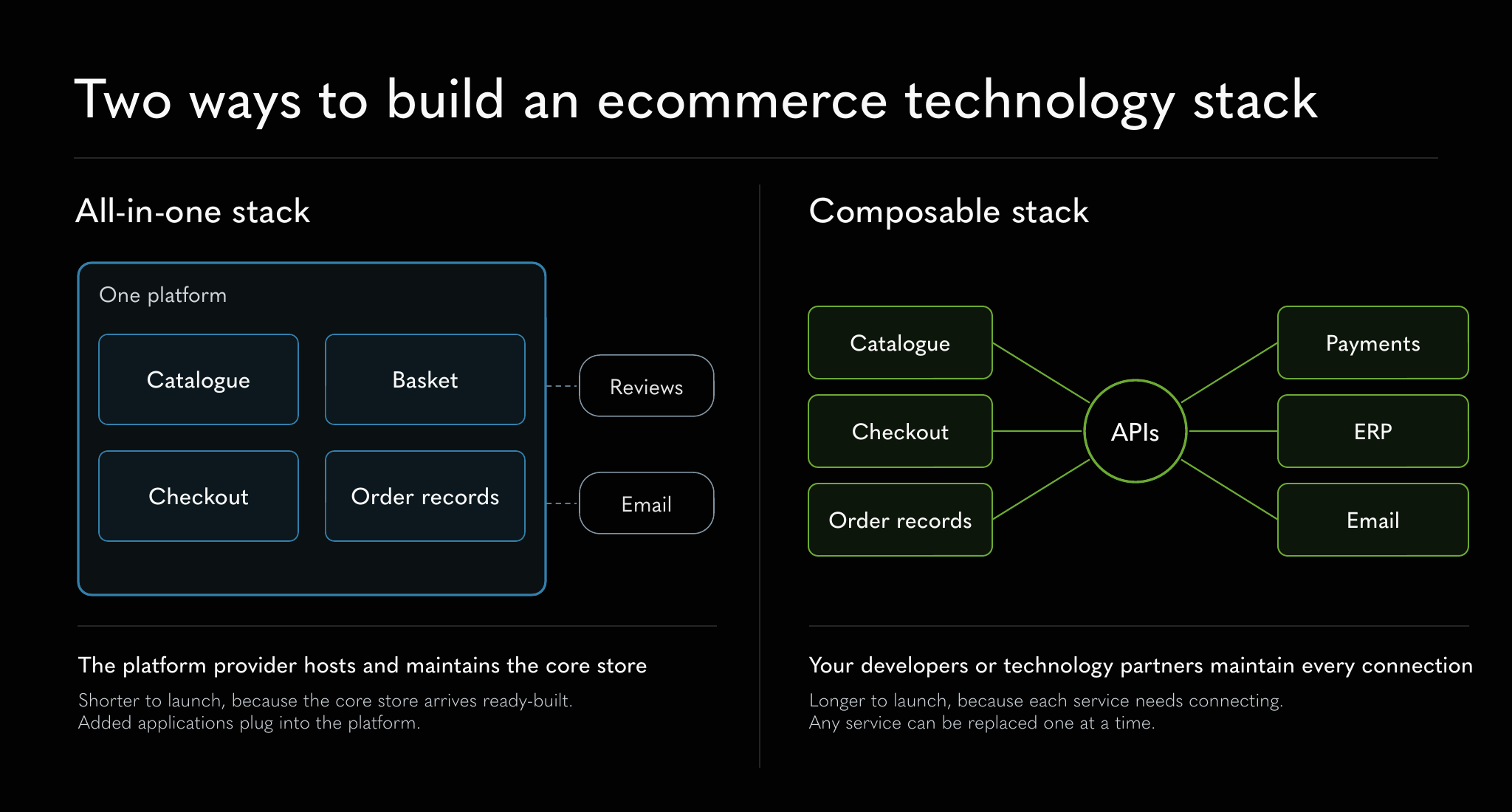
Each stack type places cost and technical effort with a different party:
| Dimension | All-in-one stack | Composable stack |
|---|---|---|
| Core system maintenance | Platform provider | The business's developers or technology partners |
| Time to launch | Shorter, because the core store arrives ready-built | Longer, because each service needs connecting |
| Integration work | Limited to added applications | Required between every service |
| Replacing one part | Limited to the provider's options | Possible one service at a time |
What is the best technology stack for an ecommerce website?
The best technology stack for an ecommerce website matches the business model, catalogue complexity and in-house technical capacity at the lowest total cost of ownership those needs allow. Those four criteria decide which stack type fits a particular business:
- Business model: business-to-consumer (B2C), business-to-business (B2B) and subscription stores need different order functions.
- Catalogue complexity: variants, bundles and customer-specific price lists raise the functions a stack must hold.
- In-house technical capacity: businesses without developers rely on an all-in-one stack for maintenance. A composable stack needs a team to maintain every connection.
- Total cost of ownership (TCO): licence, hosting, application and integration costs add up over the stack's working life.
What is the role of technology in ecommerce growth?
Technology supports ecommerce growth by running the systems that attract visitors, turn visits into paid orders, and drive repeat purchases; a failing system stalls growth in the Ecommerce Engine section it supports: Traffic, Website & Branding Performance or Customer Retention. A growth diagnosis therefore names the stalled Engine section first. Diagnosis then traces that bottleneck to the technology group behind the section. Ownership of the fix depends on where the fault sits. A growth agency measures the commercial impact and changes the marketing response. The business’s technical team or technology provider changes the system itself.
Each technology group supports different Engine sections and has its own system owner:
| Technology group | Engine section it supports | Owner of system changes |
|---|---|---|
| Ecommerce platform | Website & Branding Performance | Platform provider or developer |
| Ecommerce software | Traffic, Website & Branding Performance and Customer Retention | Technical team or software provider |
| Payment systems | Website & Branding Performance | Payment provider |
| AI | All three sections | AI provider or technical team |
How does an ecommerce platform affect ecommerce growth?
An ecommerce platform affects ecommerce growth through the commerce capabilities it provides and how reliably it keeps the store taking orders. The ecommerce platform sits at the core, and every other system connects to it. An ecommerce platform is software that runs the catalogue, basket, checkout and order records. Platform capabilities decide which products and offers the business can sell and promote. Platform reliability decides whether paid and organic demand turns into completed orders. A capable platform that fails at peak demand still loses the orders marketing attracted.
Which ecommerce platform capabilities affect growth?
Ecommerce platform capabilities affect growth when they meet the functions a growth plan needs, and they are complete, correct, and appropriate for the products the business sells. The International Organisation for Standardisation (ISO) and International Electrotechnical Commission (IEC) define functional suitability as a software quality characteristic in the ISO/IEC 25010:2023 Product quality model (ISO, 2023). Functional suitability measures how well platform functions meet users’ stated and implied needs. The model divides functional suitability into three measurable parts. Each part names one way a platform function can fail a growth plan:
- Functional completeness: the platform offers every function the plan needs, such as tiered discounts.
- Functional correctness: each function returns accurate results, such as correct order totals after discounts.
- Functional appropriateness: each function completes its task without manual workarounds from the team.
Missing or faulty functions limit the offers a campaign can promote. For example, a platform without tiered discounts cannot run a spend-more-save-more offer. Correctness errors reach paying customers directly as wrong totals at checkout.
How does ecommerce platform reliability affect trading continuity?
Ecommerce platform reliability determines whether a store can keep taking orders during peak demand and how quickly it recovers after a failure. According to the ISO/IEC 25010:2023 Product quality model (ISO, 2023), reliability is divided into four sub-characteristics covering faults, uptime and recovery. Faultlessness measures how consistently the platform operates correctly under normal conditions. Availability measures the share of time the store accepts orders. Fault tolerance keeps the store working when one component fails. Recoverability sets how fast the platform restores service and data after a failure.
99.9% availability allows about 8 hours 46 minutes of downtime each year. 99.99% availability cuts that allowance to about 53 minutes a year. Both figures are calculations from the 8,760 hours in a standard year. A service level agreement (SLA) records the availability a platform provider commits to.
What is the #1 thing holding back your ecommerce revenue?
Get an instant PDF audit powered by The Ecommerce Engine™ methodology, refined through five years of research and development.
How does ecommerce software affect ecommerce growth?
Ecommerce software affects ecommerce growth through how well it exchanges data with the ecommerce platform and whether each application adds a function the business lacks. Ecommerce software covers applications a business adds to extend beyond the platform's functions. For example, a reviews application adds product ratings to platforms that don't offer native reviews. Each added application extends what marketing and operations teams can do. Each application also adds a data connection and a recurring cost. Software supports growth when its data flows correctly, and it fills a gap.
How does ecommerce software exchange data with an ecommerce platform?
Ecommerce software exchanges data with an ecommerce platform through integrations that pass product, stock, order and customer records between the two systems. Integration quality depends on whether both systems run together and share usable data. Co-existence and interoperability describe two different levels of connection between systems:
| Dimension | Co-existence | Interoperability |
|---|---|---|
| What it means | Systems run side by side without harming each other | Systems exchange information and use it |
| What the business sees when it fails | One application slows or breaks another | Records stop matching between systems |
Interoperability failures surface as stock and order errors during live trading. A stock update that fails to pass lets the store sell unavailable items. An order that fails to pass never reaches the order management system. Both failures create refunds, delays and complaints from paying customers. The business first locates the fault in the platform, application or connection. Changing a system before locating the fault risks fixing the wrong component.
When does ecommerce software duplication reduce growth?
Ecommerce software duplication reduces growth when two or more applications perform the same function, add subscription costs, and split customer data without increasing sales. Examples include two email applications, two review applications or a repeated platform feature. Each overlap leaves no clear owner of the true customer record. Split records mean neither application holds a customer's full purchase history. Two applications can then send conflicting messages to the same customer.
Subscription costs rise with every application the business installs. Each duplicate also adds a data connection the team must maintain. An application earns its place when it supplies a function no other system provides.
How do ecommerce payment systems affect ecommerce growth?
Ecommerce payment systems affect ecommerce growth through the payment methods they accept, the authentication they apply, the security standards they meet and the share of payment attempts they complete. Ecommerce payment systems turn a shopper's decision to buy into collected revenue. The World Wide Web Consortium (W3C) sets web standards, including the Payment Request API. According to the Payment Request API (W3C, 2022), each web payment involves three parties, each with a distinct commercial role. Those parties are the payer, the payee and the payment method provider. Additional traffic cannot recover revenue that a payment system fails to collect.
How do accepted payment methods affect ecommerce sales?
Accepted payment methods affect ecommerce sales by determining whether shoppers can pay with their preferred method. Shoppers without their preferred method must switch methods or abandon the purchase. According to the Global Payments Report 2026 (Worldpay, 2026), digital wallets accounted for 56% of global ecommerce spend in 2025, more than any other online payment method. Shoppers pay through cards, digital wallets, account-to-account payments and buy now, pay later (BNPL).
Account-to-account payments move money directly between the shopper’s and merchant’s bank accounts. BNPL splits a purchase into instalments that the shopper pays over time. The same report puts BNPL at 4% of global e-commerce spend in 2025. Preferred methods vary by customer base, so no single mix suits every store. Businesses therefore set their accepted methods based on their customers’ payment data.
How does payment authentication balance fraud and conversion?
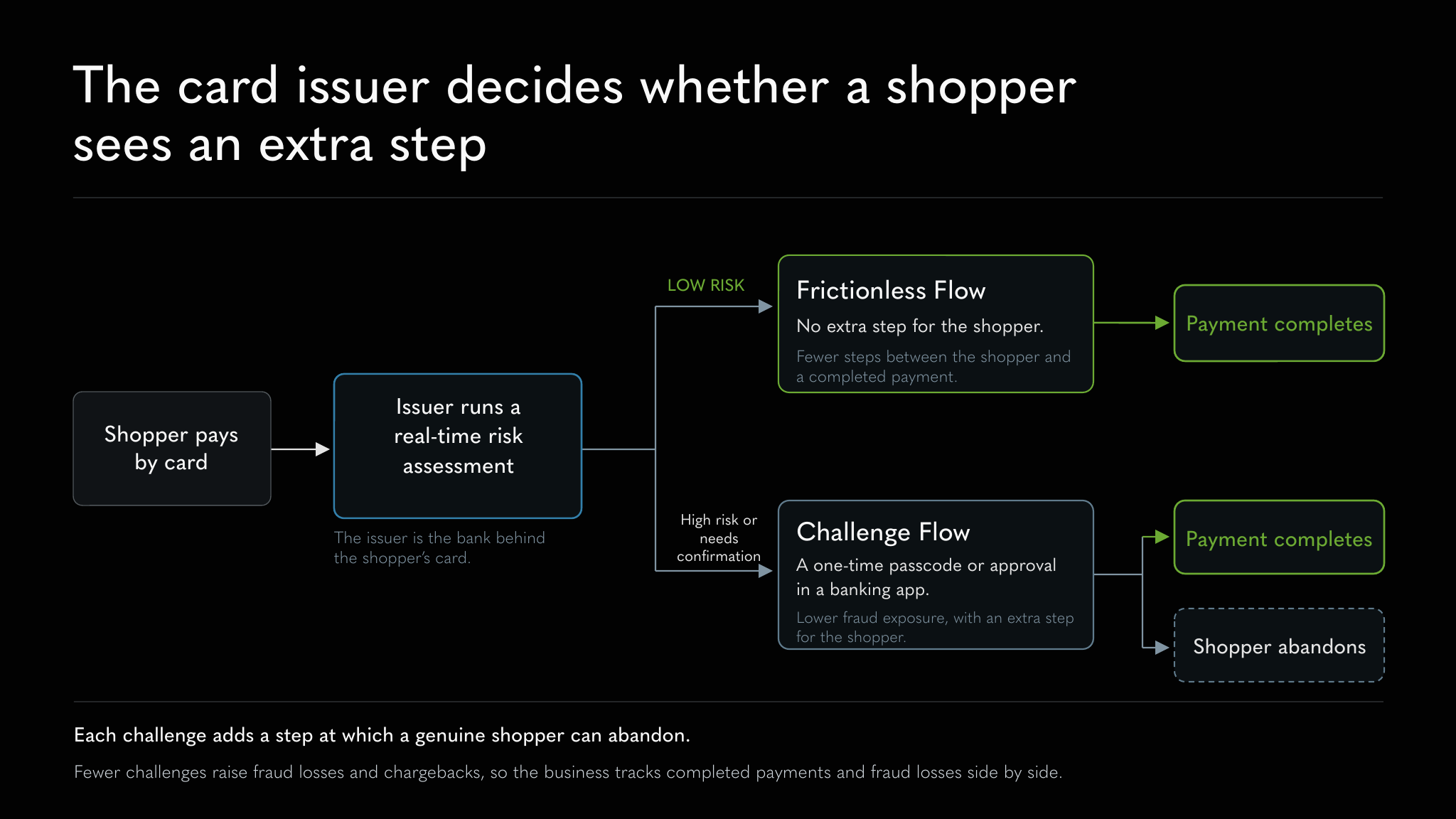
Payment authentication balances fraud and conversion by approving low-risk payments without shopper action and requiring extra verification for high-risk payments. EMV 3-D Secure (EMV 3DS) is the card authentication protocol behind both outcomes. Six card networks, including Visa and Mastercard, own EMVCo, which manages EMV 3DS. The issuer, meaning the bank behind the shopper's card, chooses each payment's flow. According to Optimising online payment authentication with EMV 3-D Secure (EMVCo, 2025), the issuer applies one of two authentication flows:
| Dimension | Frictionless Flow | Challenge Flow |
|---|---|---|
| When it applies | The issuer's real-time risk assessment rates the payment low-risk | The issuer rates the payment high-risk or needs cardholder confirmation |
| What the shopper does | No extra step | Enters a one-time passcode or approves in a banking app |
| Commercial effect | Fewer steps between the shopper and a completed payment | Lower fraud exposure, with an extra step for the shopper |
Each challenge adds a step at which a genuine shopper can abandon payment. Fewer challenges, by contrast, raise fraud losses and chargebacks for the merchant. A chargeback reverses a card payment after the cardholder disputes it with the issuer. The business therefore tracks completed payments and fraud losses side by side.
Which security standard applies to ecommerce payment systems?
The Payment Card Industry Data Security Standard (PCI DSS) applies to every business that stores, processes or transmits cardholder data, and version 4.0.1 is the current release. The Payment Card Industry Security Standards Council (PCI SSC) maintains the standard. According to PCI DSS v4.0.1 (PCI Security Standards Council, 2024), the standard sets 12 security requirements grouped under six goals.
Those goals cover secure networks, account data protection, vulnerability management, access control, network monitoring and testing, and security policy. All v4.0.1 requirements have been fully applied since 31 March 2025.
Acquiring banks require merchants that accept cards to comply with PCI DSS. A provider’s hosted payment page reduces the cardholder data the business handles. Less cardholder data in the business’s own systems means fewer requirements to meet.
How can an ecommerce business diagnose payment failures?
An ecommerce business diagnoses payment failures by separating declined, failed and abandoned payment attempts and measuring each against total payment attempts.
Each failure type has a different cause and a different party to resolve it:
| Failure type | Typical cause | Who resolves it |
|---|---|---|
| Declined | The issuer refuses due to insufficient funds or suspected fraud | The issuer, with the merchant reviewing fraud settings |
| Failed | A technical error or timeout | The payment provider |
| Abandoned | The shopper leaves during an authentication challenge | The merchant and payment provider, by reviewing the challenge rate |
Payment success rate equals successful payments divided by payment attempts, multiplied by 100. For example, 4,600 successful payments from 5,000 attempts equals 92%. Standards bodies publish no universal benchmark for payment success rate. The business therefore tracks its own rate against previous months. Shoppers who leave before starting payment belong to checkout analysis instead.
How does AI in ecommerce affect ecommerce growth?
AI in ecommerce affects ecommerce growth through its outputs, the data it relies on, the commercial value it proves, and the human oversight it receives. AI in ecommerce runs inside the platforms, software and advertising tools stores use. AI changes growth only when its outputs improve a measured commercial result. Each AI output therefore needs suitable data, a measured comparison and an accountable owner. An AI feature without those three conditions adds cost without proven revenue.
What outputs does AI in ecommerce produce?
AI in ecommerce produces four types of output: predictions, content, recommendations and decisions. According to the Explanatory Memorandum on the updated OECD definition of an AI system (OECD Publishing, 2024), an AI system infers from its inputs how to generate these outputs. Each output type supports a different e-commerce task, with varying levels of autonomy:
- Predictions: AI estimates outcomes, such as the likelihood that a visitor buys.
- Content: AI generates product descriptions and product images for store listings.
- Recommendations: AI suggests advertising bids and budgets for a marketer to approve.
- Decisions: AI acts directly, such as rejecting a payment flagged as fraud.
What data does AI in ecommerce need?
AI in ecommerce needs data that is available, representative of the customers and products it decides on, and suitable for the decision it supports. Available data lives in connected systems and exists in sufficient volume to reveal patterns. Representative data covers every customer group and product range, and suitable data fits the decision it informs. Ecommerce AI draws on three sources: product records, order records and customer records.
Short order histories limit what those records can show an AI system. New product ranges and single-season data create the same gap. For example, one December of sales data overstates demand in quieter months. Unrepresentative data produces outputs that mislead budget and campaign decisions.
Does AI adoption prove commercial value in ecommerce?
No, AI adoption does not prove commercial value, because value appears only when revenue, conversion rate or cost improves against a baseline without AI.
Adoption and commercial value record different evidence about AI in a business:
| Dimension | AI adoption | Measured commercial value |
|---|---|---|
| What it records | Whether a business uses AI | A change in revenue, conversion rate or cost |
| Evidence needed | A survey response or software licence | Results against a baseline without AI |
| What it proves | Use of the technology | A commercial return from the technology |
As individual AI use surges across the OECD, firm adoption continues to expand (OECD, 2026): 20.2% of firms in OECD countries used AI in 2025. That share rose from 14.2% in 2024 and 8.7% in 2023. In 2025, 52% of large firms and 17.4% of small firms used AI. The OECD figures cover all industries and contain no e-commerce sales results. A rising adoption rate therefore shows nothing about any single store's return.
Who should oversee AI in e-commerce decisions?
A named person in the business should oversee each AI-supported e-commerce decision, with the authority to review outputs and stop the system when results prove inaccurate. According to the Artificial Intelligence Risk Management Framework (AI RMF 1.0) (NIST, 2023), the AI RMF organises oversight into four functions.
Govern sets accountability, while Map identifies where each AI system affects the business. Measure tracks output accuracy, and Manage acts on the risks that Measure finds. According to ISO/IEC 42001:2023 Artificial intelligence: Management system (ISO, 2023), an AI management system sets policies, roles and controls.
The business owns each commercial decision that an AI output informs. A growth agency checks AI marketing outputs against measured commercial results. The technology provider maintains and updates the AI system itself.
How should an ecommerce business prioritise ecommerce technology?
An ecommerce business should prioritise the ecommerce technology behind its weakest Ecommerce Engine section before it adds new systems. Ecommerce technology works as one technology stack, so one weak part limits the rest. Ecommerce platform reliability keeps paid and organic demand trading through peak periods. Ecommerce software keeps product, stock, and order records whole between systems. Payment systems then turn each buying decision into collected revenue. AI in ecommerce earns its place only through measured commercial value.
Ecommerce growth therefore depends on finding the bottleneck before adding ecommerce technology. A diagnosed bottleneck shows which part of the technology stack limits ecommerce growth. Fixing that part raises the return from every Engine section it supports. The same priority order applies from No Proof of Concept through to Predictable Scale.
Try Us Free for 4 Weeks. Up to $5,000 in Agency Fees, On Us.
Four weeks of agency work on us, with no commitment and no obligation to carry on. For ecommerce brands at $50K+ a month and $10K+ in ad spend.
Next month’s intake closes in00days00hours00minutes00seconds

Works on the content half of search: keyword research, page copy, blog articles and the words that turn a store’s visitors into buyers.
Writes about Technical SEO, Structured data, Site architecture
More articles
 GrowthEcommerce Growth: Strategy, Framework, Metrics, Profitability, Experimentation, Consulting and AgenciesAlexander W. · 20 November 2026
 EcommerceEcommerce Marketing: Strategy, SEO, Google Ads, Meta Ads, CRO, Email, Retention, Content, Social Media, Branding and AgenciesAlexander W. · 23 November 2026
 EcommerceEcommerce: Meaning, Market Trends, Growth Drivers, Marketing, Metrics, Business Models and TechnologyAlexander W. · 19 November 2026