Growth
Ecommerce Growth: Strategy, Framework, Metrics, Profitability, Experimentation, Consulting and Agencies
On this page
- What is ecommerce growth?
- What is an ecommerce growth strategy?
- What is the ecommerce growth framework?
- What are ecommerce growth metrics?
- What is ecommerce profitability?
- What is ecommerce experimentation?
- What does an ecommerce growth consultant do?
- What does an ecommerce growth agency do?
- How do the parts of ecommerce growth work together?
Ecommerce growth depends on three parts of the Ecommerce Engine: Traffic, website and branding performance, and Customer Retention. Four stages, Build, Repair, Scale, and Maintain, determine which section improves first.
A growth strategy sets objectives and balances short-term sales with brand building. Growth metrics compare like-for-like periods to show real progress. Profitability decides how much of that growth a business can fund. Experimentation shows which store changes drive growth. Both consultants and agencies diagnose bottlenecks, but only agencies run marketing.
What is ecommerce growth?
Ecommerce growth is a sustained increase in an online business’s revenue, driven by more qualified traffic, a higher share of visitors converting and more customers buying again, at a profit. Ecommerce growth counts only revenue from orders placed online, even when payment or delivery happens offline, so a click-and-collect order paid in store still counts.
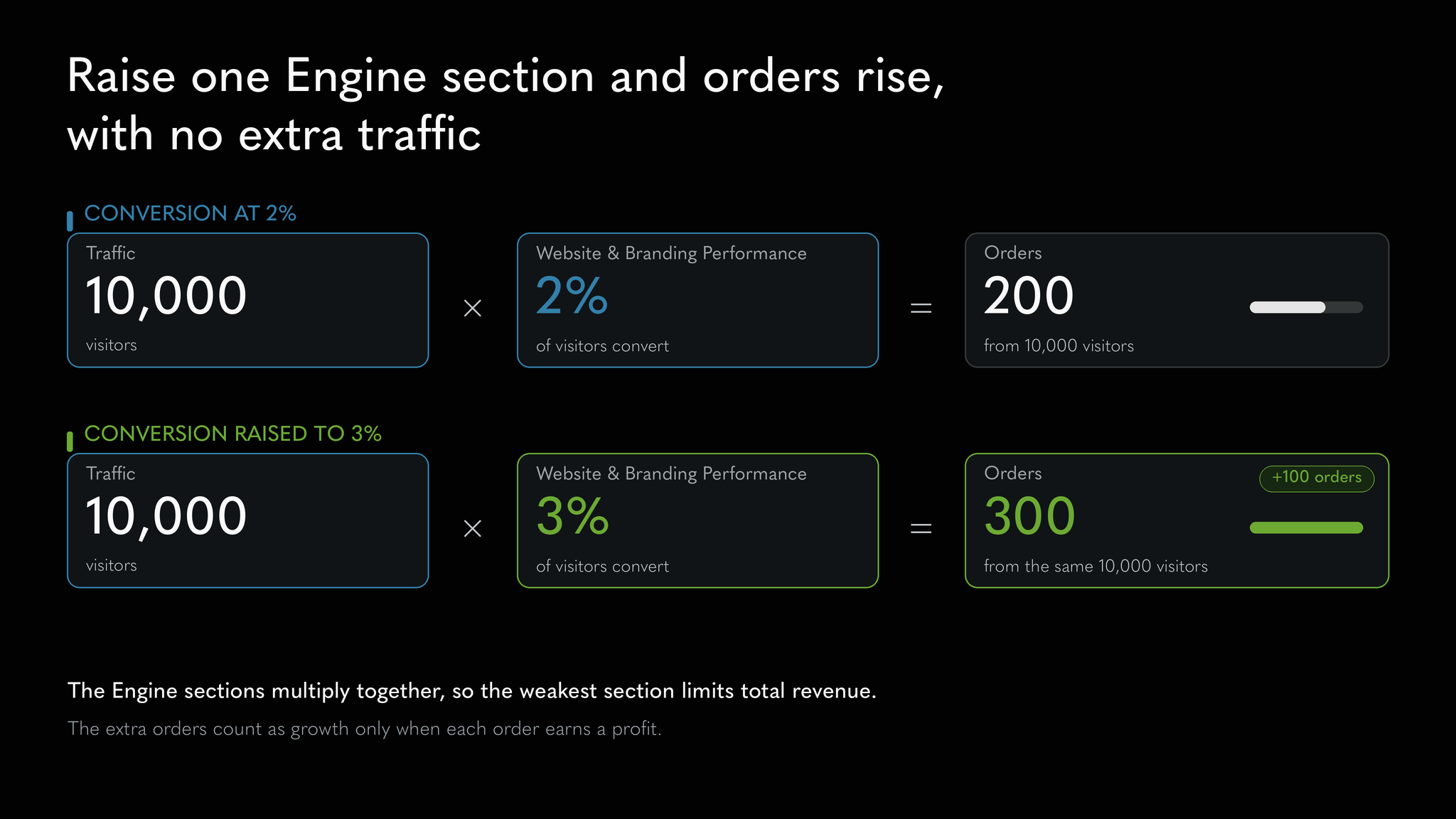
That revenue grows through the three Ecommerce Engine sections: Traffic brings in qualified visitors, Website & Branding Performance turns them into first-time customers, and Customer Retention brings them back for later orders. The three sections multiply together, so the weakest section limits total revenue. For example, 10,000 visitors converting at 2% produce 200 orders, and raising conversion to 3% lifts orders to 300 without extra traffic. Those extra orders count as growth only when each order earns a profit.
What is an ecommerce growth strategy?
An ecommerce growth strategy sets an online business's commercial objectives, chooses focus areas, and balances short-term sales against long-term brand growth. The ecommerce growth strategy sits above every channel plan and decides where to put effort. Channel plans for search, social media, or email then carry out that decision.
The objectives start with a revenue growth target for a defined period. A profit target, measured after marketing costs, keeps that revenue growth worth having. Customer targets then set how many new and returning buyers the plan needs. The objective with the widest gap to target gets priority.
What should an ecommerce growth strategy focus on?
An ecommerce growth strategy should focus on its weakest area among traffic, conversion, and retention, the three sections of the Ecommerce Engine. Each of those three areas has its own commercial role and supporting services:
- Traffic generates qualified visitors and drives ecommerce growth. Search engine optimisation (SEO), Google Ads and Meta Ads feed this section.
- Website & Branding Performance converts visitors into buyers and builds trust. Conversion rate optimisation (CRO), e-commerce branding and landing pages do that work.
- Customer Retention increases repeat purchases through email marketing, automations and retention strategy.
Spending the budget on the two stronger areas first generates less revenue than spending the same budget on the weakest. The other two areas cannot return more than that weakest area allows. For example, extra ad spend cannot fix a store that loses buyers at checkout. Individual ecommerce growth tactics work only when they strengthen that weakest area.
How does an ecommerce growth strategy balance short-term sales and long-term brand growth?
An ecommerce growth strategy balances short-term sales and long-term brand growth by giving brand building a larger share of the marketing budget than sales activation. Sales activation captures buyers already in the market, so its returns appear quickly but shrink once that existing demand is used up.
Brand building reaches people who will buy later, expanding the pool of demand sales activation converts. The exact split depends on the store’s category, growth stage, and existing demand.
| Dimension | Sales activation | Brand building |
|---|---|---|
| Purpose | Converts buyers already in the market | Builds preference for future purchases |
| When the effect appears | During or shortly after the campaign | Over the following months and years |
| Typical channels | Search ads, shopping ads, promotional email | Video, social content, sponsorships |
| How it is measured | Sales, conversion rate, return on ad spend | Brand awareness, branded search, pricing power |
Payback during the campaign period risks overfunding sales activation. Brand building pays back over months and years through future demand and pricing power.
What is the ecommerce growth framework?
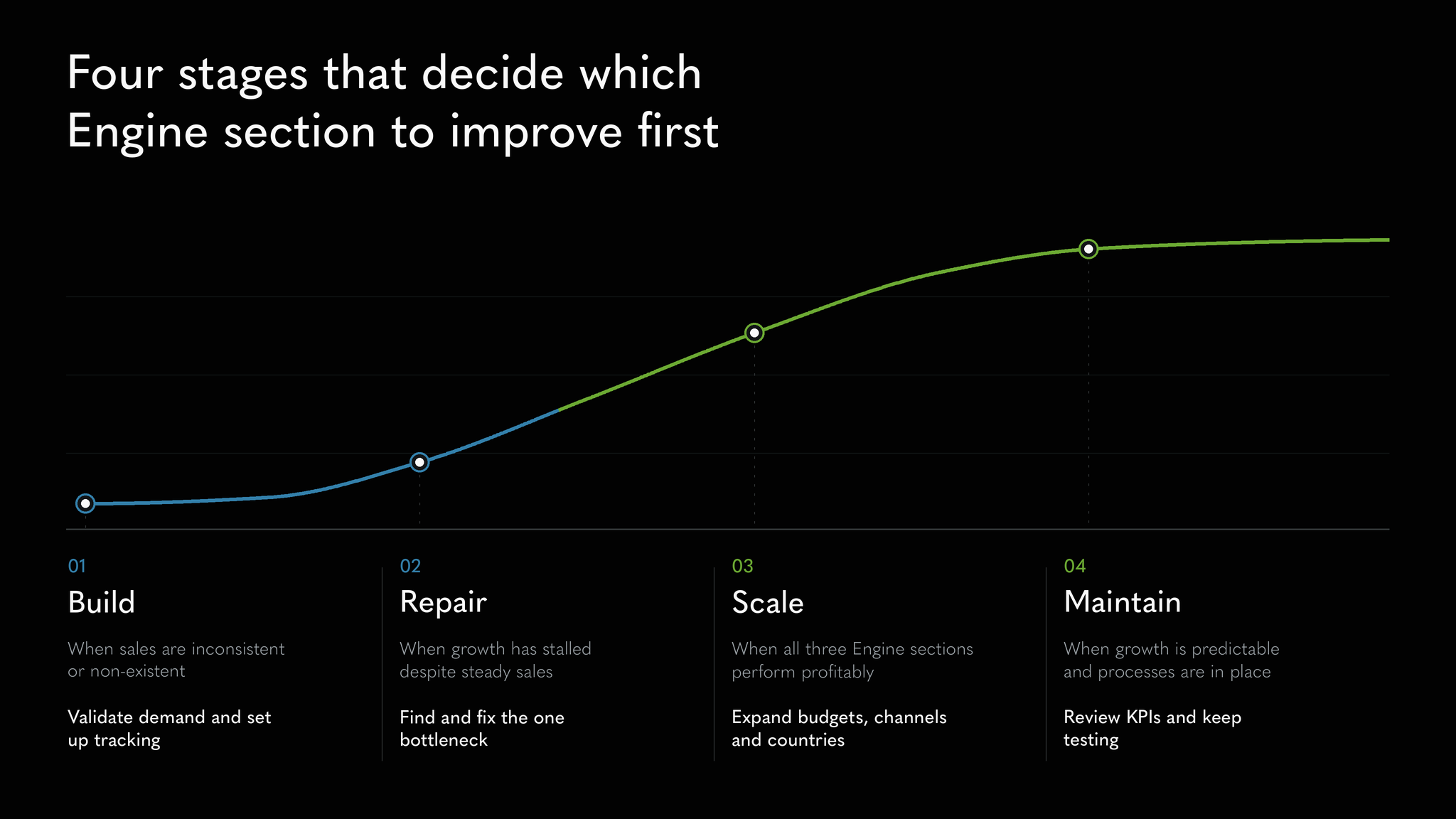
The ecommerce growth framework is a four-stage method, Build, Repair, Scale, and Maintain, that tells a business which Ecommerce Engine section to improve first at its current growth stage. Each stage of the ecommerce growth framework matches a different business situation and priority. Traffic generates qualified visitors and demand for the store. Website & Branding Performance converts those visitors into customers and builds trust. Customer Retention increases repeat purchases and each customer's total value.
The four stages decide which of those three sections needs attention first:
- Build applies when sales are inconsistent or non-existent. The business validates demand and sets up tracking in Google Analytics 4 (GA4). Server-side tracking and a key performance indicator (KPI) dashboard keep that data reliable. Without that data, no later stage can locate a bottleneck.
- Repair applies when ecommerce growth has stalled despite steady sales. A growth audit compares each section's KPIs to find the bottleneck. The bottleneck sits in one place: an unprofitable channel, weak conversion or poor retention. Fixing that one section first boosts returns from the other two.
- Scale applies when all three sections perform profitably. The business expands budgets, adds channels and starts selling in new countries. Stock, fulfilment and customer service capacity must grow at the same pace. Otherwise, extra orders create delivery delays and more returns.
- Maintain applies when growth is predictable, and processes are in place. Regular KPI reviews catch decline early, and testing keeps each section improving. Each test changes one element and measures its effect on revenue.
What are ecommerce growth metrics?
Ecommerce growth metrics measure whether an online business is growing: the growth rate, plus customer metrics such as new customer numbers, repeat purchase rate, and customer lifetime value, each compared month-on-month, over rolling three-month periods, or year-on-year. Each ecommerce growth metric compares performance between two points in time. A single-period KPI, such as last month's revenue, describes only one moment. Growth shows only in the change between periods, so the comparison method matters.
How do you calculate an ecommerce growth rate?
An ecommerce growth rate equals current-period revenue minus previous-period revenue, divided by previous-period revenue and multiplied by 100, for two comparable periods.
Ecommerce growth rate (%) = (Current period revenue − Previous period revenue) ÷ Previous period revenue × 100
For example, revenue rising from £80,000 to £100,000 gives a growth rate of 25%. The result holds only when both periods have the same length. Both periods must also use the same revenue definition, such as revenue after refunds. The previous period needs revenue above zero, because the formula divides by it.
This ecommerce growth formula also works for orders and customer numbers. Comparing growth rates across consecutive periods shows whether growth is speeding up or slowing.
Which customer metrics show whether ecommerce growth will last?
New customer numbers, repeat purchase rate, and customer lifetime value show whether ecommerce growth will last because they separate one-off sales from repeat demand. Repeat purchase rate is the share of customers who order more than once. Customer lifetime value (CLV) is the total revenue one customer brings over the relationship.
| Dimension | New customer revenue | Returning customer revenue |
|---|---|---|
| What it shows | Reach into new demand | Strength of the customer relationship |
| Engine section | Traffic and Website & Branding Performance | Customer Retention |
| Risk when it dominates | Revenue falls when ad spend stops | Revenue plateaus once new customer numbers stop rising |
Growth built only on new customers depends on ever-rising acquisition spend. A rising repeat purchase rate reduces that dependence on paid acquisition.
Which reporting periods give a fair view of ecommerce growth?
Month-on-month, rolling three-month, and year-on-year comparisons each give a fair view of ecommerce growth for a different question, so businesses should read them together. According to the Office for National Statistics (ONS), Great Britain’s retail sales volumes rose 0.5% month-on-month in August 2026. Volumes rose 0.9% in the three months to August against the previous three months. As a result, the same retail data produced two different growth figures.
| Period | Question it answers | Weakness |
|---|---|---|
| Month-on-month | Did growth change last month? | Promotions and one-off events distort single months |
| Rolling three-month | What is the underlying trend? | Reacts slowly to sudden changes |
| Year-on-year | How does growth compare with the same season last year? | Reflects changes up to 12 months old |
Year-on-year comparison removes the seasonal effect of Black Friday and Christmas.
What is the #1 thing holding back your ecommerce revenue?
Get an instant PDF audit powered by The Ecommerce Engine™ methodology, refined through five years of research and development.
What is ecommerce profitability?
Ecommerce profitability is the share of revenue an online business keeps after five costs (product cost, fulfilment and delivery, payment fees, returns and marketing), and it shows whether revenue growth also grows profit and how much marketing spend that growth can fund. Strong ecommerce profitability lets growth fund its own next stage. Contribution is the revenue left after the costs that rise with each order. Extra marketing spend pays off when each new customer's contribution exceeds their acquisition cost. That test applies to the next customer, not the average one. Additional spend reaches buyers who cost more to win than earlier ones. Repeat purchases raise contribution per customer, which raises the affordable acquisition cost.
Why can ecommerce revenue grow without profit growing?
Ecommerce revenue grows without profit when discounts, refunds and rising acquisition costs absorb the margin that extra orders bring in. Heavy discounting raises order volume but cuts the margin on each order. Returns then reverse revenue the store has already counted.
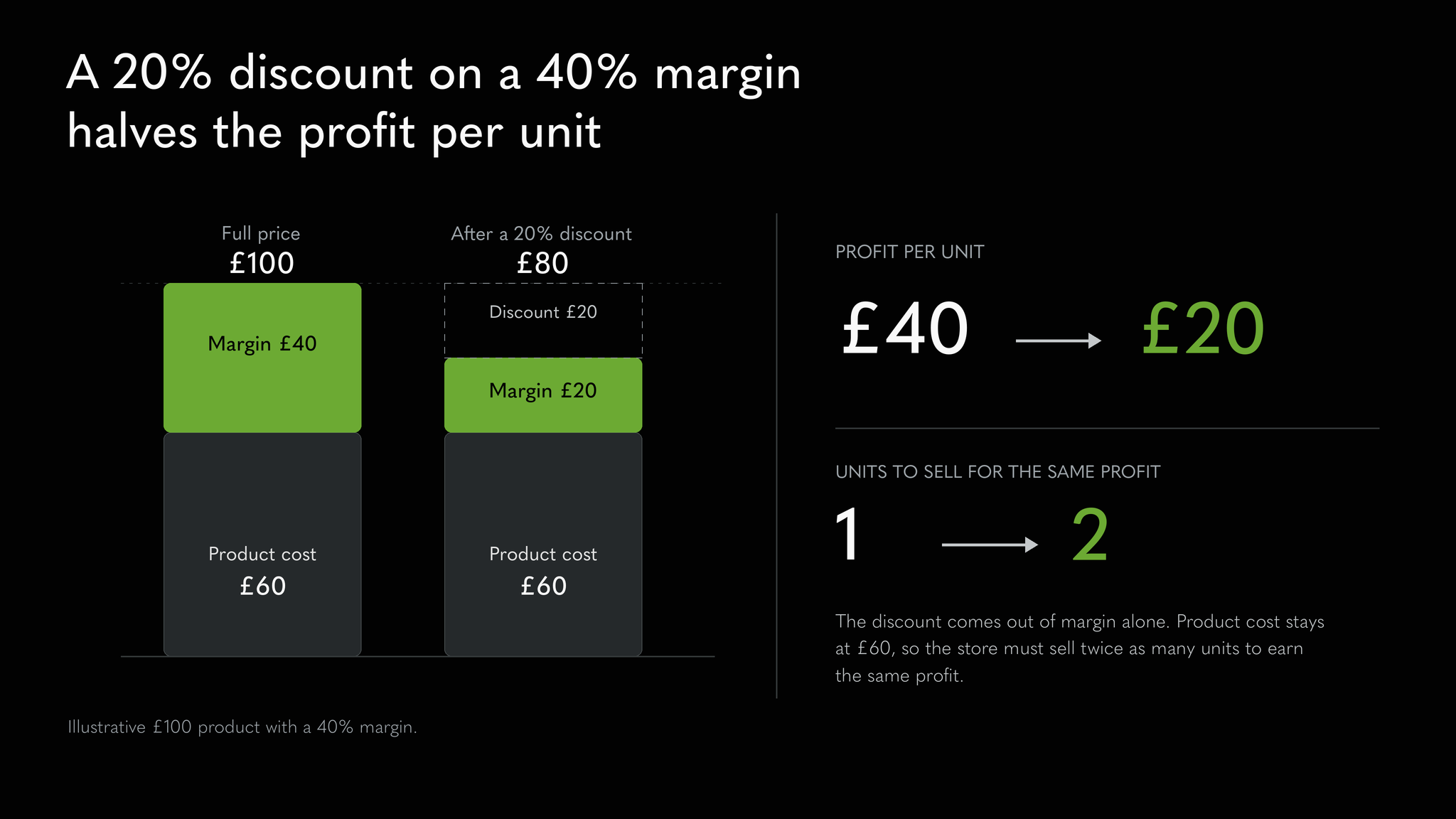
Paid acquisition also costs more per customer as spend increases. Reported revenue therefore rises while the profit from that revenue falls. For example, a 20% discount on a product with 40% margin halves its profit. The store must then sell twice as many units to earn the same profit.
Which costs decide e-commerce profitability?
Five costs decide e-commerce profitability: product cost, fulfilment and delivery, payment fees, returns and marketing.
Each of those five costs takes a share of every sale:
- Product cost is what it costs to buy or make each item. Revenue minus product cost gives the gross margin.
- Fulfilment and delivery cover picking, packing and shipping each customer order.
- Payment fees are the charges a payment provider takes on each transaction.
- Returns add reverse shipping, handling and stock that cannot be resold.
- Marketing is the spend that brings each new customer to the store.
The first four costs rise with every order placed. The remaining revenue must cover marketing and overheads.
What is ecommerce experimentation?
Ecommerce experimentation is the controlled testing of changes to a store’s offers, pricing, landing and product pages, checkout, and personalisation against a control group to prove which changes drive growth. An ecommerce experimentation programme turns growth decisions into tested evidence. A credible causal result must meet three conditions.
Each condition rules out a different false explanation for a change in sales:
- A control group that keeps the old version shows what sales would have been without the change.
- Bias control makes the test and control groups comparable.
- The measured effect must stand clear of random swings in sales.
Which ecommerce growth decisions should experimentation test?
Experimentation should test the ecommerce growth decisions with the largest revenue impact and a measurable outcome: offers and pricing, landing pages, product pages, checkout and personalisation. Each of those five decisions moves a metric the store already tracks:
- Offers and pricing change average order value and margin per order.
- Landing pages change the conversion rate of paid and organic traffic.
- Product pages change the share of visitors who add items to the basket.
- Checkout changes move the share of started checkouts that end in an order.
- Personalisation changes order value and conversion for defined customer segments.
An ecommerce growth experiment roadmap ranks these tests by expected revenue impact.
How does ecommerce experimentation differ from performance monitoring?
Performance monitoring reports changes in ecommerce results, while experimentation proves whether a specific change caused them by comparing them with a control group. Experimentation therefore shows whether a change caused growth that would not have happened anyway.
| Dimension | Performance monitoring | Experimentation |
|---|---|---|
| Question answered | What changed in results? | What caused the change? |
| Method | Tracks metrics over time | Compares a test group with a control group |
| Output | Trends in sales, traffic and conversion | The measured effect of one specific change |
| Decision use | Spots problems and opportunities | Decides whether to roll out a change |
Monitoring alone cannot separate a change's effect from seasonality or promotions. For example, a sales rise after a redesign can come from a bank holiday. A control group exposes that difference, because both groups see the same holiday.
What does an ecommerce growth consultant do?
An ecommerce growth consultant diagnoses what limits an online business's growth and advises on the fixes, the marketing channel mix and the wider growth strategy. Ecommerce consulting provides direction, while the business or its agency carries out the work. Growth diagnosis comes first, whether a solo specialist or a consultancy runs it. The audit covers traffic, conversion, and retention data. The consultant reviews analytics, channel reports and customer purchase records. The audit produces a list of fixes ranked by expected revenue impact. That ranking tells the business which Engine section to fix first.
An e-commerce marketing consultant advises on channel mix, budget split and campaign priorities. The consultant judges each channel independently of its media spend. The output is a channel plan that assigns a budget to each channel. That plan links each channel's budget to its expected return on investment. Ecommerce strategy consulting covers growth targets, channel and market expansion, pricing and investment order. Strategy consulting suits decisions with high costs and long payback periods. Entering a new market and changing business model are two examples.
What does an ecommerce growth agency do?
An ecommerce growth agency plans and runs traffic, conversion, and retention marketing to grow an online business with proven sales, supplying a specialist for each channel, and the business chooses one based on asset quality, brand strategy, channel expertise, and the challenge it brings to the brief.
An ecommerce growth agency works across all three Engine sections, not just one channel. The Obsidian Co.’s 30-Day Performance Growth Method validates one hero product’s landing page and ads before scaling spend.
What services does an ecommerce growth agency provide?
An ecommerce growth agency provides traffic, conversion and retention services, from search engine optimisation (SEO) and paid advertising to conversion rate optimisation (CRO), branding and email marketing. Those services split into three groups because each one moves the KPIs of a single Engine section:
- Traffic: SEO, Google Ads, Meta Ads, social media and content bring in qualified visitors.
- Website & Branding Performance: CRO, e-commerce branding and landing pages turn visitors into buyers.
- Customer Retention: email marketing, automations and retention strategy bring customers back.
Shared reporting across the three groups shows which Engine section currently limits revenue. An agency that runs all three groups can shift budget to the current bottleneck.
When does an ecommerce business need a growth agency?
An ecommerce business needs a growth agency when it generates proven sales but cannot scale predictably because of unresolved growth bottlenecks. Three signals show when a business has reached that point. Growth remains inconsistent despite ongoing marketing investment. Conversion rates or customer retention limit revenue growth. The internal team cannot identify which growth bottlenecks to address first.
Each signal points to weaknesses in Traffic, website and branding performance, or Customer Retention. A growth agency diagnoses these bottlenecks and coordinates improvements across the ecommerce business. A business still validating demand benefits more from building its foundations than scaling unproven sales.
How does an ecommerce growth agency compare with an in-house team?
An ecommerce growth agency gives a business specialist skills across several channels at once, while an in-house team gives it deeper product knowledge and full-time focus on one brand. The main difference is how each team manages growth. An agency can assess Traffic, Website & Branding Performance, and Customer Retention together, identify bottlenecks, and prioritise improvements across the entire ecommerce business.
| Dimension | Ecommerce growth agency | In-house team |
|---|---|---|
| Specialist breadth | Specialists across Traffic, Website & Branding Performance, and Customer Retention | Expertise depends on the employees hired |
| Growth oversight | Reviews the entire Ecommerce Engine to identify bottlenecks | Depends on internal reporting and management responsibilities |
| Strategic priorities | Uses diagnostics to identify and prioritise growth opportunities | Priorities set through internal planning and management |
| Cost structure | Subscription fees based on the agreed service scope | Salaries, benefits, recruitment, and training costs |
| Brand knowledge | Develops through collaboration and ongoing engagement | Built through continuous involvement with one brand |
| Day-to-day control | Responsibilities defined by agreed service scope | Direct management of employees and daily activities |
| Reporting | Performance reviews connect KPIs to bottlenecks and actions | Reporting depends on internal systems and processes |
A hybrid model allows the in-house team to retain ownership of brand strategy and product decisions. The agency manages selected sections of the Ecommerce Engine, such as Traffic or Website & Branding Performance. Monthly diagnostics then assess all three sections, including those managed internally. This keeps specialist execution connected to the business's overall growth priorities.
How should an ecommerce business choose an ecommerce growth agency?
An ecommerce business should choose an ecommerce growth agency on asset quality, strategic brand expertise, specialist channel knowledge and the challenge it brings to the brief. According to the IPA and Tracksuit, Bridging the Gap: Redefining the Value of Agencies (IPA, 2026), a survey of 200 senior brand-side decision-makers rated those four criteria:
- Asset quality: 83% valued excellent quality of asset production, the top-rated service. Ask to see recent ads, landing pages and emails the agency produced.
- Strategic brand expertise: 80% valued strategic brand expertise, the second-ranked service. Ask how the agency would position the brand against its competitors.
- Specialist channel knowledge: 79% valued superior specialist knowledge of key channels. Ask who runs each channel day-to-day and what their experience is.
- Challenge to the brief: 83% rated stretch and growth thinking extremely or very valuable. Only 48% felt they received it, the largest value gap measured. This 83% answers a different question from the asset production figure. Ask for an example where the agency changed a client's plan.
How do the parts of ecommerce growth work together?
The parts of ecommerce growth work together in sequence: the growth strategy sets the targets; the framework and the Ecommerce Engine locate the bottleneck; metrics and profitability judge the results; experimentation proves each fix; and consultants advise on fixes that agencies carry out. That bottleneck then decides where the ecommerce growth strategy spends its budget. A strategy without that diagnosis funds sections that already work. Ecommerce profitability decides how much of that growth the business can fund. Only a fix that beats its control group earns funding at scale.
The Ecommerce Engine ties these parts to one commercial question. The question is which section limits ecommerce growth, and what fixing it returns. Consultants and growth agencies both answer it, but only agencies turn the answer into revenue. The answer changes as a business moves from Build to Maintain.
Try Us Free for 4 Weeks. Up to $5,000 in Agency Fees, On Us.
Four weeks of agency work on us, with no commitment and no obligation to carry on. For ecommerce brands at $50K+ a month and $10K+ in ad spend.
Next month’s intake closes in00days00hours00minutes00seconds

Works on the content half of search: keyword research, page copy, blog articles and the words that turn a store’s visitors into buyers.
Writes about Technical SEO, Structured data, Site architecture