
Ecommerce: Meaning, Market Trends, Growth Drivers, Marketing, Metrics, Business Models and Technology
On this page
- What Is Ecommerce?
- What Drives Ecommerce Growth?
- How Does Ecommerce Marketing Drive Growth?
- How Does Ecommerce SEO Grow Organic Sales?
- When Should Ecommerce Brands Use Google Ads?
- When Should Ecommerce Brands Use Meta Ads?
- How Does Ecommerce CRO Increase Conversion Rates?
- How Does Email Marketing Drive Repeat Ecommerce Sales?
- How Do Ecommerce Brands Improve Customer Retention?
- How Does Content Marketing Support Ecommerce Growth?
- How Does Social Media Drive Ecommerce Sales?
- How Does Branding Affect Ecommerce Conversion?
- How Does Ecommerce Analytics Show What Drives Growth?
- How Is an Ecommerce Business Structured?
- Which Technology Does an Ecommerce Business Need?
- How Do Ecommerce Growth, Marketing, Analytics, Business and Technology Work Together?
Ecommerce is the sale of goods or services through electronic orders, and its growth depends on traffic, conversion and retention working together. According to the Office for National Statistics (ONS) (2026), online sales reached 28.8% of British retail in August 2026. Search engine optimisation (SEO), paid ads, and email drive that growth, while conversion rate, acquisition cost, and lifetime value measure it. Business models, platforms and artificial intelligence (AI) tools shape how stores sell and take orders.
What Is Ecommerce?
Ecommerce is the sale or purchase of goods or services over computer networks, using methods designed to place or receive orders. E-commerce, electronic commerce, and internet commerce all refer to the same activity. A qualifying order arrives through a website, app, marketplace or EDI. EDI (electronic data interchange) lets businesses send orders directly between their own systems. Only the order needs to be electronic, not the payment or delivery. For example, a customer can order online, then pay and collect in store. The same rule applies to goods and services sold to businesses or consumers. A hotel booked through an app counts as e-commerce, unlike a phone booking.
How Big Is the Ecommerce Market?
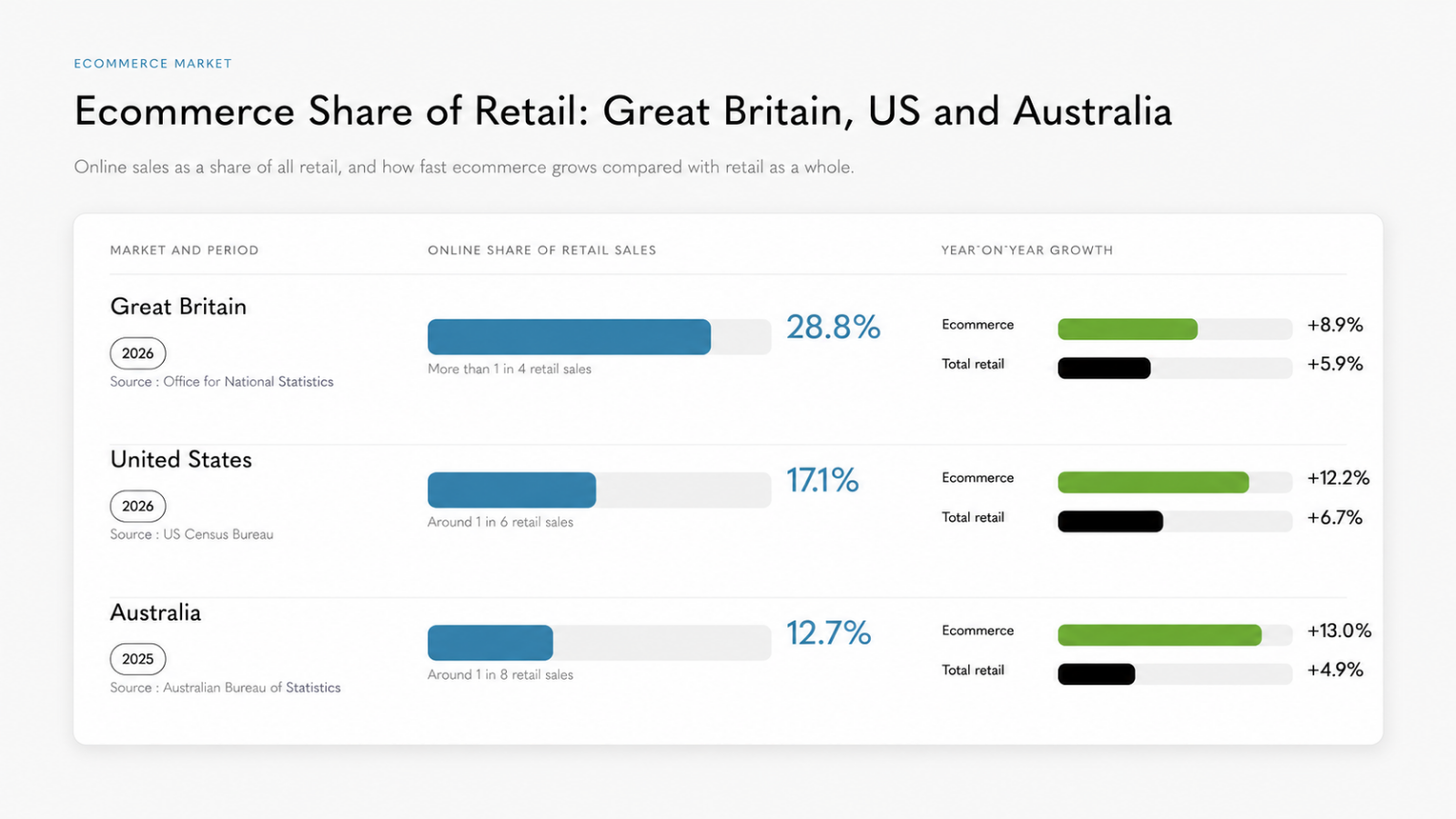
The ecommerce market accounts for more than one in four retail sales in Great Britain, around one in six in the US and one in eight in Australia:
- Great Britain: According to ONS (2026), internet sales reached 28.8% of British retail in August 2026, up from 28.4% in July. Online sales rose 8.9% year on year, against 5.9% for total retail.
- US: According to the US Census Bureau (2026), Q2 2026 e-commerce sales reached $340.2 billion, or 17.1% of retail sales, up from 16.3% a year earlier. Ecommerce grew 12.2% year on year, against 6.7% for total retail.
- Australia: According to the ABS (2025), Australian online sales reached A$4.7 billion in June 2025, or 12.7% of retail turnover, up from 11.6% a year earlier. Online sales rose 13.0% year on year, against 4.9% for total retail.
Which Ecommerce Trends Are Shaping Growth?
Six ecommerce trends are shaping growth: a higher online share, social and commerce media, AI and social ordering, AI search, creator advertising and automated ad buying. The figures behind each trend show where the future of ecommerce is heading:
- Online share: According to ONS (2026), Britain's online share rose from 19.2% (2019) to 27.5% (2025).
- Social and commerce media: According to IAB (2026), US social ads grew 32.6%, outpacing commerce media's 18.0%.
- Ordering: According to OECD Publishing (2025), social shop and AI-placed orders now count as e-commerce. According to Stripe (2025), ChatGPT Instant Checkout began taking US orders in September.
- AI search: According to Pew Research Centre (2025), AI summaries cut clicks on Google results to 8%. Without a summary, users clicked results on 15% of visits.
- Creator advertising: According to IAB (2025), US creator ad spend will grow 26% to $37 billion.
- Automated ad buying: According to Meta (2025), its AI-powered ad tools reached a $60 billion run rate. Product feeds and creative now drive performance because platforms choose the audiences.
What Drives Ecommerce Growth?
Ecommerce growth comes from more qualified traffic, a higher share of visitors converting, and more customers buying again, all while staying profitable. Traffic, conversion and retention must move together, because sales are the product of all three. The growth engine links these three areas, so a bottleneck in any one of them stalls the whole business. Growth also turns unprofitable when acquiring a customer costs more than that customer returns, and a consultant helps when the team cannot find which area is limiting growth.
The weakest of the three areas sets the ceiling for the other two. Spending extra budget on stronger areas raises costs without raising sales because the weakest area still loses additional customers. For example, a store with poor retention keeps paying to replace lost customers. Diagnosis therefore comes before increasing spend. In the retention example, budget moves from acquiring new customers to bringing existing ones back. Each repeat order costs less to win than a first order from a new customer, so the same budget produces more sales.
How Does the Ecommerce Growth Engine Work?
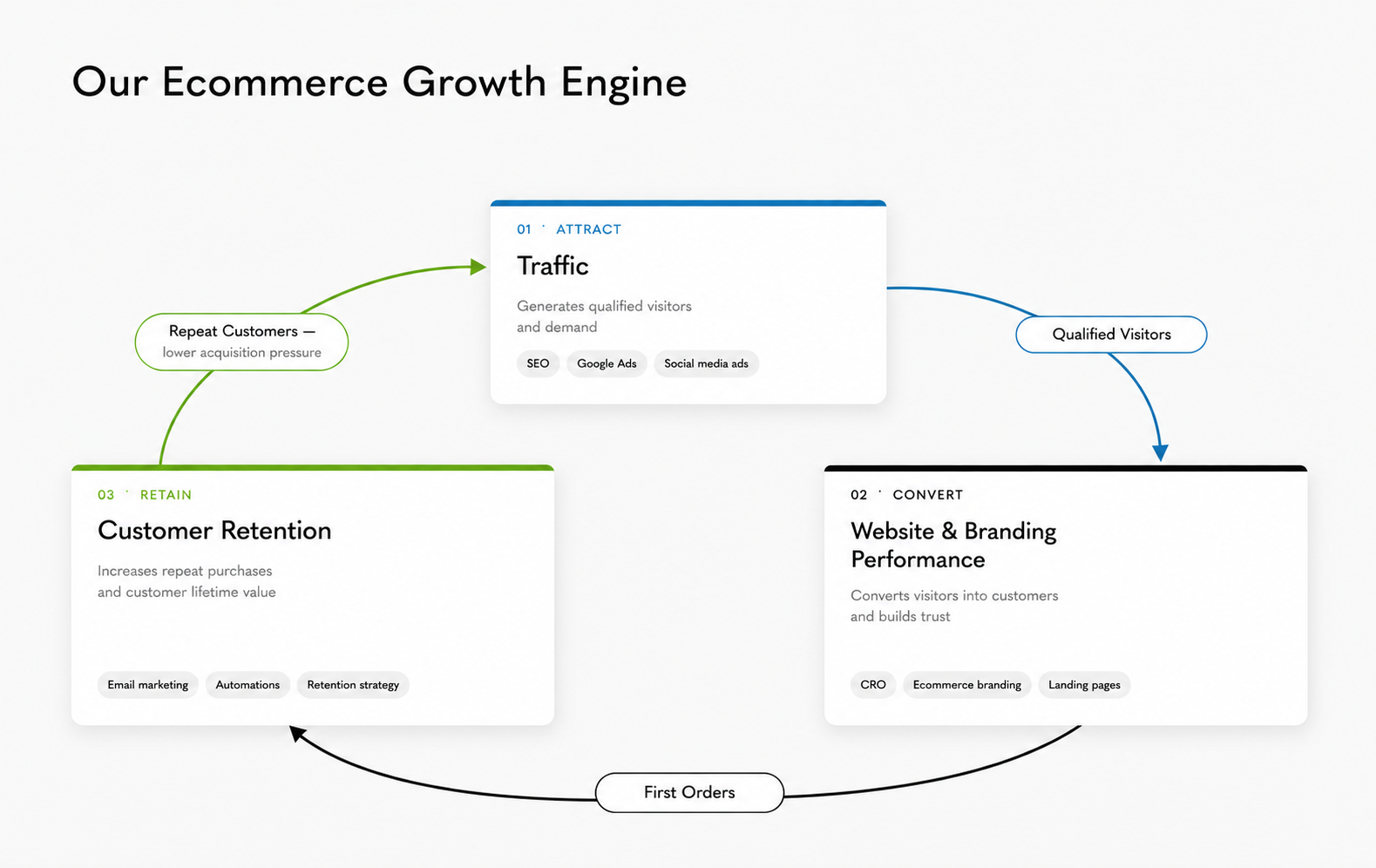
The ecommerce growth engine links three sections, Traffic, Website & Branding Performance and Customer Retention, so each one feeds the next. Each section has one commercial role and its own supporting services:
| Engine section | Role | Supporting services |
|---|---|---|
| Traffic | Generates qualified visitors and demand | SEO, Google Ads, social media advertising |
| Website & Branding Performance | Converts visitors into customers and builds trust | CRO, e-commerce branding, landing pages |
| Customer Retention | Increases repeat purchases and customer lifetime value | Email marketing, automations, retention strategy |
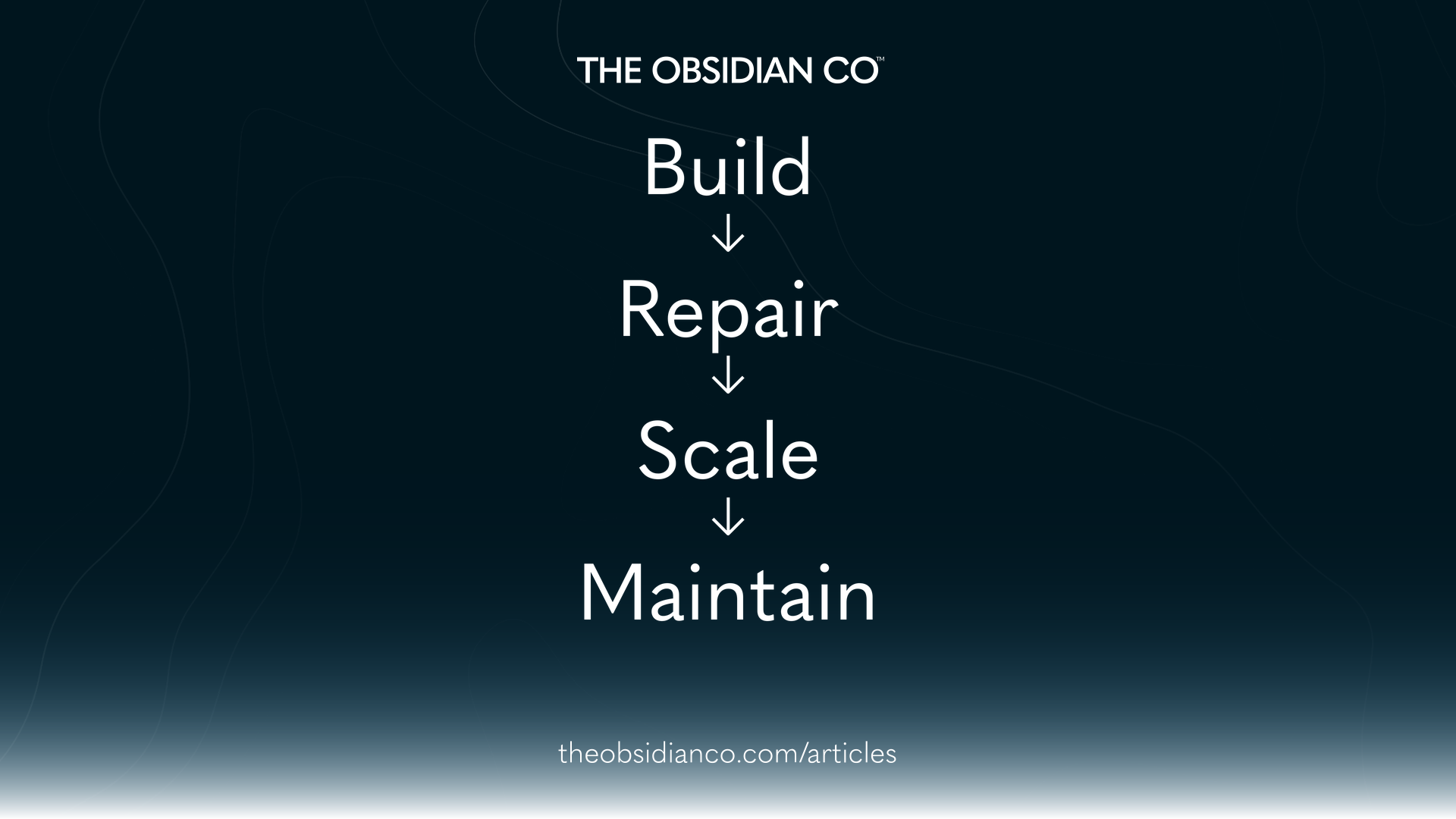
Traffic delivers the visitors that Website & Branding Performance converts into buyers. Customer Retention then turns those first orders into repeat revenue. The Engine also changes priority across four business stages. Build covers businesses with inconsistent sales or no sales yet. Repair covers businesses that make sales but cannot scale them. Scale covers businesses with a working Engine that is ready to expand. Maintain covers businesses with predictable growth that needs protecting.
Why Do Ecommerce Businesses Stop Growing?
Ecommerce businesses stop growing when one Engine section becomes a bottleneck that caps the return of the other two. These growth bottlenecks explain the ecommerce challenges that stall stores already making sales. A growth audit finds the bottleneck by comparing each section’s KPIs side by side. For example, extra paid traffic sent to a weak checkout raises acquisition cost. Sales stay flat because the checkout loses the additional visitors before they buy.
Specialist audits then examine single areas in more detail. An SEO audit checks how search engines crawl, index, and rank the store. A conversion rate optimisation (CRO) audit checks where visitors drop out between the product page and payment. A paid media audit checks which campaigns return more than they cost. Each ecommerce audit shows where performance drops first across the Engine. Fixing the bottleneck improves returns from the other two sections. The same traffic then produces more orders without any extra spend.
When Does Ecommerce Growth Stop Being Profitable?
Ecommerce growth stops being profitable when the cost of acquiring each extra customer exceeds the margin that customer returns over their lifetime. Ecommerce profitability therefore depends as much on customer value as on revenue. Revenue growth and profitable growth answer two different commercial questions:
| Dimension | Revenue growth | Profitable growth |
|---|---|---|
| Purpose | Expands sales volume | Expands sales while protecting margin |
| Underlying data | Orders and revenue | Revenue, costs and customer value |
| Interpretation | Shows rising demand | Shows whether growth creates value |
When Should an Ecommerce Business Hire a Consultant?
An ecommerce business should hire a consultant when growth has stalled, and the team cannot identify which part of the business is limiting it. An ecommerce consultancy brings outside diagnosis to that specific problem. An ecommerce consultant advises on the whole business, from channels to operations. An ecommerce marketing consultant focuses on channels, campaigns and their commercial returns. Ecommerce strategy consulting covers growth planning, priorities and the roadmap that follows.
A consultancy diagnoses problems and sets the order in which to fix them. An agency then implements that work across the relevant marketing channels. The two roles therefore cover different stages of the same growth plan. Teams with in-house marketers can act directly on a consultant's roadmap. Teams without that capacity need an agency to carry out the work.
What is the #1 thing holding back your ecommerce revenue?
Get an instant PDF audit powered by The Ecommerce Engine™ methodology, refined through five years of research and development.
How Does Ecommerce Marketing Drive Growth?
Ecommerce marketing drives growth by bringing qualified buyers to a store, converting more of them and bringing them back to buy again. Ecommerce marketing therefore spans all three sections of the Engine. SEO, Google Ads, Meta Ads, content marketing and social media drive Traffic. CRO and branding serve the Website & Branding Performance section. Email marketing and customer retention work serve the Customer Retention section.
An ecommerce marketing agency runs these nine disciplines against one shared growth target. A single target stops channels competing with each other for credit and budget. The ecommerce marketing strategy then assigns each channel a clear commercial role. Each role connects channel activity to revenue, acquisition cost or retention. Budget then shifts toward the area that currently limits growth. That allocation keeps every channel accountable to the same commercial result.
How Does Ecommerce SEO Grow Organic Sales?
Ecommerce SEO grows organic sales by ranking category and product pages for the searches buyers make before they purchase. The work covers four areas: category pages, product pages, blog posts and technical SEO. Category pages target broad product searches, product pages capture specific ones, and blog posts capture early-stage research searches. Technical SEO makes sure search engines can crawl and index every page. According to Google Search Central (2025), crawlable stores need clear URLs and site structures. Once indexed, pages rank and drive organic traffic at no cost per click. A clear ecommerce SEO strategy therefore lowers the average cost of each visitor.
When Should Ecommerce Brands Use Google Ads?
Ecommerce brands should use Google Ads when buyers are already searching for their products and the brand needs sales faster than SEO can deliver. Google Ads for ecommerce works through three main campaign formats. Search campaigns show text ads against the keywords buyers type. Google Shopping ads display products drawn from a Merchant Centre product feed. Performance Max runs automated campaigns across Google's full advertising inventory. Together, these formats make ecommerce PPC (pay-per-click) a channel for capturing existing demand. PPC traffic, however, stops as soon as you stop spending.
When Should Ecommerce Brands Use Meta Ads?
Ecommerce brands should use Meta Ads when they need to create demand among buyers who are not yet searching for their products. Meta Ads reach chosen audiences across Facebook and Instagram feeds. Google Ads captures existing demand, while Meta Ads create new demand. Facebook ads for ecommerce work by placing relevant products inside everyday browsing. Ad creative decides most of the results in these campaigns. Product video and customer content give buyers a reason to stop scrolling. Stronger creative therefore lowers the cost of each new customer.
How Does Ecommerce CRO Increase Conversion Rates?
Ecommerce CRO increases conversion rates by removing friction that stops visitors from buying, then testing changes that raise sales. Ecommerce conversion rate optimisation works on product pages, landing pages and site search. CRO also improves the cart and checkout, where buyers commit or abandon. Testing confirms which changes raise sales before they reach every visitor. Confirmed changes then lift the conversion rate in the Website & Branding Performance section. A higher conversion rate raises the return on every visitor Traffic delivers. The same advertising budget then produces more orders.
How Does Email Marketing Drive Repeat Ecommerce Sales?
Email marketing drives repeat ecommerce sales by reaching existing customers when they are most likely to buy again. Ecommerce email marketing works through two forms: automated flows and scheduled campaigns. Automated flows send welcome, abandoned cart and post-purchase emails. Each flow triggers when a customer takes, or skips, a specific action. Scheduled campaigns, by contrast, announce launches, offers and seasonal ranges to the full list. The brand owns that list, so each send costs less than paid traffic. That low cost improves the margin on every repeat order.
How Do Ecommerce Brands Improve Customer Retention?
Ecommerce brands improve customer retention by giving existing customers reasons to buy again, through relevant contact, loyalty incentives and reliable service. Ecommerce customer retention depends on all three working together. Ecommerce loyalty programmes reward repeat purchases with points, tiers or perks. Three measures track retention: repeat purchase rate, purchase frequency and churn. Repeat purchase rate shows the share of customers who order again. Churn shows the share of customers who stop buying altogether. Retaining customers increases lifetime value for each relationship. Higher lifetime value lets a business spend more to acquire each customer.
How Does Content Marketing Support Ecommerce Growth?
Content marketing supports ecommerce growth by attracting buyers through search and social, and by answering their questions before they purchase. Ecommerce content marketing uses three main formats to reach those buyers. Buying guides, video and product copy each answer different questions. Buying guides and video help buyers compare options while they decide. Product copy answers final questions on the product page. The same content feeds SEO by earning rankings and links. Clear answers also build trust, which raises conversion.
How Does Social Media Drive Ecommerce Sales?
Social media drives ecommerce sales by putting products in front of buyers through organic posts, content creators, paid social, and in-app shops that take orders directly. TikTok, Instagram and Facebook are the main platforms for all four routes. On those platforms, organic posts reach existing followers, while paid social reaches new audiences. Content creators extend that reach by showing products to their own audiences. In-app shops then shorten the path from product discovery to order. Buyers can complete purchases without ever leaving the social platform. Social media therefore acts as both a Traffic channel and a sales channel.
How Does Branding Affect Ecommerce Conversion?
Branding affects ecommerce conversion because buyers complete purchases faster from stores they recognise and trust. Ecommerce branding builds that recognition through four connected parts. Those parts are the name, visual identity, tone of voice and customer promise. Each part tells buyers what the store sells and why that offer matters. That clarity builds trust within the Engine's Website & Branding Performance section. That trust makes paid traffic cheaper to convert into first orders. The same trust gives existing customers a reason to return.
How Does Ecommerce Analytics Show What Drives Growth?
Ecommerce analytics shows what drives growth by measuring each part of the business against sales, so teams can see what's limiting the rest. Ecommerce analytics and measurement turn store data into decisions about where to act. Three areas matter most: core KPIs, conversion rate, and attribution versus incrementality.
Analytics records outcomes such as orders, revenue and returning customers. Measurement then asks which actions actually caused those outcomes. Observing a rise in sales shows that something in the business changed. Establishing the cause shows which channel or change deserves more investment. Ecommerce diagnostics rely on that distinction to accurately locate growth bottlenecks. Teams that skip it fund the channel claiming credit instead of earning it.
Which Ecommerce KPIs Matter Most?
Six ecommerce KPIs matter most: conversion rate, average order value, customer acquisition cost, customer lifetime value, ROAS and MER. Each of these ecommerce metrics reflects one part of the Engine: Website & Branding Performance: Conversion rate measures the share of visits that end in an order. Website & Branding Performance: Average order value (AOV) measures the average revenue each order brings in. Traffic: Customer acquisition cost (CAC) measures the marketing spend needed to win one new customer. Customer Retention: Customer lifetime value (CLV) measures the total value a customer returns over the relationship. Traffic: ROAS (return on ad spend) measures the revenue each pound of advertising returns. All three sections: MER (marketing efficiency ratio) measures total revenue against total marketing spend. Read together, the six KPIs show which Engine section is limiting growth.
What Does an Ecommerce Conversion Rate Reveal?
An ecommerce conversion rate reveals the share of visits that end in an order, which shows how well the store turns traffic into sales. The rate reflects two inputs: traffic quality and website and branding performance. A falling rate therefore traces back to one or both of those inputs. Diagnosis checks both inputs before the store redesigns a product page.
Ecommerce conversion rates also vary by device, traffic source and product category. Mobile visits, new-audience social traffic and high-value products each convert below the store average. An average ecommerce conversion rate therefore hides those below-average segments. A store compares each segment's rate against the same period a year earlier. That comparison shows whether conversion improved or the segment mix shifted.
How Do Ecommerce Attribution and Incrementality Differ?
Attribution assigns reported sales to marketing interactions, while incrementality estimates the sales a campaign actually caused. Ecommerce attribution shows which touchpoints came before each sale. Incrementality shows how many of those sales the campaign itself created. The two methods answer different questions across four dimensions:
| Dimension | Attribution | Incrementality |
|---|---|---|
| Question answered | Which interactions came before the sale? | Which sales did the campaign cause? |
| Method | Assigns credit by a rule or model | Compares exposed and unexposed groups |
| Output | Reported sales per channel | Incremental sales per campaign |
| Typical use | Day-to-day channel reporting | Budget and channel investment decisions |
How Is an Ecommerce Business Structured?
An ecommerce business is structured around who it sells to, what it sells, where it takes orders and how it fulfils them. Who it sells to sets the transaction model, while what it sells decides whether delivery means parcels, downloads or bookings. Where it takes orders decides which fees, platform rules and customer data come with each sale. How it fulfils orders, whether in-house, through a third-party logistics provider or by dropshipping, decides delivery speed and cost.
Each choice therefore shapes margin, operating cost and the customer experience. Changing one choice usually forces changes to the others, so the four work as one operating model. For example, adding a marketplace channel brings new fees and fulfilment rules alongside new customers. Two structural choices matter most for growth: the transaction model and post-purchase performance.
How Do B2B and B2C Ecommerce Differ?
B2B ecommerce sells to other businesses through larger, repeat orders on negotiated terms, while B2C ecommerce sells to individual consumers through single retail purchases. These types of ecommerce differ in buyer, order size and buying process. Each type reflects a distinct relationship between buyer and seller:
| Type | Seller | Buyer | Typical order |
|---|---|---|---|
| B2B | Business | Business | Large, repeat orders on agreed terms |
| B2C | Business | Consumer | Single retail purchase at a listed price |
| C2C | Consumer | Consumer | One-off sale through a marketplace |
D2C ecommerce is a B2C model in which brands sell directly to consumers. D2C brands sell through their own stores and keep the customer relationship. B2B sellers, by contrast, take repeat orders through EDI and dedicated trade portals. Each model therefore needs its own ordering channel, pricing terms and fulfilment method.
Why Do Post-Purchase Problems Cost Ecommerce Businesses Customers?
Post-purchase problems cost ecommerce businesses customers because a failed delivery or poor experience removes the reason to buy again. Ecommerce operations protect the second order through on-time delivery and a working website. According to Eurostat, 35.4% of EU residents who bought online in the three months before the 2025 survey reported a problem. Slower delivery than indicated affected 19.9% of those buyers. Hard-to-use or faulty seller websites and apps affected 11.5% of those buyers.
The merchant keeps every fulfilment and service obligation after a digital order. Each missed obligation therefore damages the seller's reputation with the affected buyer. Customer Retention suffers first, because a disappointed buyer has no reason to return. Delivery performance therefore belongs in the same diagnosis as marketing performance.
Which Technology Does an Ecommerce Business Need?
An ecommerce business needs technology that displays products, accepts orders, takes payment, records sales and connects to its marketing channels. Every ecommerce technology decision affects at least one Engine section. Three areas matter most: the tech stack, platform choice and AI.
Platform choice varies, but two standards apply to every store. According to the PCI SSC (Payment Card Industry Security Standards Council, 2024), PCI DSS v4.0.1 is the first standard and covers payment-card security. PCI DSS protects card data wherever a store processes, stores, or transmits it. According to the W3C (World Wide Web Consortium), the second standard is WCAG 2.2, covering web accessibility. WCAG 2.2 uses three conformance levels: A, AA and AAA. Meeting those levels helps more buyers complete purchases without assistance.
What Does an Ecommerce Tech Stack Include?
An ecommerce tech stack includes five systems: the storefront, product catalogue, order processing, payment connection and business records. Each system runs on ecommerce software built for one commercial job:
| System | Primary commercial function |
|---|---|
| Storefront | Displays products and takes the electronic order |
| Product catalogue | Holds product data, prices and stock levels |
| Order processing | Routes orders to fulfilment and tracks their status |
| Payment connection | Authorises and settles customer payments |
| Business records | Stores sales, customer and accounting data |
According to OECD, OECD Publishing, 2025, the order-taking storefront defines the e-commerce transaction itself. The other four systems then share each storefront order's stock, payment and customer data. A catalogue stock error therefore lets the storefront sell items fulfilment cannot ship. Real-time integration between the catalogue and storefront prevents that overselling.
How Does Platform Choice Affect Ecommerce Marketing?
Platform choice affects ecommerce marketing because the platform controls URL structure, product data feeds, checkout design and the integrations that marketing channels rely on. Ecommerce platforms fall into two main categories: hosted and open-source. Hosted platforms run on the provider's servers for a monthly fee. Open-source platforms give full control of the code but require in-house development. Both platform types control the URL structure and page speed that rankings use. Beyond search, the platform's product feeds power Google Shopping and Meta catalogue ads. Platform integrations then connect the same store to email marketing and analytics tools. Weak feeds or integrations limit every Traffic channel. Platform choice is therefore as much a marketing decision as a technical one.
How Is AI Changing Ecommerce?
AI is changing ecommerce by personalising product discovery, automating customer service and placing orders on buyers’ behalf. AI in ecommerce now touches all three sections of the Engine. According to the 2025 OECD Definition of E-commerce and Guidelines for Interpretation (OECD Publishing, 2025), orders count as e-commerce when an AI-powered method places them. Chatbots and voice shopping both qualify under that 2025 definition.
Before those AI-placed orders, AI search changes how buyers discover products. AI assistants summarise options and recommend products directly inside the answer. Complete product data and structured data therefore matter more for SEO. Stores with incomplete product data give AI tools less to recommend. That reliance on product data makes AI a technology layer, not a business model.
How Do Ecommerce Growth, Marketing, Analytics, Business and Technology Work Together?
The five areas serve connected purposes: ecommerce growth sets the commercial goal, and the other four deliver it. Ecommerce marketing feeds the growth engine with qualified traffic. Analytics then identifies the growth bottlenecks that limit the return on that traffic. Business structure governs how the business takes and fulfils each order. Ecommerce technology executes every step, from product display to payment. Each area depends on the others, so a weakness anywhere slows ecommerce growth. A growth engine therefore performs only as well as its weakest section. Diagnosing that section first turns ecommerce marketing spend into profitable growth. The same logic applies at every stage, from Build to Maintain.
Try Us Free for 4 Weeks. Up to $5,000 in Agency Fees, On Us.
Four weeks of agency work on us, with no commitment and no obligation to carry on. For ecommerce brands at $50K+ a month and $10K+ in ad spend.
Next month’s intake closes in00days00hours00minutes00seconds

Works on the content half of search: keyword research, page copy, blog articles and the words that turn a store’s visitors into buyers.
Writes about Technical SEO, Structured data, Site architecture
More articles
 GrowthEcommerce Growth: Strategy, Framework, Metrics, Profitability, Experimentation, Consulting and AgenciesAlexander W. · 20 November 2026
 EcommerceEcommerce Marketing: Strategy, SEO, Google Ads, Meta Ads, CRO, Email, Retention, Content, Social Media, Branding and AgenciesAlexander W. · 23 November 2026
 EcommerceEcommerce Analytics and Measurement: Tracking, KPIs, Funnels, Cohorts, Attribution, Incrementality, Segmentation and ForecastingAlexander W. · 23 November 2026