
Growth
Ecommerce Growth Framework: Build, Repair, Scale and Maintain the Ecommerce Growth Engine
On this page
The ecommerce growth framework is a four-stage model, Build, Repair, Scale and Maintain, that tells an ecommerce business which part of its ecommerce growth engine to improve first. The Engine has three sections: Traffic, Website & Branding Performance and Customer Retention.
Each stage matches one business condition, from inconsistent sales to predictable growth. The weakest Engine section limits the return of the other two. Diagnosis therefore comes before any extra marketing spend.
What is the ecommerce growth framework?
The ecommerce growth framework is a four-stage model that matches an ecommerce business's current condition to one priority: build the ecommerce growth engine, repair it, scale it or maintain it. The framework turns ecommerce growth from a spending question into a set of ordered decisions. Each stage describes where the business stands today, based on its own sales evidence. A business sits in exactly one stage at any point in time. That stage decides which Engine section receives the next pound of spend.
Every stage has one business condition, one Engine priority and one completion point:
| Stage | Business condition | Engine priority | Outcome that completes the stage |
|---|---|---|---|
| Build | Sales are inconsistent or non-existent | Validate demand and set up all three Engine sections with measurement | Consistent sales with reliable data |
| Repair | Sales exist, but growth has stalled or become inconsistent | Find and fix the bottleneck section | All three sections perform profitably |
| Scale | All three sections perform profitably | Expand budgets, channels, markets and operational capacity | A larger sales base that stays profitable |
| Maintain | Growth is predictable | Protect performance through key performance indicator (KPI) reviews and testing. | Stable growth at the chosen size |
Stages run in order because each stage depends on the one before it. A business moves back a stage when new evidence shows a section declining.
What is the ecommerce growth engine?
The ecommerce growth engine is the system of three connected sections, Traffic, Website & Branding Performance and Customer Retention, that turns marketing activity into ecommerce growth.
Each Engine section has one commercial role and its own supporting services:
- Traffic generates qualified visitors and demand for the store's products. Search engine optimisation (SEO), Google Ads and social media advertising feed this section.
- Website & Branding Performance converts visitors into customers and builds their trust. Conversion rate optimisation (CRO), e-commerce branding and landing pages serve it.
- Customer Retention increases repeat purchases and customer lifetime value. Email marketing, automations and retention strategy drive this section.
Each section feeds the next, so the three work as one system. Traffic delivers the visitors that Website & Branding Performance converts into first orders. Customer Retention then turns those first orders into repeat revenue.
The weakest section, called the bottleneck, caps the return of the other two. For example, strong Traffic sent to a weak checkout produces visits without orders. Engine health is the combined performance of all three Engine sections. KPIs for each section show that health in numbers.
Which stage of the ecommerce growth framework applies to a business?
The applicable stage is the earliest one the business has not yet met: consistent sales for Build, a profitable Engine for Repair, profitable expansion for Scale, and predictable growth for Maintain.
Those four conditions become four questions, which a business answers in this order:
- Does the store make consistent sales with reliable data on their source? A "no" answer puts the business in Build.
- Does every Engine section perform profitably, with no section limiting the others? A no answer places the business in Repair.
- Does the business have the demand and capacity to grow beyond its size? A yes answer places the business in Scale.
- Has growth become predictable at the business's chosen size? A yes answer places the business in Maintain.
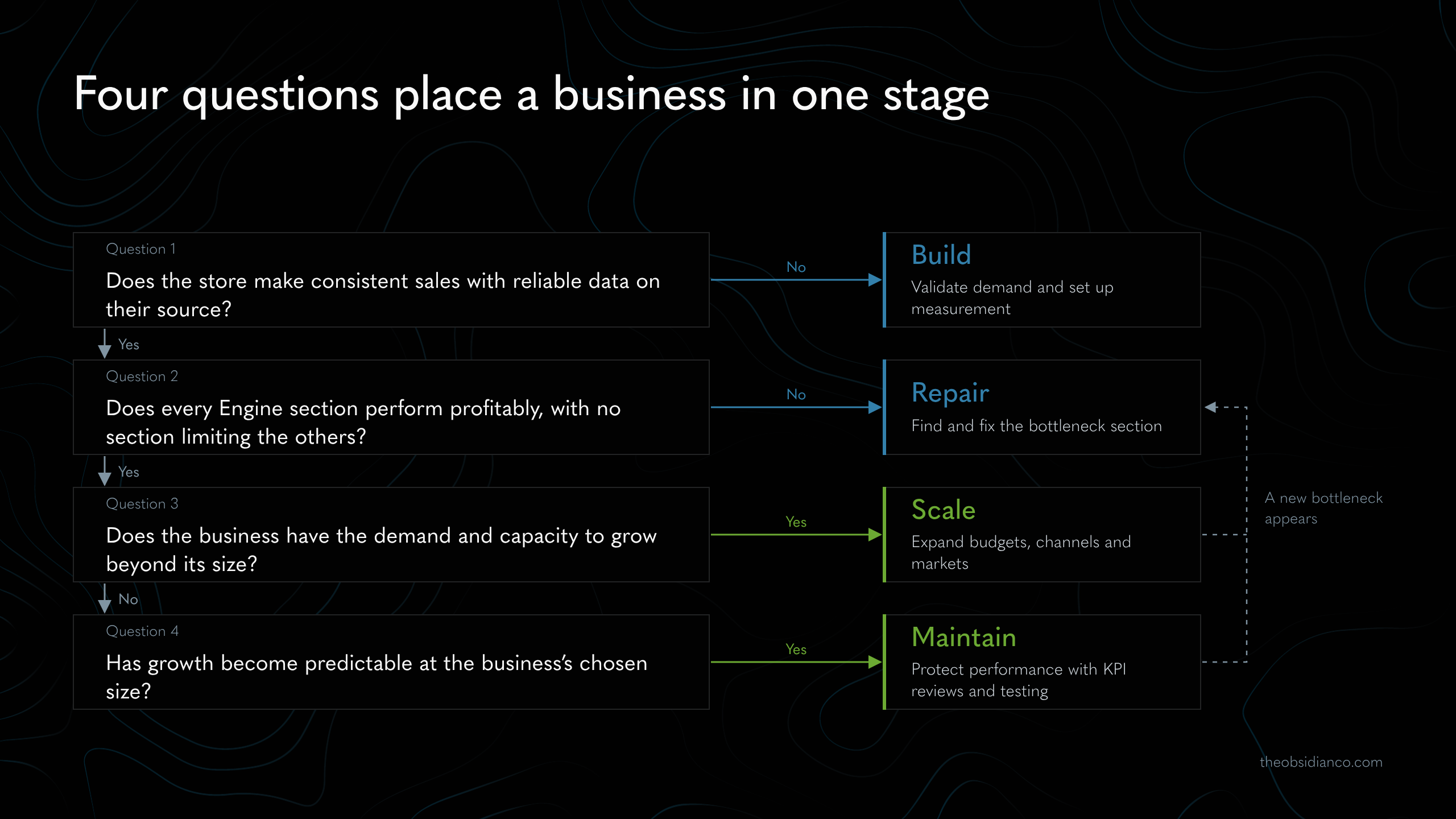
Earlier stages take priority because spend added to an unfinished stage amplifies its weakness. For example, scaling before repair multiplies losses in the bottleneck section. Stage selection also reverses as conditions change over time. Scale and Maintain businesses return to Repair when a new bottleneck appears.
How do you build the ecommerce growth engine?
Building the ecommerce growth engine means validating demand, aligning all three Engine sections to shared commercial objectives, and putting in place measurement the business actually uses. Each step in building the Ecommerce Growth Engine gives each section a commercial role. Traffic proves that buyers respond to the product at a sustainable cost. Website & Branding Performance then turns those first visits into first orders. Customer Retention keeps those first customers coming back.
Measurement completes the Build stage, because each section needs reliable sales data. According to Ron Berman and Ayelet Israeli, The Value of Descriptive Analytics: Evidence from Online Retailers (Marketing Science, INFORMS, 2022), the study tracked more than 1,500 online retailers adopting an analytics dashboard. Average weekly revenue rose 4% to 10% after adoption. The gain appeared only among retailers that actually used the dashboard. The 4% to 10% range describes that study's retailers in their own setting.
When does an ecommerce business need to build its growth engine?
An ecommerce business needs to build its growth engine when sales are inconsistent or nonexistent, and it hasn't yet proven repeatable demand for its products. Three situations place a business in this stage of the framework. A new store sits here until its sales become consistent across comparable months. A store whose sales depend on launches or single promotions also belongs here. The third situation is a store with no data showing which section drives sales.
Each of these businesses belongs in Build rather than Repair. Repair needs a working Engine with a measurable baseline to compare against. None of these three businesses has such a baseline yet. For example, one store's orders arrive only during its paid promotions. Those orders stop as soon as the promotional spend stops. The store has proved that a discount sells, while repeat demand remains unproven. Build therefore starts by proving that buyers return without a promotion.
What separates a built ecommerce growth engine from a set of campaigns?
A built ecommerce growth engine connects Traffic, Website & Branding Performance and Customer Retention to shared commercial objectives. At the same time, a set of campaigns runs each channel against its own separate target. Under shared objectives, the business judges every section by the revenue, profit and new customers it adds to the whole Engine. Individual campaigns can each hit their targets while the business loses money.
The two approaches differ across five dimensions of how growth is managed:
| Dimension | Built ecommerce growth engine | Set of campaigns |
|---|---|---|
| Objective | Shared revenue, profit and customer targets for the whole Engine | Separate channel targets, such as clicks or platform-reported sales |
| Ownership | A named owner for each section and for the Engine overall | Each channel managed in isolation by its own owner |
| Data | One agreed source of sales data used for decisions | Separate platform reports that each claim the same sales |
| Customer journey | First orders feed Customer Retention for repeat purchases | Acquisition ends at the first purchase |
| Spend decisions | Based on Engine health across all three sections | Based on each platform's reported return |
Consistent sales and shared reporting across all three sections mark a built Engine. The business then moves to Repair or Scale, depending on section profitability.
What is the #1 thing holding back your ecommerce revenue?
Get an instant PDF audit powered by The Ecommerce Engine™ methodology, refined through five years of research and development.
How do you repair the ecommerce growth engine?
Repairing the ecommerce growth engine means finding the one Engine section that limits the other two, fixing that bottleneck before adding spend, and confirming that performance has recovered. Work to Repair the Ecommerce Growth Engine targets one section at a time. The bottleneck sits in one of the three Engine sections. Traffic bottlenecks show up as channels that cost more than they return—visitors who leave without buying point to Website & Branding Performance instead. Customer Retention is the bottleneck when first-time buyers never order again.
A growth audit locates the bottleneck by comparing each section's KPIs side by side. Fixing the bottleneck raises the return on spend in the two healthy sections. Repair ends when that section's KPIs return to the business's own baseline. The baseline must cover comparable periods, such as the same months last year.
What are the signs that an ecommerce growth engine needs repair?
An ecommerce growth engine needs repair when the store makes sales, but growth stalls, becomes inconsistent, or stops responding to extra marketing spend.
A stall of that kind shows up in four measurable signs:
- Revenue stays flat across comparable periods while marketing spend holds or rises.
- Revenue rises while profit after marketing costs falls each period.
- The cost of acquiring each new customer rises while order volume holds.
- Growth depends on new customers while repeat purchases decline each period.
Each sign points to one Engine section worth investigating first.—flat revenue despite rising spend points to visitors who leave without buying. Profit falling as revenue rises traces back to channels costing more than they return. For example, rising acquisition costs point to the Traffic section first. Declining repeat purchases direct attention to the Customer Retention section. A sign points to where to look, while diagnosis confirms the cause. The business confirms the cause before changing any channel or budget.
Why does repair come before scaling the ecommerce growth engine?
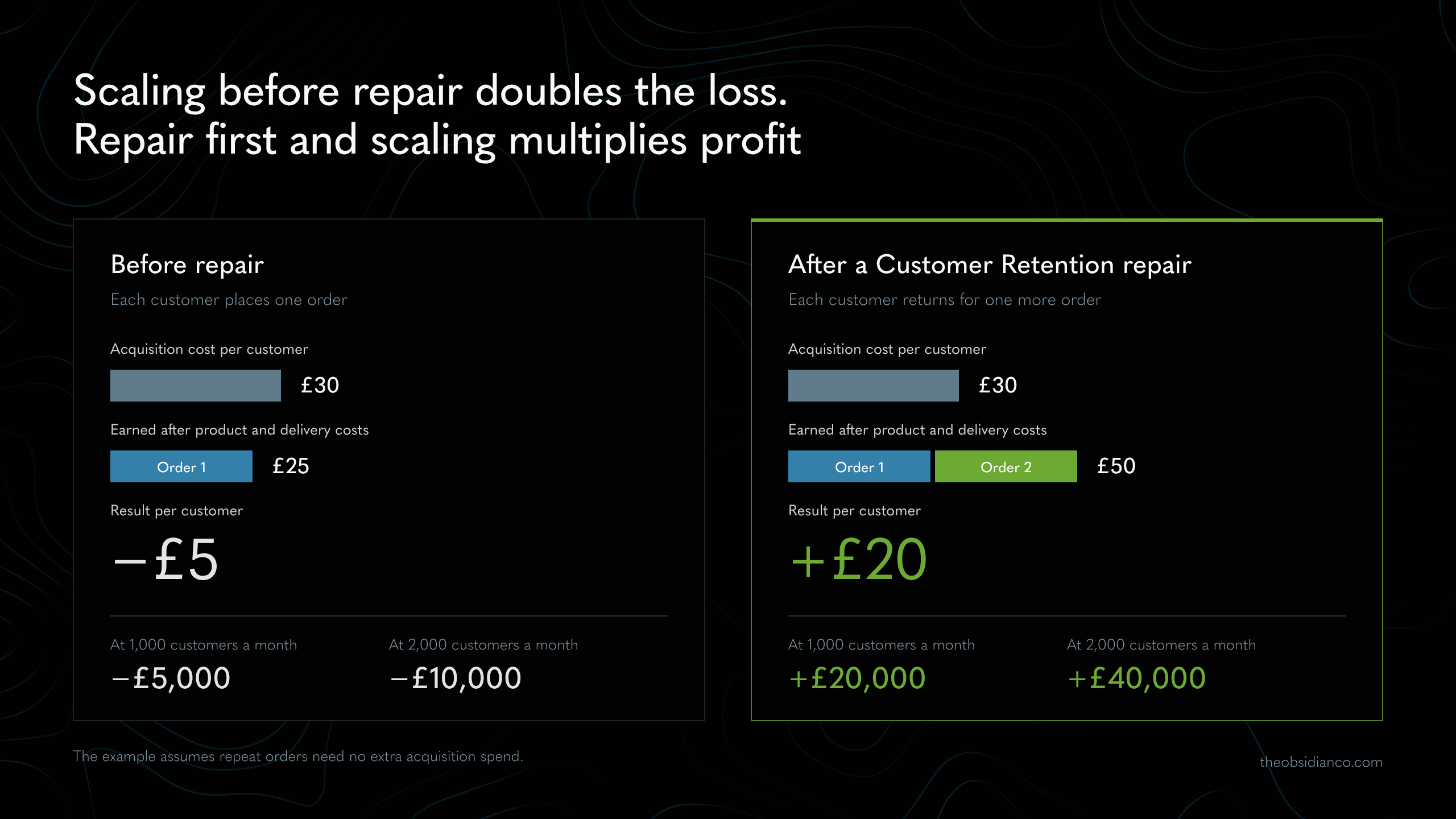
Repair comes before scaling because extra spend sent through a bottleneck raises costs faster than sales, so scaling an unrepaired engine multiplies its losses. For example, a store pays £30 to acquire each new customer. Each customer places one order that earns £25 after product and delivery costs. The store therefore loses £5 on every customer it acquires. Doubling acquisition spend doubles the number of loss-making customers. At 1,000 customers a month, the monthly loss grows from £5,000 to £10,000.
A Customer Retention repair changes that result at the same acquisition cost. Each customer now returns for one more order worth £25. Two orders earn £50 against the £30 acquisition cost. Each customer now generates £20 of profit instead of a £5 loss. The example assumes repeat orders require no extra acquisition spend. At that point, scaling multiplies profit because each new customer adds £20.
How do you scale the ecommerce growth engine?
Scaling the ecommerce growth engine means expanding an Engine that already performs profitably across all three sections by increasing budgets, adding new channels and markets, and building greater operational capacity. Each move to scale the Ecommerce Growth Engine adds volume to a proven Engine. Larger budgets buy more reach in channels that already return a profit. New channels add audiences the current channels haven't reached yet. New markets extend the same Engine to buyers in other countries. Greater operational capacity lets the business serve those extra orders on time.
Each route must first prove profitability in the Repair stage. Stock, fulfilment and customer service capacity must grow at the same pace as demand. Otherwise, extra orders create delivery delays and higher return rates. Those delays then damage Customer Retention, the section that protects repeat revenue.
When is an ecommerce growth engine ready to scale?
An ecommerce growth engine is ready to scale when all three sections perform profitably, extra spend still produces incremental sales, and the business has the stock, cash and fulfilment capacity to serve more orders. Incremental sales are sales that would not happen without the extra marketing. Extra spend without incremental sales pays for orders that would arrive anyway.
Profitability across all three sections confirms that the Engine has no bottleneck. Incremental sales then prove that demand remains beyond the store's current buyers. The capacity check covers stock, cash and fulfilment before any spend increases. Cash matters because the business pays for stock and advertising before customers pay. Fulfilment capacity sets how many orders the business can ship each day. Revenue growth alone misses both the profit and capacity conditions.
A failed profitability condition returns the business to the Repair stage. A failed demand or capacity condition delays scaling until the business meets it. For example, a store short of stock waits until supply matches forecast demand.
How does scaling the ecommerce growth engine differ from increasing ad spend?
Scaling expands every section of the ecommerce growth engine in step, while increasing ad spend raises only the Traffic budget and leaves the other two sections unchanged. Businesses raising ad spend judge results by return on ad spend (ROAS). ROAS counts only platform-credited revenue, missing the Engine-wide profit that scaling measures. Measurement is one of five dimensions where the two choices differ:
| Dimension | Scaling the ecommerce growth engine | Increasing ad spend |
|---|---|---|
| What grows | Traffic, conversion capacity, retention and operations together | The Traffic budget only |
| Success measure | Profit across the whole Engine | Platform-reported ROAS for each channel |
| Effect on other sections | Each section expands to handle more customers | Website & Branding Performance and Customer Retention stay unchanged |
| Operational capacity | Stock and fulfilment grow with demand | Capacity stays fixed while orders rise |
| Main risk | Expansion costs run ahead of proven demand | Cost per order rises as each extra pound returns less |
How do you maintain the ecommerce growth engine?
Maintaining the ecommerce growth engine means protecting predictable growth through regular KPI reviews across all three sections, continuous testing, and early action when a section starts to decline. Each task to maintain the Ecommerce Growth Engine protects one source of predictable growth. KPI reviews compare like-for-like periods, such as year-on-year results for each section. Year-on-year comparison stops a Christmas peak from looking like lasting growth. Those accurate comparisons then let continuous testing improve each section at its current size. Early action then stops any decline those tests reveal from becoming a new bottleneck.
Stopping that decline requires a named owner responsible for each section's KPIs. That owner reviews the section's figures and acts when the figures fall below baseline. Sections without an owner decline unnoticed until the drop reaches total revenue. Owners, not extra budget, prevent those declines, so maintenance spend stays near current levels.
How does maintaining the ecommerce growth engine differ from scaling it?
Maintaining protects the ecommerce growth engine's current performance, while scaling expands that performance to a larger size. Both stages start from an Engine that already performs profitably in all three sections. The two stages differ across five dimensions of purpose and measurement:
| Dimension | Maintain | Scale |
|---|---|---|
| Goal | Protect current performance at the chosen size | Expand performance to a larger size |
| Business condition | Growth is predictable at the current size | All three sections perform profitably with spare demand |
| Main question | Is each section holding its own baseline? | Can the Engine grow without losing profit? |
| Change in spend | Spend stays close to current levels, with tests funded from the existing budget | Spend rises across budgets, channels or markets |
| Success measure | Stable KPIs across comparable periods | Profit per order holds as sales volume rises across the Engine |
Each scaling step returns to Maintain once performance at the new size becomes predictable.
When should a maintained ecommerce growth engine return to repair?
A maintained e-commerce growth engine should return to repair when one section underperforms its baseline in comparable periods, with no known seasonal or one-off cause.
The trigger separates lasting underperformance from normal variation across four dimensions:
| Dimension | Normal variation | Repair trigger |
|---|---|---|
| Duration | A single week or one reporting period | Repeated across comparable periods |
| Scope | One metric moves on its own | A section's KPIs move down together |
| Cause | A known seasonal or one-off event | No known seasonal or one-off cause |
| Response | Keep monitoring the section | Move the business to Repair |
Underperformance with no known cause can stem from market changes that invalidate earlier decisions. New competitors, changing customer behaviour and advertising platform changes are three such market changes.
No fixed number of days or percentage suits every store facing those changes. Each business therefore sets its own tolerance from its objectives and trading history. Setting that tolerance in advance prevents one slow trading week from triggering repair.
How does the ecommerce growth framework guide ecommerce growth decisions?
The ecommerce growth framework guides ecommerce growth decisions by matching each business to the earliest stage it hasn't completed, so investment goes to the Engine section limiting growth. Build creates the ecommerce growth engine from consistent sales and reliable data. Repair removes the bottleneck that caps returns from the other two sections. Scale expands profitable performance once every Engine section can carry more volume. Maintain protects that performance and returns the business to Repair when a section declines.
The ecommerce growth framework therefore turns growth into a sequence of priorities. Each priority directs spend to the Engine section with the lowest return. Diagnosis comes first at every stage, because the bottleneck sets the limit. Ecommerce growth then compounds across the whole Engine, not through spend alone.
Try Us Free for 4 Weeks. Up to $5,000 in Agency Fees, On Us.
Four weeks of agency work on us, with no commitment and no obligation to carry on. For ecommerce brands at $50K+ a month and $10K+ in ad spend.
Next month’s intake closes in00days00hours00minutes00seconds

Works on the content half of search: keyword research, page copy, blog articles and the words that turn a store’s visitors into buyers.
Writes about Technical SEO, Structured data, Site architecture
More articles
 GrowthEcommerce Growth: Strategy, Framework, Metrics, Profitability, Experimentation, Consulting and AgenciesAlexander W. · 20 November 2026
 GrowthEcommerce Consulting: Consultancy Services, Ecommerce Consultants, Marketing Consultants and Strategy ConsultingAlexander W. · 23 November 2026
 EcommerceEcommerce Marketing: Strategy, SEO, Google Ads, Meta Ads, CRO, Email, Retention, Content, Social Media, Branding and AgenciesAlexander W. · 23 November 2026