
Growth
Ecommerce Consulting: Consultancy Services, Ecommerce Consultants, Marketing Consultants and Strategy Consulting
On this page
Ecommerce consulting diagnoses what limits an ecommerce business’s growth and recommends what to change, through three advisory functions: an ecommerce consultant’s business assessment, an ecommerce marketing consultant’s channel assessment and ecommerce strategy consulting’s commercial direction.
All three functions read the same evidence from the Ecommerce Engine. The Engine’s sections are Traffic, Website & Branding Performance and Customer Retention. Each function turns that evidence into recommendations ranked by expected return. Platform consulting, by contrast, advises on the technology that runs the store.
What is ecommerce consulting?
Ecommerce consulting is advisory work that examines an online store’s commercial evidence, identifies what limits its growth, and recommends changes most likely to increase revenue and profit. Consulting turns ecommerce growth into specific decisions that a business can act on. Those decisions draw on an online store’s sales and customer data. The advice covers acquisition, conversion and retention, because all three shape revenue.
Three advisory functions divide the work, and each one answers a different question:
| Consulting function | Question it answers | What the business receives |
|---|---|---|
| Ecommerce consultant | What is holding back the business’s growth? | Findings and recommended changes from a business-wide assessment |
| Ecommerce marketing consultant | Which marketing channels earn their budget? | Advice on channel mix, budget split and campaign priorities |
| Ecommerce strategy consulting | Where should the business compete and invest next? | Growth targets, market choices and an investment order |
What do ecommerce consultancy services assess?
Ecommerce consultancy services assess the three sections of the Ecommerce Engine, Traffic, Website & Branding Performance and Customer Retention, against the business’s revenue, profit and customer results.
Each Engine section receives its own assessment, measured against those same commercial results:
- Traffic: The assessment measures the qualified demand that each acquisition channel creates. Those channels include search engine optimisation (SEO), Google Ads, Meta Ads and social media. The assessment then weighs each channel’s demand against that channel’s cost.
- Website & Branding Performance: The assessment measures how many visitors become paying customers. The review also checks whether the brand and landing pages earn buyers’ trust.
- Customer Retention: The assessment measures how often existing customers return to buy again. The review also tracks the repeat revenue generated by email and retention activities.
How does ecommerce growth consulting differ from ecommerce platform consulting?
Ecommerce growth consulting advises on an existing store's marketing and commercial performance. In contrast, ecommerce platform consulting advises on the technology that runs the store, such as platform choice, replatforming and development. Growth consulting therefore changes how the store wins and keeps customers, while platform consulting changes the system those customers buy through.
The two types of consulting differ across five practical dimensions:
| Dimension | Ecommerce growth consulting | Ecommerce platform consulting |
|---|---|---|
| Question it answers | Why are sales or profit not growing? | Which technology should the store run on? |
| Evidence reviewed | Sales, channel and customer data | Systems, integrations and site performance |
| Typical specialists | Marketing and commercial advisers | Platform specialists, for example Shopify or Magento consultants |
| Output | Growth recommendations ranked by revenue and profit | A technology plan or a migration plan |
| When a business needs it | Sales or profit have stalled on a working store | The current platform blocks a feature, integration or speed target |
Growth consulting therefore suits a store whose platform works but whose sales have stalled. Platform consulting suits a store whose technology blocks a feature, integration or speed target. A planned replatform still needs growth evidence, since customers and channels carry over.
What is the #1 thing holding back your ecommerce revenue?
Get an instant PDF audit powered by The Ecommerce Engine™ methodology, refined through five years of research and development.
What does an e-commerce consultant do?
An e-commerce consultant reviews a business’s financial and performance evidence, turns it into findings and recommended management changes. An e-commerce consultant examines the whole business, from marketing channels to margins. The consultant works outside the business’s day-to-day operations. The outside position lets the consultant compare every channel on equal terms. Management, however, owns every decision that the consultant’s evidence supports. Each recommendation therefore needs evidence that a manager can check before approving it.
Which evidence does an e-commerce consultant review?
An e-commerce consultant reviews financial records such as revenue and expenditure, the store’s channel and customer data, and explanations from the people who run the business. In e-commerce, that financial data sits alongside website analytics and customer purchase records. Channel reports from Google Ads and Meta Ads add each platform’s own results.
Evidence quality decides how far management can trust a recommendation. The consultant therefore checks that every source describes the same orders and periods. For example, ad platforms can report more sales than the store’s order records show. Each platform credits itself for sales that another channel also claims. The store’s own order records therefore settle how many orders actually happened.
What does an ecommerce consultant deliver?
An ecommerce consultant delivers findings, recommended changes, and the evidence behind each in a written report or management presentation. Consultants then confer with managers to check that approved changes are working.
A useful recommendation names both a decision and a problem. For example, “conversion is low” names a problem but offers no next step. “Visitors abandon at delivery costs; test a free-delivery threshold” gives management a decision. The second version states the cause, the evidence and the change to test. Each finding states its evidence so that managers can test the reasoning themselves. A report that ranks changes by expected profit shows management where to start.
When should an ecommerce business hire an ecommerce consultant?
An ecommerce business should hire an ecommerce consultant when leadership needs an outside assessment of a defined growth question, such as stalled revenue or rising acquisition costs. A defined question gives the consultant a clear scope of work. A plan to act gives the findings a route into the business.
Without that route, the report records problems that nobody then fixes. Leadership therefore confirms both conditions before inviting consultants to bid for the work. The organisation then selects the proposal that suits its needs and budget.
The chosen proposal targets a growth question that differs for new and established stores. For example, a new store checks that its first channels sell at a profit. An established store, by contrast, asks why growth has slowed after earlier gains.
What does an ecommerce marketing consultant do?
An ecommerce marketing consultant assesses how each marketing channel contributes to sales and profit, covering SEO and paid advertising, conversion and branding, and email and customer retention, then advises on channel mix, budget split and campaign priorities. Every ecommerce marketing consultant judges channels by the profit they return. SEO and paid advertising sit in Traffic, the Engine’s demand section. Conversion and branding sit in Website & Branding Performance. Email belongs to Customer Retention, the section that drives repeat purchases.
How does an ecommerce marketing consultant assess SEO and PPC?
An ecommerce marketing consultant assesses SEO by the organic visibility and traffic it builds over time, and pay-per-click (PPC) advertising by the profit and new customers each paid click returns. The two channels need different measures because they reach buyers differently. PPC on Google Ads and Meta Ads buys visits that stop when spending stops. SEO instead earns unpaid rankings that keep bringing visitors without paid clicks.
The consultant therefore tracks SEO through keyword rankings, non-brand organic traffic and organic conversions. Rankings and traffic move first, because sales follow months later. Organic visits also support purchases customers complete later through other channels.
PPC, by contrast, is judged on the profit each pound of spend returns. Return on ad spend (ROAS) compares advertising revenue with ad costs. Platforms report ROAS by their own rules, so the consultant verifies it against store orders. Store orders also show that campaigns often win back existing buyers more than they attract new ones.
How does an ecommerce marketing consultant assess conversion and branding?
An ecommerce marketing consultant assesses conversion by the share of visits that end in an order and assesses branding by how clearly the store sets its products apart from competitors. Conversion rate is orders divided by visits over the same period. Conversion rate optimisation (CRO) is the work of raising that rate. For example, 600 orders from 40,000 visits give a conversion rate of 1.5%. That definition must remain consistent across reports to keep the figures comparable. Orders per visit and orders per visitor yield different rates for a single store.
A clear brand distinction gives visitors a reason to buy from one particular store. If a visitor sees no difference, they compare stores on price alone. Price-only buying lowers margin even when the conversion rate holds steady. The consultant therefore checks whether product pages clearly state that difference.
How does an ecommerce marketing consultant assess email and customer retention?
An ecommerce marketing consultant assesses email and customer retention by how often customers buy again and by the future value of the existing customer base, measured in orders and margin. Customer lifetime value (CLV) therefore measures future value rather than past spending.
Retention changes how much a business can afford to pay per customer. A customer who buys three times repays acquisition cost from three margins. A one-order customer repays that same cost from a single margin. Higher CLV therefore lets a store spend more to win each new customer.
What does ecommerce strategy consulting decide?
Ecommerce strategy consulting decides a business’s commercial direction: which customers to target, how its offer competes, which growth targets to set and in which order to invest. Ecommerce strategy consulting suits high-cost choices with long payback periods. Examples include entering a new market, changing prices or shifting channel budgets. A wrong choice at that scale costs more than one failed campaign.
Each advisory function answers a different part of the growth question. The ecommerce consultant finds what limits growth across the whole business. The marketing consultant judges whether each channel earns its budget. Strategy consulting then chooses where the business goes next. That order matters because setting direction on flawed evidence repeats the original problem.
How does ecommerce strategy consulting set growth targets and investment order?
Ecommerce strategy consulting sets measurable growth targets with time frames, ties the marketing budget to those targets, and ranks each investment by expected return. As a result, the business funds its highest-value move first. Spending stays limited to activities that contribute to those targets. The business also removes activities that results show were ineffective.
Comparing each activity’s marketing and sales costs with its revenue shows its return on investment (ROI). The business also updates its marketing plan at least once a year.
Investment order then ranks each move by expected return and payback time. A cheaper move with a fast, measurable return comes first. An expensive move goes first only when evidence shows a higher return. Measurable targets then show whether each investment delivered its expected return.
Which ecommerce consulting service fits a growth problem?
The right ecommerce consulting service depends on the question the business needs answered: an ecommerce consultant for what is holding growth back, an ecommerce marketing consultant for which channels earn their budget, and ecommerce strategy consulting for where to compete and invest next. All three functions read the same Ecommerce Engine evidence.
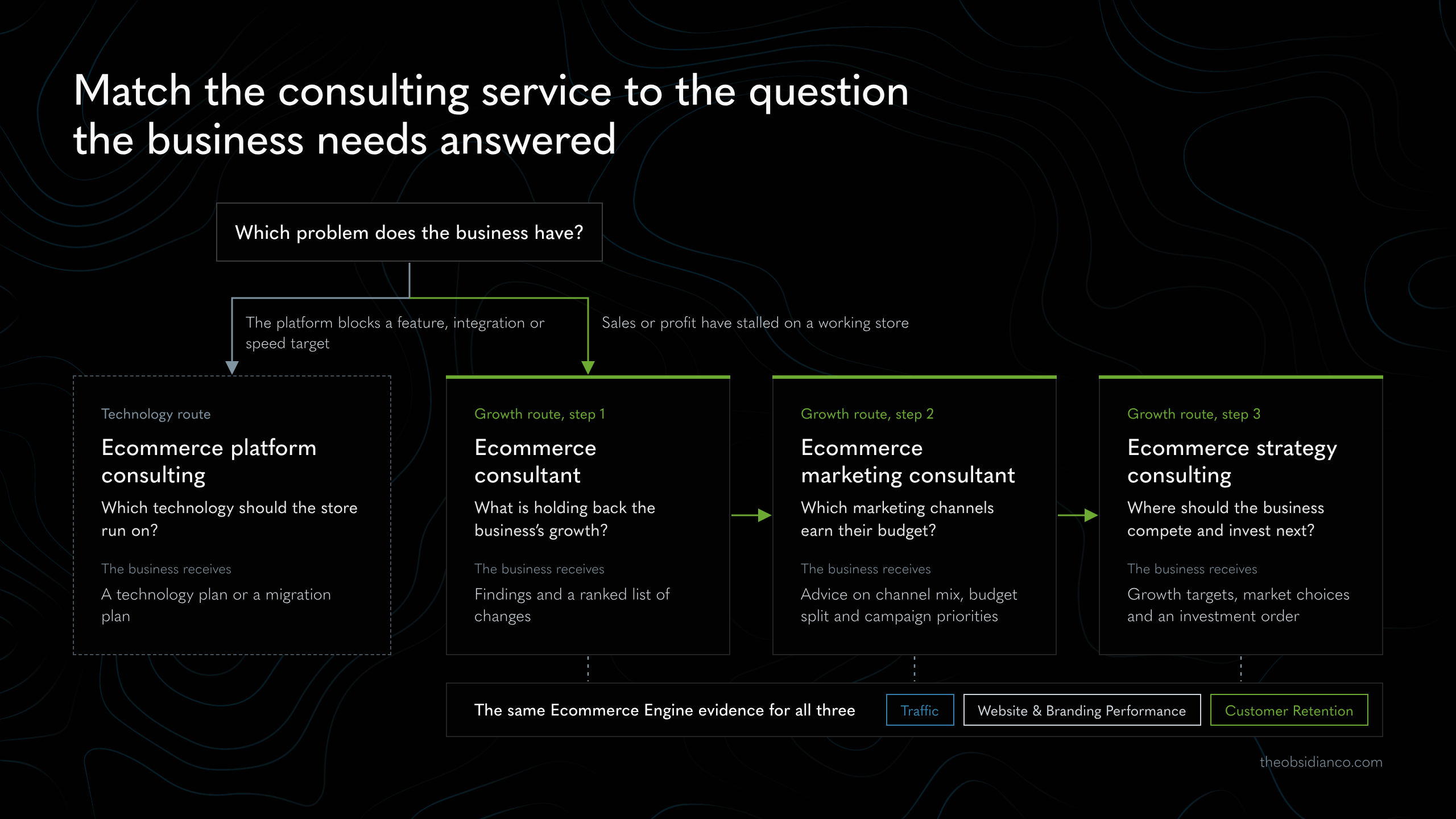
The functions differ in the decision that the evidence supports. An ecommerce consultant turns stalled ecommerce growth into a ranked list of changes. The marketing consultant then tests whether spending on traffic, conversion, and retention pays back. Strategy consulting sets where that stronger Engine competes and invests next. Ecommerce consulting therefore moves a business from diagnosis to commercial direction.
Try Us Free for 4 Weeks. Up to $5,000 in Agency Fees, On Us.
Four weeks of agency work on us, with no commitment and no obligation to carry on. For ecommerce brands at $50K+ a month and $10K+ in ad spend.
Next month’s intake closes in00days00hours00minutes00seconds

Works on the content half of search: keyword research, page copy, blog articles and the words that turn a store’s visitors into buyers.
Writes about Technical SEO, Structured data, Site architecture
More articles
 GrowthEcommerce Growth: Strategy, Framework, Metrics, Profitability, Experimentation, Consulting and AgenciesAlexander W. · 20 November 2026
 GrowthEcommerce Growth Framework: Build, Repair, Scale and Maintain the Ecommerce Growth EngineAlexander W. · 23 November 2026
 EcommerceEcommerce Marketing: Strategy, SEO, Google Ads, Meta Ads, CRO, Email, Retention, Content, Social Media, Branding and AgenciesAlexander W. · 23 November 2026