
Ecommerce Business: Definition, Website, Transaction Models, Business Models, Channels, Startup Requirements, Industries, Companies, Trends and Operations
On this page
- What Is an Ecommerce Business?
- What Role Does an Ecommerce Website Play in an Ecommerce Business?
- What Are Ecommerce Transaction Models?
- What Are the Main Ecommerce Business Models?
- What Are the Main Ecommerce Channels?
- What Do You Need to Start an Ecommerce Business?
- How Do Ecommerce Industries Differ?
- What Are Ecommerce Companies?
- What Do Current Ecommerce Trends Show?
- How Do Ecommerce Operations Affect an Ecommerce Business?
- What Makes an Ecommerce Business Successful?
An e-commerce business takes, fulfils and supports digital orders through nine components: website, transaction model, business model, channels, startup requirements, product category, commercial role, market trends and operations. Online sales values in Great Britain rose 8.9% year on year in August 2026. Online sales reached 28.8% of all British retail sales that month. An ecommerce business that grows below that market rate loses share of online spending. Its website converts visitors into orders, its business model sets margin, and its operations decide repeat purchases.
What Is an Ecommerce Business?
An ecommerce business sells goods or services through orders placed on websites, apps, marketplaces, or other digital ordering systems. Within ecommerce, the business is the operator that takes, fulfils and supports each order. The business includes the people, stock, systems and suppliers behind every order. A website displays the products, but the team and suppliers deliver each purchase.
The business structure therefore determines its order volume and margin per order. The same structure decides how many first-time customers return to buy again. For example, a store with slow suppliers wins first orders but loses repeat purchases.
Which Orders Count as Ecommerce Business Transactions?
E-commerce business transactions are orders placed through methods designed for digital ordering, namely webpages, apps, extranets and electronic data interchange (EDI). EDI connects two businesses' software, so orders pass directly between their systems. Payment and delivery can happen offline without changing the order's e-commerce status. The order itself must travel through a qualifying digital method.
For example, a customer orders through an app and pays on collection. That sale still counts as an e-commerce business transaction.
The definition separates qualifying and non-qualifying ordering methods across four pairs:
| Counts as an e-commerce order | Falls outside the definition |
|---|---|
| Webpage orders | Telephone orders |
| App orders | Fax orders |
| Extranet and EDI orders | Manually typed email orders |
| Marketplace orders | In-store kiosk and quick response (QR) code orders |
The rule matters commercially because it decides which sales count as online revenue. A business taking phone and web orders reports only web orders as e-commerce.
What Are the Key Components of an Ecommerce Business?
An e-commerce business has nine key components: website, transaction model, business model, channels, startup requirements, product category, commercial role, market trends and operations. Each of those nine components settles one decision and shapes one commercial outcome:
| Component | What it decides | Commercial outcome it shapes |
|---|---|---|
| Website | The business's own store, where customers order | Conversion of visitors into orders |
| Transaction model | Who buys and who sells | Order size and buying process |
| Business model | Product ownership, revenue pattern and stock-holding | Margin and repeat revenue |
| Channels | The routes orders take to the business | Fees, reach and access to customer data |
| Startup requirements | Demand and cost base | Break-even point |
| Product category | What buyers need to know before ordering | Demand level and return exposure |
| Commercial role | Merchant or platform operator | Which revenue measure applies |
| Market trends | Direction of online demand | Size of the opportunity |
| Operations | Stock, fulfilment and delivery | Order reliability and cost per order |
The nine components interact, so one change moves two or more outcomes at once. For example, switching from held stock to dropshipping moves inventory to the supplier. The supplier then controls delivery speed and sets the wholesale price per order. A founder therefore weighs each component against the others before changing one.
How Does an Ecommerce Business Work?
An ecommerce business works through five stages: attracting visitors, taking digital orders, collecting payment, fulfilling orders and serving customers after purchase.
Each stage feeds the next, and three match sections of the Ecommerce Engine:
- Attracting visitors: Search, ads and social posts bring buyers, forming the Engine's Traffic section.
- Taking digital orders: Product pages and checkout turn visits into orders within Website & Branding Performance.
- Collecting payment: A payment provider authorises the card and settles the funds with the business.
- Fulfilling orders: The business or its supplier picks, packs and ships each order.
- Serving customers after purchase: Delivery updates, returns and support decide whether buyers order again, within Customer Retention.
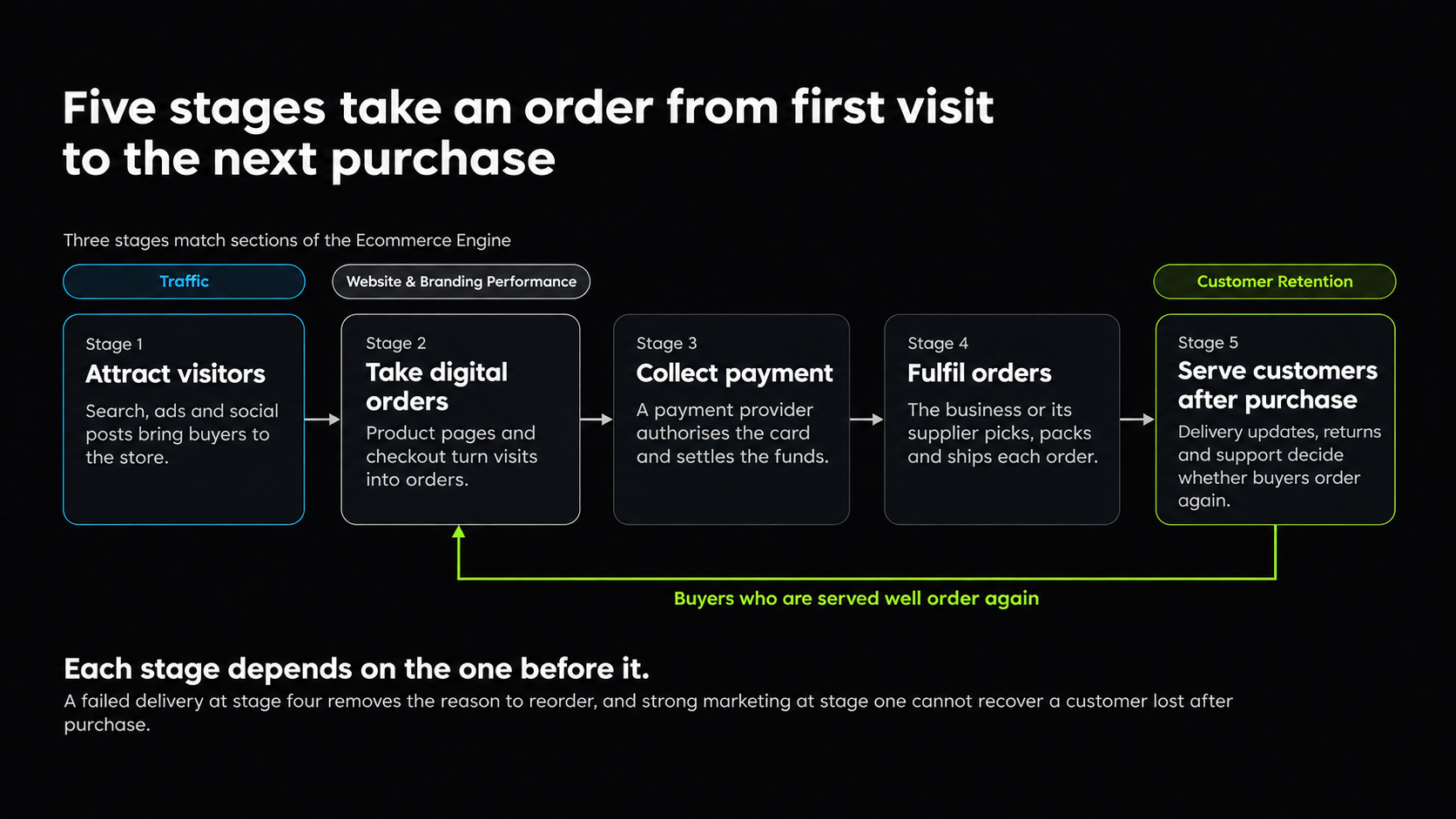
Each stage depends on the one before it. A failed delivery at stage four therefore removes the reason to reorder. Strong marketing at stage one cannot recover a customer lost after purchase.
What Is the Difference Between Ecommerce and E-Business?
Ecommerce covers buying and selling through digital transactions, while e-business covers every business process a company runs on digital systems. E-business, also called digital business, therefore includes ecommerce as one part. E-business also covers the internal processes a company runs digitally. E-commerce itself has two sides: sell-side orders from customers and buy-side orders to suppliers.
The two terms differ in scope, processes covered and everyday examples:
| Dimension | Ecommerce | E-business |
|---|---|---|
| Scope | Digital buying and selling | All digitally run business processes |
| Processes covered | Customer orders and supplier purchases | Orders plus stock control, staffing and accounting |
| Example | An online checkout | Stock software linking the warehouse to the accounts |
An e-commerce business needs e-business systems to fulfil the orders it wins. For example, accurate stock software stops the store from selling items it cannot ship.
What Are the Advantages and Disadvantages of an Ecommerce Business?
An e-commerce business gains wider reach, round-the-clock ordering, and direct customer data, but faces delivery, returns, and platform fees.
Each advantage raises revenue, while each disadvantage adds cost to every order:
| Advantages | Disadvantages |
|---|---|
| Sales reach beyond one shop's local area | Delivery cost on every order |
| Ordering 24 hours a day | Returns on goods buyers cannot inspect before buying |
| No shop rent for online-only stores | Marketplace and payment fees on each sale |
| Customer data for email and repeat sales | Price comparison across competing stores |
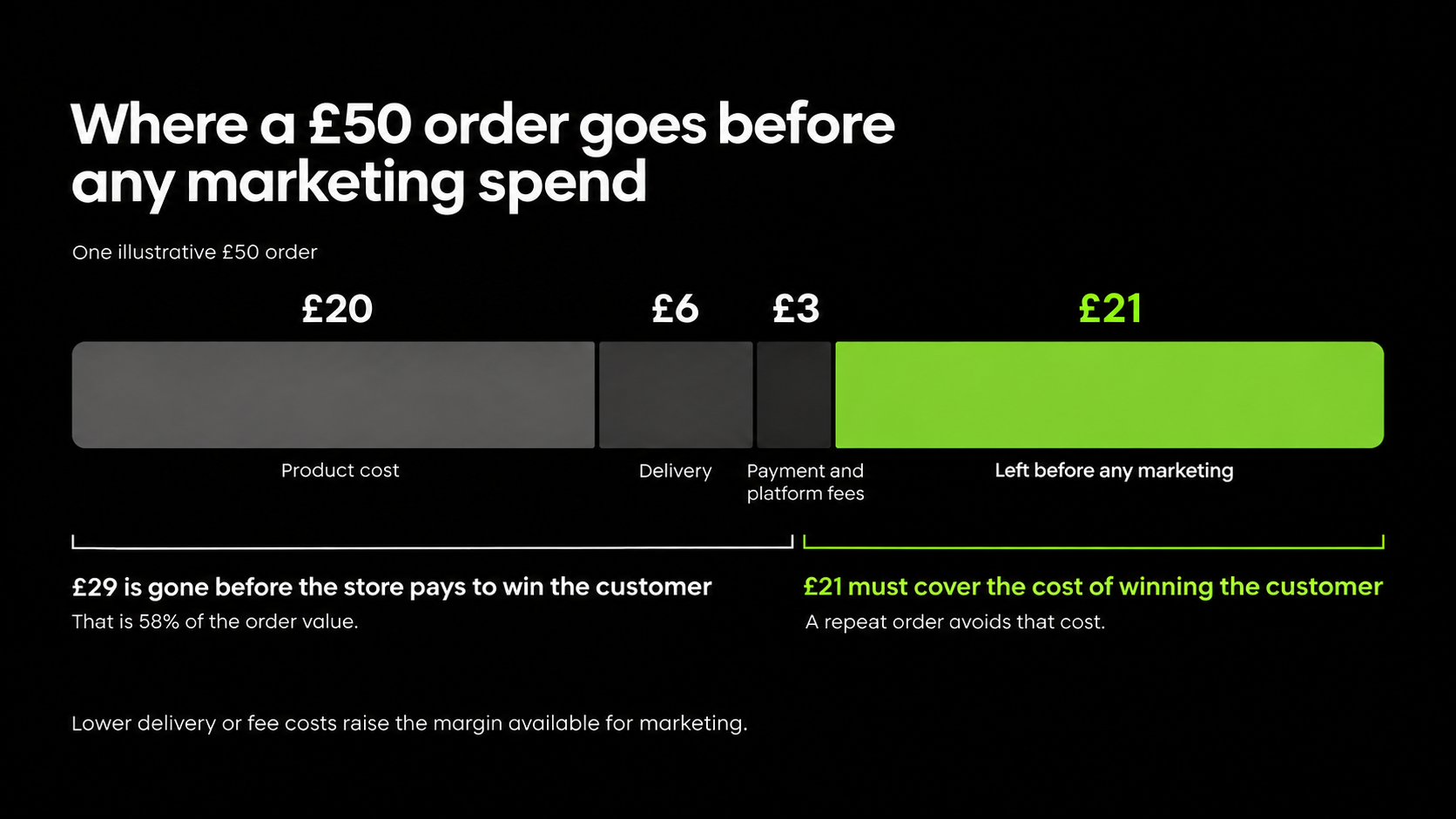
The balance depends on the margin left per order after delivery, returns and fees. For example, take an illustrative £50 order with a £20 product cost. Delivery costs £6, and payment and platform fees take another £3. The business keeps £21 before paying for any marketing. That £21 must cover the cost of winning the customer. A repeat order avoids the cost of winning a new customer. Lower delivery or fee costs also raise the margin available for marketing.
What Role Does an Ecommerce Website Play in an Ecommerce Business?
An ecommerce website serves as the ecommerce business's owned ordering point, where customers browse products, place orders and pay on terms the business sets. The business controls its own ecommerce website, including prices, presentation and checkout. Marketplace listings, by contrast, follow the platform's rules on price display and checkout.
Website & Branding Performance is the ecommerce engine that converts visitors into customers. The website is where that conversion happens. A higher conversion rate means more orders from the same number of visitors.
How Does an Ecommerce Website Capture Orders?
An ecommerce website captures orders by showing products, prices,s stock, answering buying questions, and accepting payment at checkout. Product pages answer buying questions with photos, descriptions, sizes and delivery times. Price and stock displays set buyer expectations before checkout. Checkout records the order, takes payment, and confirms the purchase by email. Each step removes one reason a buyer might leave.
Checkout also records the customer's name, address, and email address. The business owns those details for every order it takes on the website. An email address lets the business contact the buyer about the next purchase. That owned data feeds Customer Retention, the Engine section that drives repeat purchases. Marketplace orders, by contrast, give the platform control of the buyer's contact details.
How Does Website Friction Affect an Ecommerce Business?
Website friction cuts an ecommerce business's sales because buyers abandon purchases they find slow, confusing or broken. Website friction is any obstacle that slows or stops a buyer from completing an order. Examples include slow pages, unclear delivery costs and checkout errors.
According to Eurostat's 2025 survey on information and communication technology (ICT) usage in households and by individuals (Eurostat, 2026), 11.5% of recent European Union (EU) online buyers found seller websites hard to use. The survey covered buyers aged 16 to 74 in the previous three months.
Friction lowers the return on every paid and organic visit. Extra traffic sent to a faulty checkout therefore raises costs faster than orders. Conversion rate, the share of visits ending in an order, shows the effect. For example, 1,000 visits at an illustrative 2% conversion rate produce 20 orders. A checkout error cutting the rate to 1.5% leaves 15 orders.
What Are Ecommerce Transaction Models?
Ecommerce transaction models classify online sales by who sells and who buys: business-to-business (B2B), business-to-consumer (B2C), and consumer-to-consumer (C2C). Every ecommerce business sits within one or more ecommerce transaction models. The transaction model sets order size, pricing terms and the buying process. For example, a B2B wholesaler supports bulk orders and account pricing.
The transaction model names who trades, while the business model sets how revenue arrives. A single business can run B2B and B2C sales through separate channels.
Who Buys and Sells in Each Ecommerce Transaction Model?
In B2B, businesses sell to businesses; in B2C, businesses sell to consumers; and in C2C, consumers sell to other consumers. E-commerce covers transactions between businesses, households and individuals. Each model differs across seller, buyer, purchase decision, pricing and ordering route:
| Model | Seller | Buyer | Purchase decision | Pricing | Typical ordering route |
|---|---|---|---|---|---|
| B2B | Business | Business | Purchasing staff and budget holders approve | Negotiated or account pricing | Trade portal, extranet or EDI |
| B2C | Business | Consumer | One person decides | Listed retail price | Website, app or marketplace |
| C2C | Consumer | Consumer | One person decides | Price set by the individual seller | Marketplace listing |
B2B orders pass through purchasing approval, so sales cycles run longer than consumer purchases. B2B buyers reorder on agreed terms, which gives the seller repeat revenue.
B2C orders rest on one person’s decision at a listed price. B2C sellers therefore compete on product pages, price and delivery promises. Direct-to-consumer (D2C) selling is a B2C arrangement in which brands sell their own products.
C2C sales run through marketplaces, which charge sellers a fee per sale. The marketplace earns that fee, while the individual seller earns the sale price.
What Are the Main Ecommerce Business Models?
The main ecommerce business models are direct-to-consumer selling, subscription ecommerce, and dropshipping, which differ in product ownership, revenue patterns, and stock holding. A founder chooses between ecommerce business models by deciding what the business owns. A business can combine these models. For example, a D2C brand can sell a subscription range from its own website.
Each model shapes per-order margin, revenue predictability, and exposure to unsold stock. Changing the business model therefore changes both costs and revenue.
How Do Ecommerce Business Models Divide Seller Responsibility?
A D2C brand owns its products and sets their prices, while a reseller sells another company's products within the supplier's terms. The two models divide responsibility across product ownership, pricing, product range and margin:
| Dimension | D2C brand | Reseller |
|---|---|---|
| Product ownership | Designs or makes its own products | Buys finished products from other brands |
| Pricing control | Sets its own retail prices | Works within the supplier's wholesale price |
| Product range | Limited to the brand's own products | Spans products from two or more brands |
| Margin source | Retail price minus production cost | Retail price minus wholesale price |
The D2C brand keeps the full margin between production cost and retail price. That brand also carries product development and stock costs before any sale. By contrast, the reseller depends on the supplier's range and wholesale price. However, the reseller can add or drop brands without development cost.
Product responsibility is a separate decision from the channel each order uses. A D2C brand can still sell through a marketplace.
How Do Recurring and One-Time Ecommerce Business Models Differ?
Subscription e-commerce earns repeat revenue from scheduled orders, while one-time models earn revenue only when customers choose to buy again. Every digitally ordered subscription counts as an e-commerce transaction. The two models differ in revenue pattern, the customer’s next action and the main risk:
| Dimension | Subscription | One-time purchase |
|---|---|---|
| Revenue pattern | Scheduled, recurring orders | Separate orders at irregular intervals |
| Customer action for the next order | None until the customer cancels | A new decision to buy |
| Main revenue risk | Subscribers cancelling | Customers never returning |
Scheduled orders make subscription revenue easier to forecast month by month. Each renewal is a repeat purchase within Customer Retention, the Engine’s repeat-revenue section. Subscription revenue continues only as long as customers stay subscribed. Churn, the share of subscribers who cancel in a period, therefore decides its value. A one-time model, by contrast, relies on email and offers to prompt each reorder.
Who Holds Inventory in Each Ecommerce Business Model?
In stock-holding models, the retailer holds inventory, while in dropshipping, the supplier holds stock and ships orders directly. Dropshipping retailers pass each order to suppliers, who ship it to the customer. The two models split ownership, shipping and risk between the retailer and the supplier:
| Dimension | Stock-holding retailer | Dropshipping retailer |
|---|---|---|
| Who owns stock | The retailer | The supplier |
| Who ships | The retailer or its logistics provider | The supplier |
| Unsold-stock risk | Carried by the retailer | Carried by the supplier |
| Control of delivery speed | Held by the retailer | Held by the supplier |
A stock-holding retailer pays for goods before selling them. That upfront payment ties up cash but gives control over packing and delivery. A dropshipping retailer avoids the upfront stock cost entirely. However, the same retailer relies on the supplier for availability and delivery times. A supplier delay therefore reaches the customer under the retailer’s brand.
What is the #1 thing holding back your ecommerce revenue?
Get an instant PDF audit powered by The Ecommerce Engine™ methodology, refined through five years of research and development.
What Are the Main Ecommerce Channels?
The main ecommerce channels are the business's own website and app, online marketplaces, social commerce, mobile commerce and physical retail linked through omnichannel selling. Businesses combine ecommerce channels based on where their buyers place orders. Each channel routes orders to the business on different terms. Those terms cover fees, platform rules, audience reach and access to customer data.
Social commerce, for example, takes orders inside platforms such as Instagram and TikTok. Traffic, the Ecommerce Engine section that generates qualified visitors, feeds every channel. A channel without qualified visitors produces no orders, no matter the terms.
How Do Owned and Marketplace Ecommerce Channels Differ?
Owned channels give an ecommerce business control of the store, prices and customer data, while marketplaces supply buyers in exchange for fees. The two channel types differ in interface control, customer data, cost and buyer source:
| Dimension | Owned website or app | Marketplace |
|---|---|---|
| Ordering interface | Controlled by the business | Controlled by the platform |
| Customer data | Held by the business | Held mainly by the platform |
| Cost per order | Payment fees plus the cost of attracting visitors | Platform fees on each sale |
| Source of buyers | Traffic the business generates | Shoppers already on the platform |
According to Amazon FBA Calculator: Check Fees & Profits for UK Sellers, UK Professional sellers pay £25 a month, excluding VAT. Amazon.co.uk also charges a 15% referral fee on toys, books and office products. Sellers pay those fees to list and sell products to shoppers already on Amazon.
Marketplaces therefore give sellers immediate buyers at a recurring per-sale cost. Owned channels, by contrast, need the business to generate its own traffic. Each owned-channel order then carries no platform commission.
How Does Channel Dependence Affect an Ecommerce Business?
Channel dependence exposes an ecommerce business to fee increases, rule changes, and account suspensions on the channels that supply most of its orders. Channel dependence is the share of a business's orders arriving through one channel. Each change in that channel's terms then reaches the same share of orders. The change hits margin directly, because those orders have no alternative route. An account suspension stops all orders until the platform reinstates the seller.
For example, a store takes 80% of £100,000 monthly sales through one marketplace. A one-point fee rise on that marketplace costs the store £800 a month. Owned customer lists, such as email subscribers, reduce that exposure to platform terms. The business reaches those subscribers without paying a platform for each order. Email lists sit within Customer Retention, the Engine section that drives repeat purchases. Followers and impressions measure exposure, while orders measure actual sales. A social media following therefore protects revenue only when followers place orders.
What Do You Need to Start an Ecommerce Business?
Starting an ecommerce business requires validated customer demand, a competitive product offer, and sales that cover fixed and variable costs. Founders deciding how to start an ecommerce business test demand before buying stock. Demand evidence answers whether customers will buy the product. Break-even analysis answers whether those sales will cover the business's costs.
A competitive offer links the two, because price affects both demand and margin. For example, a lower price can raise demand while raising the break-even point. Both checks therefore come before stock purchases, platform fees and advertising spend.
Which Demand Signals Matter Before Starting an Ecommerce Business?
Six demand signals matter before starting an ecommerce business: demand, market size, economic indicators, location, market saturation and pricing.
Each signal answers one question about potential customers:
| Signal | What it shows |
|---|---|
| Demand | Whether enough customers want the product |
| Market size | How many potential buyers the product can reach |
| Economic indicators | Buyers' income levels and spending power |
| Location | Which delivery areas the business can serve profitably |
| Market saturation | How many competitors already sell the same product |
| Pricing | What competitors charge and what buyers will pay |
Demand evidence comes from observed behaviour, such as search volume and competitor sales. A product idea alone shows only the founder’s interest. Market saturation then shows how much of that demand competitors already serve. Competitors bidding on the same ads raise the cost of winning each customer.
Pricing data sets the margin the business can expect per order. Location determines delivery cost, as carriers add surcharges for remote areas and international shipping.
When Does an Ecommerce Business Reach Break-Even?
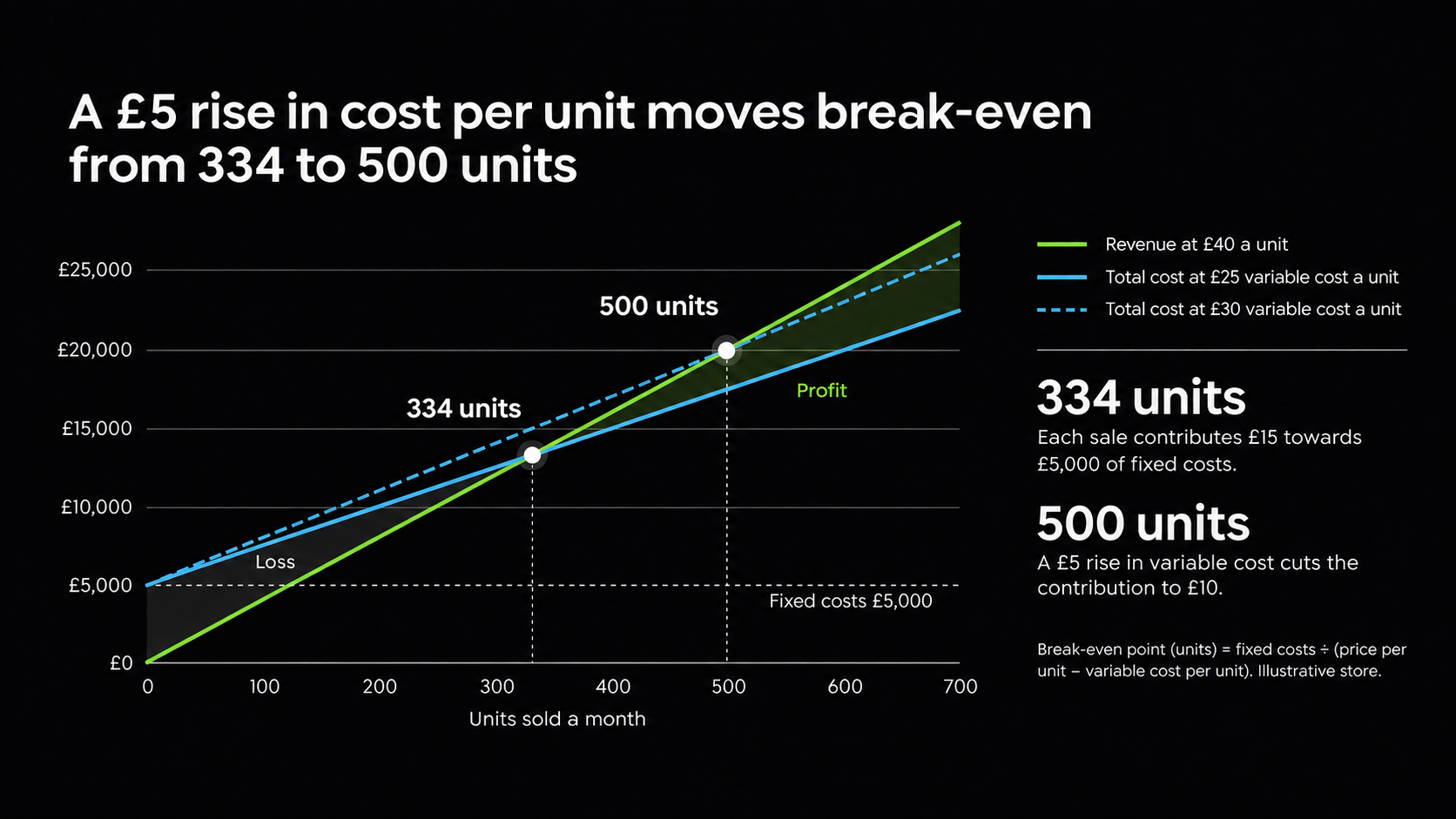
An ecommerce business reaches break-even when total revenue equals total costs, so profit stands at zero.
The break-even point in units uses this formula:
Break-even point (units) = fixed costs ÷ (price per unit minus variable cost per unit)
Contribution margin is the price per unit minus the variable cost per unit. E-commerce variable costs include product cost, packaging, delivery, payment fees and marketplace commission. Fixed costs, such as software and salaries, stay level regardless of sales volume.
For example, an illustrative store has £5,000 in monthly fixed costs. The store sells each unit at £40, with £25 in variable costs. Each sale therefore contributes £15 towards fixed costs. The store breaks even at 334 units a month. Every unit sold above 334 adds £15 of profit. A £5 rise in variable costs cuts contribution to £10. The break-even point then rises to 500 units a month. Sales growth below break-even still leaves the business making a loss.
How Do Ecommerce Industries Differ?
Ecommerce industries differ in how many buyers purchase online, what information buyers need before ordering and how often they buy again. Fashion and beauty illustrate how buyer behaviour differs across ecommerce industries. Online buyer numbers determine demand in each category. Pre-purchase information needs affect conversion, because missing details stop buyers s ordering.
Repeat-purchase patterns then decide how much revenue each customer returns over time. An ecommerce business in a high-repeat category can spend more to win each customer.
How Does Online Demand Differ Across Ecommerce Industries?
Online demand differs across ecommerce industries based on the share of online buyers each product category attracts, and that share varies by more than twofold between categories. In 2024, clothing accounted for 70% of recent EU online buyers, while cosmetics accounted for 31%.
According to E-commerce statistics for individuals (Eurostat, 2025), both figures cover people who bought online in the previous three months. The clothing figure includes clothes, shoes and accessories. The cosmetics figure includes beauty and wellness products. Both shares count buyers, so spend per buyer and revenue need separate data.
The two categories also differ in buyer information needs and repeat-purchase patterns:
| Dimension | Fashion | Beauty |
|---|---|---|
| Share of recent EU online buyers (2024) | 70% | 31% |
| Information buyers need before ordering | Size, fit and material | Ingredients, shade and skin type |
| Repeat-purchase pattern | New seasonal ranges | Replacing used-up products |
Fashion product pages therefore carry size guides, fit notes and material details. Beauty product pages list ingredients and shade ranges for the same reason. Beauty replenishment creates predictable reorders, which suit subscription models. Fashion repeat sales depend instead on new ranges each season.
What Are Ecommerce Companies?
Ecommerce companies earn revenue from digital orders, either by selling products or by running platforms where other businesses sell. Amazon Marketplace and eBay are ecommerce companies that run platforms for other sellers. Merchants, by contrast, earn revenue from the full price of each product sold. Platform operators earn fees on orders that third-party sellers complete.
Comparing ecommerce companies therefore requires matching each company's revenue measure to its role. A merchant's sales and a platform's fees measure two different things.
How Do Ecommerce Companies Differ by Commercial Role?
Ecommerce companies act as merchants that sell their own stock, platform operators that charge sellers fees, or hybrids that do both.
Merchants and platform operators differ in what they sell, earn and hold:
| Dimension | Merchant | Platform operator |
|---|---|---|
| What it sells | Products it owns | Access to buyers and selling services |
| Revenue source | Full price of each product | Fees on third-party sales |
| Stock-holding | Holds its own stock | Holds sellers' stock only through fulfilment services |
| Comparable revenue measure | Product sales | Fee revenue |
Amazon runs both roles, selling its own stock and hosting third-party sellers. Gross merchandise value (GMV) is the total value of orders a platform processes. According to the 2025 OECD Definition of E-commerce and Guidelines for Interpretation (OECD Publishing, 2025), digital intermediaries earn fees separate from transaction value.
A platform's revenue therefore equals its fees, which form a share of GMV. For example, £1 million in GMV at a 10% fee earns £100,000. Comparing one platform's GMV with a merchant's revenue overstates the platform's earnings. Fair comparisons set platform fee revenue against merchant product sales.
What Do Current Ecommerce Trends Show?
Current ecommerce trends show online sales outgrowing total retail and taking a rising share of spending, mobile wallets becoming a mainstream way to pay, artificial intelligence (AI) assistants reshaping online search, and marketplaces reaching nearly every online shopper. According to UK Payment Markets 2026 (UK Finance, 2026), 37.6 million UK adults, or 65%, had registered for a mobile wallet in 2025, up from 57% a year earlier. Wallet payments at checkout therefore let most UK adults pay without typing card details.
According to Online Nation 2025 (Ofcom, 2025), ChatGPT drew 1.8 billion UK visits in the first eight months of 2025, up from 368 million a year earlier. Ofcom also found AI overviews on around 30% of searches. Mintel’s UK Online Retailing Market Report 2025 found that 91% of online shoppers used Amazon.
How Fast Is Ecommerce Growing?
Ecommerce is growing faster than total retail, so online sales are taking a rising share of retail spending. Ecommerce is growing by 8.9% to 14% year on year across the UK, US and Australia. Each market’s latest figures come from a different source and period:
| Market | Period | Online sales growth (year on year) | Source |
|---|---|---|---|
| UK (Great Britain) | August 2026 | 8.9% | ONS |
| US | Q2 2026 | 12.2% | US Census Bureau |
| Australia | 2025 calendar year | 14% | Australia Post |
According to the ONS August 2026 retail sales release, the online share of British retail rose to 28.8% from 27.6% a year earlier. According to Quarterly Retail E-Commerce Sales, 2nd Quarter 2026 (US Census Bureau, 2026), US online sales grew 12.2% while total retail grew 6.7%. That gap lifted e-commerce to 17.1% of US retail, up from 16.3% a year earlier. According to the Australia Post eCommerce Report 2026 (Australia Post, 2026), Australians spent A$82.6 billion online in 2025.
An e-commerce business growing below the market rate loses market share. For example, an illustrative UK store growing 6% a year trails a market growing 8.9%. That store’s sales rise, yet its share of online spending falls.
How Should an Ecommerce Business Read Trend Data?
An ecommerce business should read trend data by checking each figure’s population, period and adjustment method before comparing it with its own results. Population also matters, since EU shopper surveys cover only people aged 16 to 74. Seasonal adjustment removes predictable calendar effects, such as Christmas spending, from the figures. For example, compare unadjusted December store sales with the unadjusted market data.
How Do Ecommerce Operations Affect an Ecommerce Business?
Ecommerce operations decide whether an ecommerce business delivers each order accurately, on time and at a cost its margin can absorb. Ecommerce operations cover inventory, warehousing, order management, fulfilment, shipping and the supply chain. Each operational area sits between the customer's order and the delivered parcel. A failure in one area reaches the customer as a late or wrong order.
Delivery experience then decides whether a first-time buyer orders again. Operations therefore feed Customer Retention, the Engine section that drives repeat purchases. Operational cost per order also sets the margin left for marketing.
Which Ecommerce Operations Affect Order Reliability?
Product identification, stock accuracy and delivery performance decide whether an ecommerce business's orders arrive correctly and on time. According to the GS1 GTIN Executive Summary, the Global Trade Item Number (GTIN) uniquely identifies each trade item. Every trading partner then recognises the same product by the same number.
According to Eurostat's 2025 survey on ICT usage in households and by individuals, 19.9% of recent EU online buyers reported slower delivery than indicated. In the same survey, 10.4% received wrong or damaged goods. Each operational area controls one part of reliability and causes one visible failure:
| Operational area | What it controls | Failure the customer sees |
|---|---|---|
| Product identification | Which item the warehouse picks | Wrong item delivered |
| Stock accuracy | Which items the store offers for sale | Order cancelled for lack of stock |
| Delivery performance | When the parcel arrives | Late delivery |
Each failure breaks the promise the product page made before checkout. A broken promise removes the buyer's reason to order again. Reliable operations therefore protect the repeat purchases that Customer Retention depends on. Inaccurate stock records add a further cost, because cancelled orders still consume marketing spend.
How Do Ecommerce Operations Affect Profitability?
Ecommerce operations affect profitability through returns, delivery costs and stock tied up in unsold goods. According to the ZigZag Returns Benchmark 2025 (Retail Economics and ZigZag, 2025), UK online returns across non-food categories were forecast at £25.1 billion in 2025. The same forecast puts the returns rate at 19.5%, down from 21% in 2024. The forecast return value is down from £26.7 billion in 2024.
Each return costs reverse shipping, handling and goods that cannot be sold at full price. For example, an illustrative store sells £100,000 online each month. A 19.5% return rate refunds £19,500 before any handling costs. Each operational cost reaches profit through a different route:
| Operational cost | Commercial effect |
|---|---|
| Returns | Refunds reduce revenue, and handling adds cost |
| Delivery | Cuts margin on every order shipped |
| Unsold stock | Ties up cash that could fund marketing |
Unsold stock also loses value once a season or product version ends. Operational cost per order then sets how much the business can spend per customer. Lower operating costs therefore increase the budget available to win new customers.
What Makes an Ecommerce Business Successful?
An ecommerce business succeeds when its website, business model, channels and operations work together to turn demand into profitable repeat purchases. The website converts that demand into digital orders on terms the business controls. The business model and channels then set the margin each digital order leaves. Operations decide whether the first order becomes repeat purchases or a lost customer. Each component therefore depends on the others to protect margin.
The Ecommerce Engine's three sections follow that chain from visitor to returning customer. A strong business model cannot offset a website that loses digital orders. Reliable operations, likewise, turn first orders into repeat purchases. The e-commerce business that aligns all nine components keeps more margin from every order.
Try Us Free for 4 Weeks. Up to $5,000 in Agency Fees, On Us.
Four weeks of agency work on us, with no commitment and no obligation to carry on. For ecommerce brands at $50K+ a month and $10K+ in ad spend.
Next month’s intake closes in00days00hours00minutes00seconds

Works on the content half of search: keyword research, page copy, blog articles and the words that turn a store’s visitors into buyers.
Writes about Technical SEO, Structured data, Site architecture
More articles
 GrowthEcommerce Growth: Strategy, Framework, Metrics, Profitability, Experimentation, Consulting and AgenciesAlexander W. · 20 November 2026
 EcommerceEcommerce Marketing: Strategy, SEO, Google Ads, Meta Ads, CRO, Email, Retention, Content, Social Media, Branding and AgenciesAlexander W. · 23 November 2026
 EcommerceEcommerce: Meaning, Market Trends, Growth Drivers, Marketing, Metrics, Business Models and TechnologyAlexander W. · 19 November 2026